QUESTION IMAGE
Question
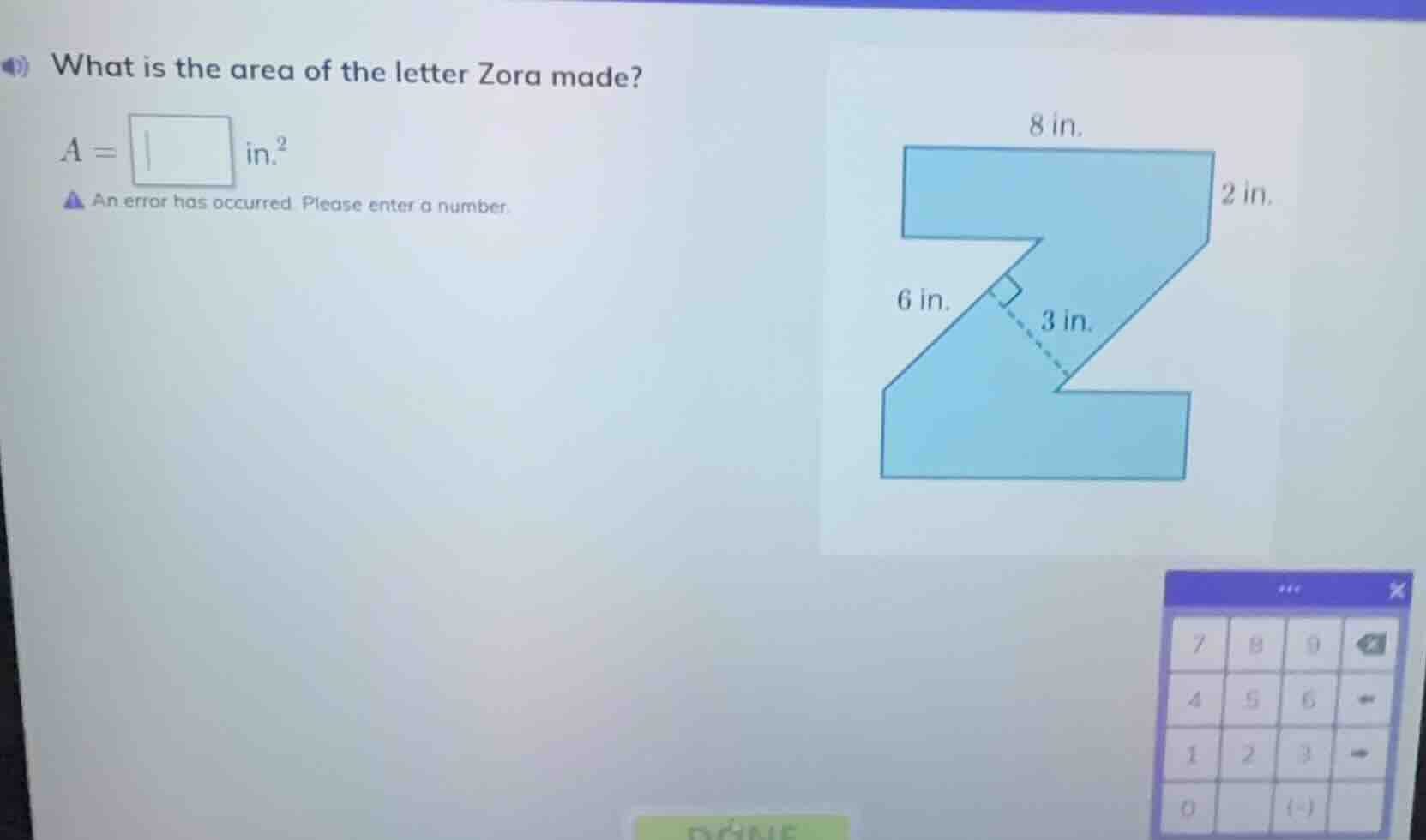
what is the area of the letter zora made? a = \square in.^2 an error has occurred. please enter a number. 8 in. 2 in. 6 in. 3 in.
Step1: Analyze the shape
The letter "Z" can be divided into three parts: two rectangles and one parallelogram (or we can also think of it as a large rectangle minus the area of the two triangles, but here we use the method of adding areas of components). The top and bottom rectangles each have dimensions \(8\) in (length) and \(2\) in (width). The middle part is a parallelogram with base \(6\) in and height \(3\) in.
Step2: Calculate area of top rectangle
The area of a rectangle is \(A = l\times w\). For the top rectangle, \(l = 8\) in, \(w=2\) in. So area \(A_1=8\times2 = 16\) \( \text{in}^2\).
Step3: Calculate area of bottom rectangle
The bottom rectangle has the same dimensions as the top one, so \(A_2 = 8\times2=16\) \( \text{in}^2\).
Step4: Calculate area of middle parallelogram
The area of a parallelogram is \(A = b\times h\), where \(b = 6\) in and \(h = 3\) in. So \(A_3=6\times3 = 18\) \( \text{in}^2\).
Step5: Total area
Add the areas of the three parts: \(A = A_1+A_2 + A_3=16 + 16+18=50\) \( \text{in}^2\). Wait, no, actually, looking at the shape again, maybe a better way: The overall height of the Z: the vertical side of the parallelogram is \(6\) in, and the top and bottom rectangles are \(2\) in each, so total height is \(2 + 6+ 2=10\) in? Wait, no, maybe I misdivided. Let's try another approach: The shape can be considered as a large rectangle with length \(8\) in and height \(2 + 6+ 2=10\) in, minus the area of the two triangles that are "cut out". Wait, no, the middle part: the slanted part. Wait, actually, the correct way is: the top rectangle: \(8\times2 = 16\), the bottom rectangle: \(8\times2=16\), and the middle parallelogram: base is \(8 - \) (the horizontal part? No, wait the given parallelogram has base \(6\) and height \(3\). Wait, maybe the initial division was wrong. Let's look at the diagram again. The top rectangle: \(8\) in length, \(2\) in height. The bottom rectangle: \(8\) in length, \(2\) in height. The middle part: the vertical side is \(6\) in, and the horizontal distance between the two slants is \(3\) in (the height of the parallelogram). Wait, actually, the area of the Z can be calculated as: area of top rectangle + area of bottom rectangle + area of the middle parallelogram. Wait, but when we look at the diagram, the middle parallelogram: the base is \(6\) in (the vertical segment) and the height is \(3\) in (the horizontal distance). So area of parallelogram is \(6\times3 = 18\). Then top and bottom rectangles: each \(8\times2 = 16\), so total \(16+16 + 18=50\)? Wait, no, that can't be. Wait, maybe the middle part is a parallelogram with base \(8 - \) something? Wait, no, the diagram shows a right angle on the parallelogram, so it's a rectangle? Wait, no, the dashed line is \(3\) in, and the vertical side is \(6\) in, with a right angle, so it's a rectangle? Wait, no, the angle is a right angle, so the middle part is a rectangle with length \(6\) in and width \(3\) in? No, the dashed line is \(3\) in, and the vertical side is \(6\) in, with a right angle, so the middle part is a rectangle? Wait, maybe I made a mistake. Let's try another approach. The total area can be calculated as the area of the large rectangle (if we consider the Z as a rectangle with length \(8\) and height \(2 + 6+ 2 = 10\)) minus the area of the two triangles that are missing. Wait, the two missing triangles: each triangle has base \(6\) in and height \(3\) in? No, wait, the Z shape: the top and bottom are rectangles, and the middle is a parallelogram. Wait, let's count the squares or use the given dime…

Snap & solve any problem in the app
Get step-by-step solutions on Sovi AI
Photo-based solutions with guided steps
Explore more problems and detailed explanations
\(50\)