QUESTION IMAGE
Question
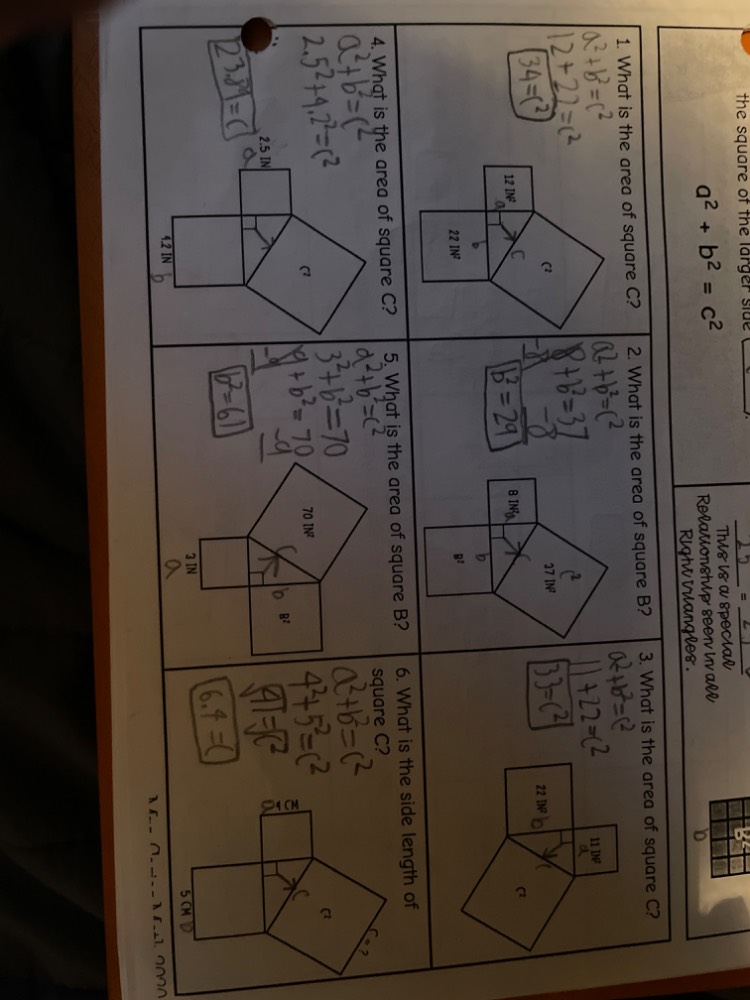
- what is the area of square c?
- what is the area of square b?
- what is the area of square c?
- what is the area of square c?
- what is the area of square b?
- what is the side length of square c?
the formula: (a^2 + b^2 = c^2)
Let's solve these problems one by one using the Pythagorean theorem, which states that for a right triangle, \( a^2 + b^2 = c^2 \), where \( a \) and \( b \) are the legs and \( c \) is the hypotenuse. In these problems, the areas of the squares on the legs are \( a^2 \) and \( b^2 \), and the area of the square on the hypotenuse is \( c^2 \).
Problem 1: Area of Square C
We know the areas of the two smaller squares: \( a^2 = 12 \, \text{in}^2 \) and \( b^2 = 22 \, \text{in}^2 \). Using the Pythagorean theorem:
Step 1: Apply \( a^2 + b^2 = c^2 \)
\( c^2 = 12 + 22 \)
Step 2: Calculate the sum
\( c^2 = 34 \)
So the area of Square C is \( 34 \, \text{in}^2 \).
Problem 2: Area of Square B
We know the area of the hypotenuse square \( c^2 = 37 \, \text{in}^2 \) and one leg square \( a^2 = 8 \, \text{in}^2 \). We need to find \( b^2 \). Rearranging the Pythagorean theorem: \( b^2 = c^2 - a^2 \)
Step 1: Substitute the known values
\( b^2 = 37 - 8 \)
Step 2: Calculate the difference
\( b^2 = 29 \)
So the area of Square B is \( 29 \, \text{in}^2 \).
Problem 3: Area of Square C
We know the areas of the two smaller squares: \( a^2 = 11 \, \text{in}^2 \) and \( b^2 = 22 \, \text{in}^2 \). Using the Pythagorean theorem:
Step 1: Apply \( a^2 + b^2 = c^2 \)
\( c^2 = 11 + 22 \)
Step 2: Calculate the sum
\( c^2 = 33 \)
So the area of Square C is \( 33 \, \text{in}^2 \).
Problem 4: Area of Square C
We know the areas of the two smaller squares: \( a^2 = 2.5^2 = 6.25 \, \text{in}^2 \) (wait, actually, the side lengths are 2.5 in and 4.2 in? Wait, looking at the diagram, the side lengths of the smaller squares are 2.5 in and 4.2 in? Wait, no, the areas of the smaller squares: Wait, the first smaller square has side 2.5 in, so its area is \( 2.5^2 = 6.25 \, \text{in}^2 \)? Wait, no, maybe the areas are given as the side lengths? Wait, no, the diagram shows the side lengths: 2.5 in and 4.2 in? Wait, no, the problem says "What is the area of square C?" with the smaller squares having side lengths 2.5 in and 4.2 in? Wait, no, looking at the handwritten note: "2.5² + 4.2² = C²". Wait, maybe the side lengths are 2.5 in and 4.2 in, so their areas are \( 2.5^2 \) and \( 4.2^2 \). Wait, but maybe the areas are given as the side lengths? Wait, no, the user's diagram: "2.5 in" and "4.2 in" as the sides of the smaller squares. So the area of the first smaller square is \( (2.5)^2 = 6.25 \, \text{in}^2 \) and the second is \( (4.2)^2 = 17.64 \, \text{in}^2 \). Then:
Step 1: Calculate \( a^2 \) and \( b^2 \)
\( a^2 = (2.5)^2 = 6.25 \)
\( b^2 = (4.2)^2 = 17.64 \)
Step 2: Apply \( a^2 + b^2 = c^2 \)
\( c^2 = 6.25 + 17.64 \)
Step 3: Calculate the sum
\( c^2 = 23.89 \)
Wait, but maybe the side lengths are the areas? Wait, the handwritten note says "2.5² + 4.2² = C²". Wait, maybe the problem is that the side lengths are 2.5 and 4.2, so their areas (of the squares) are \( 2.5^2 \) and \( 4.2^2 \). So:
\( 2.5^2 = 6.25 \)
\( 4.2^2 = 17.64 \)
Then \( c^2 = 6.25 + 17.64 = 23.89 \). But maybe the diagram has the areas as 2.5 and 4.2? Wait, the user's handwritten note: "2.5² + 4.2² = C²" and "2.5² + 4.2² = C²" with "2.5 in" and "4.2 in" as the sides. So the area of Square C is \( 2.5^2 + 4.2^2 = 6.25 + 17.64 = 23.89 \, \text{in}^2 \). But maybe the problem is simpler: if the side lengths are 2.5 and 4.2, then the areas of the smaller squares are \( 2.5^2 \) and \( 4.2^2 \), so adding them gives the area of Square C.
Problem 5: Area of Square B
We know the area of the hypotenuse square \( c^2 = 70 \, \text{in}^2 \) and one leg squa…

Snap & solve any problem in the app
Get step-by-step solutions on Sovi AI
Photo-based solutions with guided steps
Explore more problems and detailed explanations
Let's solve these problems one by one using the Pythagorean theorem, which states that for a right triangle, \( a^2 + b^2 = c^2 \), where \( a \) and \( b \) are the legs and \( c \) is the hypotenuse. In these problems, the areas of the squares on the legs are \( a^2 \) and \( b^2 \), and the area of the square on the hypotenuse is \( c^2 \).
Problem 1: Area of Square C
We know the areas of the two smaller squares: \( a^2 = 12 \, \text{in}^2 \) and \( b^2 = 22 \, \text{in}^2 \). Using the Pythagorean theorem:
Step 1: Apply \( a^2 + b^2 = c^2 \)
\( c^2 = 12 + 22 \)
Step 2: Calculate the sum
\( c^2 = 34 \)
So the area of Square C is \( 34 \, \text{in}^2 \).
Problem 2: Area of Square B
We know the area of the hypotenuse square \( c^2 = 37 \, \text{in}^2 \) and one leg square \( a^2 = 8 \, \text{in}^2 \). We need to find \( b^2 \). Rearranging the Pythagorean theorem: \( b^2 = c^2 - a^2 \)
Step 1: Substitute the known values
\( b^2 = 37 - 8 \)
Step 2: Calculate the difference
\( b^2 = 29 \)
So the area of Square B is \( 29 \, \text{in}^2 \).
Problem 3: Area of Square C
We know the areas of the two smaller squares: \( a^2 = 11 \, \text{in}^2 \) and \( b^2 = 22 \, \text{in}^2 \). Using the Pythagorean theorem:
Step 1: Apply \( a^2 + b^2 = c^2 \)
\( c^2 = 11 + 22 \)
Step 2: Calculate the sum
\( c^2 = 33 \)
So the area of Square C is \( 33 \, \text{in}^2 \).
Problem 4: Area of Square C
We know the areas of the two smaller squares: \( a^2 = 2.5^2 = 6.25 \, \text{in}^2 \) (wait, actually, the side lengths are 2.5 in and 4.2 in? Wait, looking at the diagram, the side lengths of the smaller squares are 2.5 in and 4.2 in? Wait, no, the areas of the smaller squares: Wait, the first smaller square has side 2.5 in, so its area is \( 2.5^2 = 6.25 \, \text{in}^2 \)? Wait, no, maybe the areas are given as the side lengths? Wait, no, the diagram shows the side lengths: 2.5 in and 4.2 in? Wait, no, the problem says "What is the area of square C?" with the smaller squares having side lengths 2.5 in and 4.2 in? Wait, no, looking at the handwritten note: "2.5² + 4.2² = C²". Wait, maybe the side lengths are 2.5 in and 4.2 in, so their areas are \( 2.5^2 \) and \( 4.2^2 \). Wait, but maybe the areas are given as the side lengths? Wait, no, the user's diagram: "2.5 in" and "4.2 in" as the sides of the smaller squares. So the area of the first smaller square is \( (2.5)^2 = 6.25 \, \text{in}^2 \) and the second is \( (4.2)^2 = 17.64 \, \text{in}^2 \). Then:
Step 1: Calculate \( a^2 \) and \( b^2 \)
\( a^2 = (2.5)^2 = 6.25 \)
\( b^2 = (4.2)^2 = 17.64 \)
Step 2: Apply \( a^2 + b^2 = c^2 \)
\( c^2 = 6.25 + 17.64 \)
Step 3: Calculate the sum
\( c^2 = 23.89 \)
Wait, but maybe the side lengths are the areas? Wait, the handwritten note says "2.5² + 4.2² = C²". Wait, maybe the problem is that the side lengths are 2.5 and 4.2, so their areas (of the squares) are \( 2.5^2 \) and \( 4.2^2 \). So:
\( 2.5^2 = 6.25 \)
\( 4.2^2 = 17.64 \)
Then \( c^2 = 6.25 + 17.64 = 23.89 \). But maybe the diagram has the areas as 2.5 and 4.2? Wait, the user's handwritten note: "2.5² + 4.2² = C²" and "2.5² + 4.2² = C²" with "2.5 in" and "4.2 in" as the sides. So the area of Square C is \( 2.5^2 + 4.2^2 = 6.25 + 17.64 = 23.89 \, \text{in}^2 \). But maybe the problem is simpler: if the side lengths are 2.5 and 4.2, then the areas of the smaller squares are \( 2.5^2 \) and \( 4.2^2 \), so adding them gives the area of Square C.
Problem 5: Area of Square B
We know the area of the hypotenuse square \( c^2 = 70 \, \text{in}^2 \) and one leg square \( a^2 = 3^2 = 9 \, \text{in}^2 \) (since the side length is 3 in). We need to find \( b^2 \). Rearranging: \( b^2 = c^2 - a^2 \)
Step 1: Substitute the known values
\( b^2 = 70 - 9 \)
Step 2: Calculate the difference
\( b^2 = 61 \)
So the area of Square B is \( 61 \, \text{in}^2 \).
Problem 6: Side Length of Square C
We know the side lengths of the smaller squares: 4 in and 5 in. So their areas are \( 4^2 = 16 \, \text{in}^2 \) and \( 5^2 = 25 \, \text{in}^2 \). First, find the area of Square C:
Step 1: Apply \( a^2 + b^2 = c^2 \)
\( c^2 = 16 + 25 \)
Step 2: Calculate the sum
\( c^2 = 41 \)
Now, the side length of Square C is the square root of its area:
Step 3: Find the side length
\( \text{Side length} = \sqrt{41} \approx 6.4 \, \text{in} \) (since \( 6.4^2 = 40.96 \approx 41 \))
Final Answers:
- \( \boldsymbol{34 \, \text{in}^2} \)
- \( \boldsymbol{29 \, \text{in}^2} \)
- \( \boldsymbol{33 \, \text{in}^2} \)
- \( \boldsymbol{23.89 \, \text{in}^2} \) (or if side lengths are areas: \( 2.5 + 4.2 = 6.7 \)? Wait, no, the Pythagorean theorem is about areas, not side lengths. So the correct way is to square the side lengths. But maybe the diagram has the areas as 2.5 and 4.2? Then \( 2.5 + 4.2 = 6.7 \), but that's wrong. Wait, the handwritten note says "2.5² + 4.2² = C²", so it's the sum of the squares. So 6.25 + 17.64 = 23.89.
- \( \boldsymbol{61 \, \text{in}^2} \)
- \( \boldsymbol{\approx 6.4 \, \text{in}} \)