QUESTION IMAGE
Question
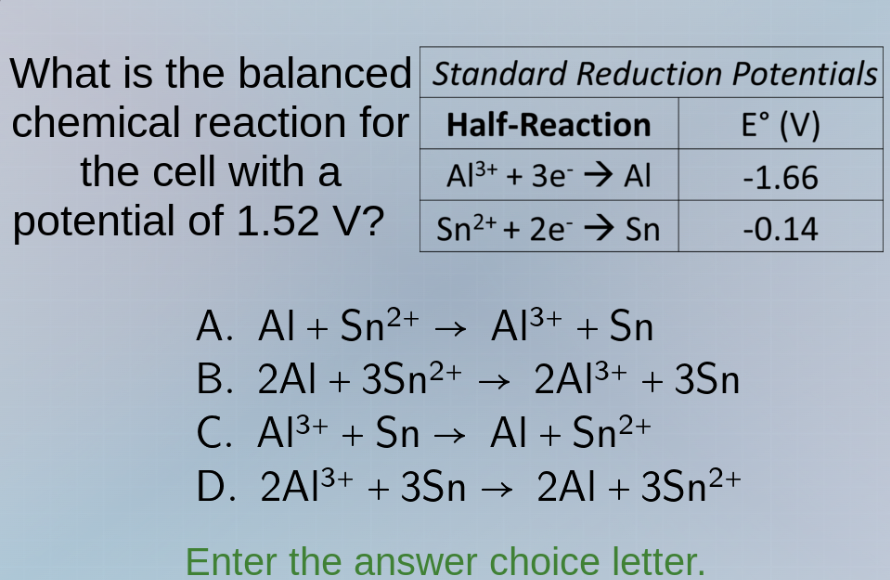
what is the balanced chemical reaction for the cell with a potential of 1.52 v? standard reduction potentials half-reaction e° (v) al³⁺ + 3e⁻ → al -1.66 sn²⁺ + 2e⁻ → sn -0.14 a. al + sn²⁺ → al³⁺ + sn b. 2al + 3sn²⁺ → 2al³⁺ + 3sn c. al³⁺ + sn → al + sn²⁺ d. 2al³⁺ + 3sn → 2al + 3sn²⁺ enter the answer choice letter.
To determine the balanced cell reaction, we first identify the anode (oxidation) and cathode (reduction) based on standard reduction potentials. The half - reaction with the more negative \(E^{\circ}\) is oxidized (anode). For \(\text{Al}^{3 +}+3e^-
ightarrow\text{Al}\), \(E^{\circ}=- 1.66\space V\) and for \(\text{Sn}^{2+}+2e^-
ightarrow\text{Sn}\), \(E^{\circ}=-0.14\space V\). Since \(-1.66\) is more negative than \(-0.14\), \(\text{Al}\) is oxidized (reverse the \(\text{Al}\) half - reaction: \(\text{Al}
ightarrow\text{Al}^{3+}+3e^-\)) and \(\text{Sn}^{2+}\) is reduced (\(\text{Sn}^{2+}+2e^-
ightarrow\text{Sn}\)).
To balance electrons, we find the least common multiple of 3 (electrons from Al oxidation) and 2 (electrons from Sn reduction), which is 6. Multiply the Al oxidation half - reaction by 2: \(2\text{Al}
ightarrow2\text{Al}^{3+}+6e^-\) and multiply the Sn reduction half - reaction by 3: \(3\text{Sn}^{2+}+6e^-
ightarrow3\text{Sn}\).
Now, add the two balanced half - reactions together: \(2\text{Al}+3\text{Sn}^{2+}
ightarrow2\text{Al}^{3+}+3\text{Sn}\). We also check the cell potential. The \(E^{\circ}_{cell}=E^{\circ}_{cathode}-E^{\circ}_{anode}\). \(E^{\circ}_{cathode}=- 0.14\space V\) (for \(\text{Sn}^{2+}\) reduction) and \(E^{\circ}_{anode}=-1.66\space V\) (for \(\text{Al}\) oxidation, we use the reduction potential of \(\text{Al}^{3+}\) here). So \(E^{\circ}_{cell}=-0.14-(-1.66)=1.52\space V\), which matches the given cell potential.
Option A is not balanced for electrons. Option C and D involve the wrong species being oxidized and reduced (they would have a negative cell potential, not 1.52 V).

Snap & solve any problem in the app
Get step-by-step solutions on Sovi AI
Photo-based solutions with guided steps
Explore more problems and detailed explanations
B. \(2\text{Al}+3\text{Sn}^{2+}
ightarrow2\text{Al}^{3+}+3\text{Sn}\)