QUESTION IMAGE
Question
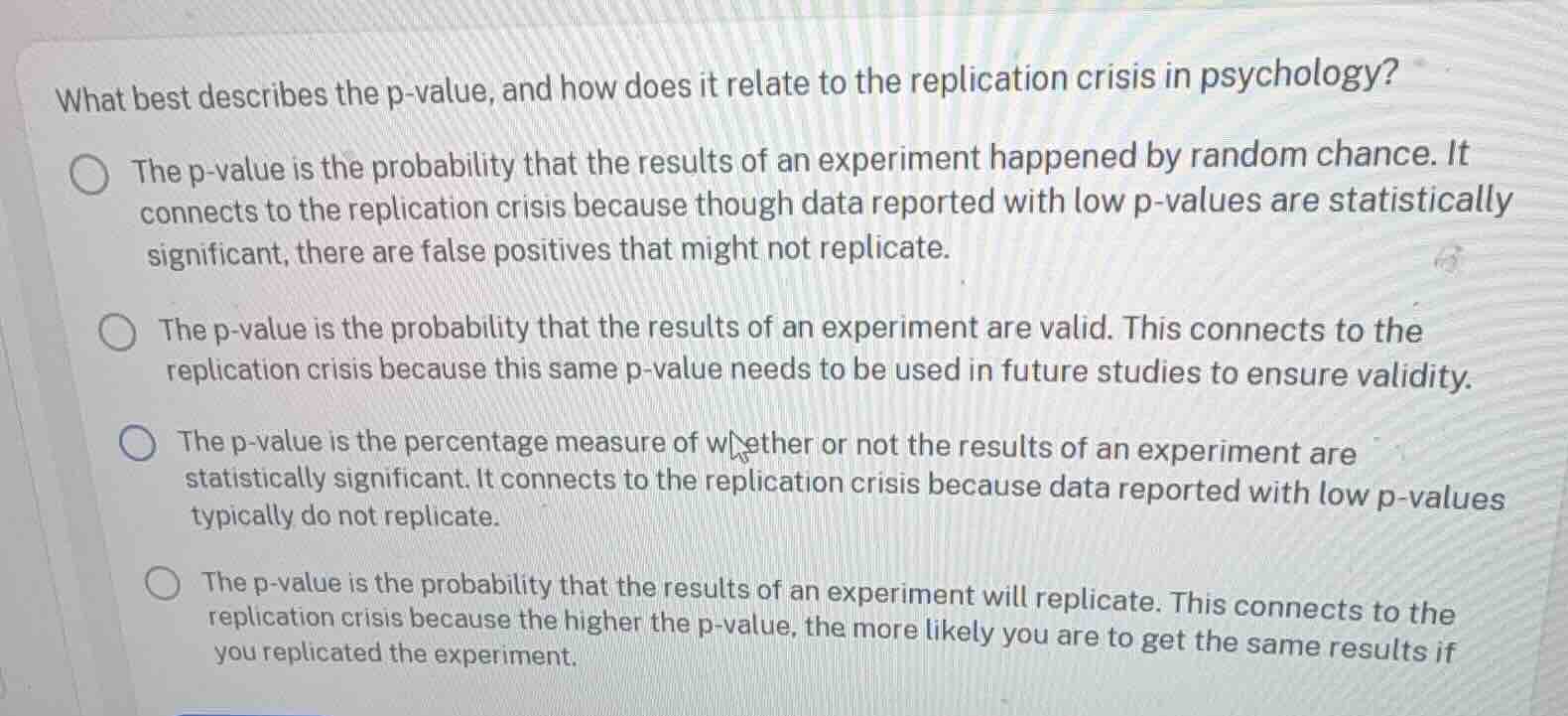
what best describes the p - value, and how does it relate to the replication crisis in psychology?
the p - value is the probability that the results of an experiment happened by random chance. it connects to the replication crisis because though data reported with low p - values are statistically significant, there are false positives that might not replicate.
the p - value is the probability that the results of an experiment are valid. this connects to the replication crisis because this same p - value needs to be used in future studies to ensure validity.
the p - value is the percentage measure of whether or not the results of an experiment are statistically significant. it connects to the replication crisis because data reported with low p - values typically do not replicate.
the p - value is the probability that the results of an experiment will replicate. this connects to the replication crisis because the higher the p - value, the more likely you are to get the same results if you replicated the experiment.
To determine the correct option, we analyze the definition of a p - value and its relation to the replication crisis in psychology:
- For the first option: The p - value is defined as the probability of obtaining results as extreme as, or more extreme than, the observed results under the assumption that the null hypothesis (random chance) is true. In the context of the replication crisis, even if a study has a low p - value (suggesting statistical significance), there can be false positives. These false positives are results that seem significant but are actually due to chance, and thus they will not replicate in subsequent studies.
- For the second option: A p - value does not measure the probability that the results of an experiment are valid. Validity of results depends on many factors beyond just the p - value, like the experimental design, sample representativeness, etc. Also, the idea that the same p - value needs to be used in future studies to ensure validity is incorrect.
- For the third option: A p - value is not a percentage measure of whether results are statistically significant in that way. Also, the statement that data with low p - values typically do not replicate is wrong. Low p - values suggest statistical significance, but the replication crisis is about false positives (not all low p - value results are false positives).
- For the fourth option: A p - value is not the probability that the results of an experiment will replicate. It is related to the probability of results under the null hypothesis, not replication probability. Also, the relationship between p - value and replication likelihood as described here is incorrect.

Snap & solve any problem in the app
Get step-by-step solutions on Sovi AI
Photo-based solutions with guided steps
Explore more problems and detailed explanations
The p - value is the probability that the results of an experiment happened by random chance. It connects to the replication crisis because though data reported with low p - values are statistically significant, there are false positives that might not replicate.