QUESTION IMAGE
Question
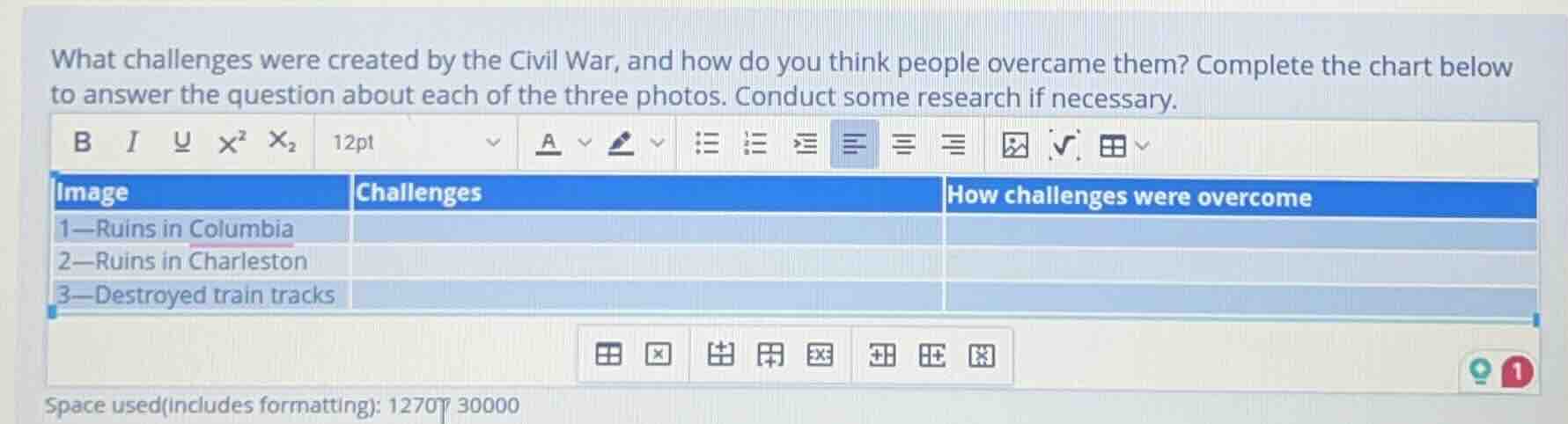
what challenges were created by the civil war, and how do you think people overcame them? complete the chart below to answer the question about each of the three photos. conduct some research if necessary. image challenges how challenges were overcome 1—ruins in columbia 2—ruins in charleston 3—destroyed train tracks
1. Image 1—Ruins in Columbia
Challenges:
The Civil War (specifically Sherman’s March) led to widespread destruction of buildings, infrastructure, and homes in Columbia. This caused displacement of residents, loss of property, and a breakdown of local economic and social systems. There was also a lack of basic necessities (shelter, food, water) for the surviving population.
How challenges were overcome:
- Reconstruction Efforts: The federal government and local communities initiated rebuilding programs. People pooled resources to reconstruct homes, public buildings, and businesses.
- Humanitarian Aid: Organizations (both local and from other regions) provided food, medical supplies, and temporary shelter.
- Economic Revival: Gradually, industries and trade were restarted. The agricultural sector (e.g., cotton production) was revived, and new businesses emerged to meet the needs of the rebuilding population.
2. Image 2—Ruins in Charleston
Challenges:
Charleston, a major port city, suffered extensive damage from military bombardment and occupation. Its port infrastructure (docks, warehouses) was destroyed, disrupting trade and the local economy. Residential areas were devastated, leading to homelessness, food shortages, and a collapse of social services (like healthcare and education).
How challenges were overcome:
- Port Reconstruction: The port was rebuilt with federal and private investment to restore trade. This revived Charleston’s role as a commercial hub, bringing in goods and revenue.
- Community Rebuilding: Local residents, with support from northern aid societies, worked to repair homes and public spaces. Former enslaved people and white residents collaborated (to varying degrees) to rebuild neighborhoods.
- Economic Diversification: Beyond traditional trade, new industries (e.g., manufacturing small goods) emerged to create jobs and stabilize the economy.
3. Image 3—Destroyed train tracks
Challenges:
Destroyed train tracks disrupted transportation networks, which were critical for moving troops, supplies, and commercial goods during and after the war. This led to supply shortages in cities and rural areas, hindered trade between regions, and slowed the movement of people (including displaced persons and workers).
How challenges were overcome:
- Infrastructure Repair: The federal government and railroad companies funded the repair and expansion of train tracks. Skilled laborers (including formerly enslaved people and immigrant workers) were hired to lay new rails and rebuild bridges.
- Standardization: During Reconstruction, railroad systems were standardized (e.g., gauge sizes) to improve efficiency, allowing for smoother trade and transportation across state lines.
- Economic Incentives: The government provided subsidies and land grants to railroad companies to encourage rapid reconstruction, which boosted regional and national trade.
Completed Chart (Summary)
| Image | Challenges | How challenges were overcome |
|---|

Snap & solve any problem in the app
Get step-by-step solutions on Sovi AI
Photo-based solutions with guided steps
Explore more problems and detailed explanations
1. Image 1—Ruins in Columbia
Challenges:
The Civil War (specifically Sherman’s March) led to widespread destruction of buildings, infrastructure, and homes in Columbia. This caused displacement of residents, loss of property, and a breakdown of local economic and social systems. There was also a lack of basic necessities (shelter, food, water) for the surviving population.
How challenges were overcome:
- Reconstruction Efforts: The federal government and local communities initiated rebuilding programs. People pooled resources to reconstruct homes, public buildings, and businesses.
- Humanitarian Aid: Organizations (both local and from other regions) provided food, medical supplies, and temporary shelter.
- Economic Revival: Gradually, industries and trade were restarted. The agricultural sector (e.g., cotton production) was revived, and new businesses emerged to meet the needs of the rebuilding population.
2. Image 2—Ruins in Charleston
Challenges:
Charleston, a major port city, suffered extensive damage from military bombardment and occupation. Its port infrastructure (docks, warehouses) was destroyed, disrupting trade and the local economy. Residential areas were devastated, leading to homelessness, food shortages, and a collapse of social services (like healthcare and education).
How challenges were overcome:
- Port Reconstruction: The port was rebuilt with federal and private investment to restore trade. This revived Charleston’s role as a commercial hub, bringing in goods and revenue.
- Community Rebuilding: Local residents, with support from northern aid societies, worked to repair homes and public spaces. Former enslaved people and white residents collaborated (to varying degrees) to rebuild neighborhoods.
- Economic Diversification: Beyond traditional trade, new industries (e.g., manufacturing small goods) emerged to create jobs and stabilize the economy.
3. Image 3—Destroyed train tracks
Challenges:
Destroyed train tracks disrupted transportation networks, which were critical for moving troops, supplies, and commercial goods during and after the war. This led to supply shortages in cities and rural areas, hindered trade between regions, and slowed the movement of people (including displaced persons and workers).
How challenges were overcome:
- Infrastructure Repair: The federal government and railroad companies funded the repair and expansion of train tracks. Skilled laborers (including formerly enslaved people and immigrant workers) were hired to lay new rails and rebuild bridges.
- Standardization: During Reconstruction, railroad systems were standardized (e.g., gauge sizes) to improve efficiency, allowing for smoother trade and transportation across state lines.
- Economic Incentives: The government provided subsidies and land grants to railroad companies to encourage rapid reconstruction, which boosted regional and national trade.
Completed Chart (Summary)
| Image | Challenges | How challenges were overcome |
|---|---|---|
| 2—Ruins in Charleston | Port/infrastructure damage, trade disruption, homelessness, food shortages | Port reconstruction, community rebuilding, economic diversification |
| 3—Destroyed train tracks | Transportation disruption, supply shortages, trade barriers | Infrastructure repair, standardization, government subsidies for railroads |