QUESTION IMAGE
Question
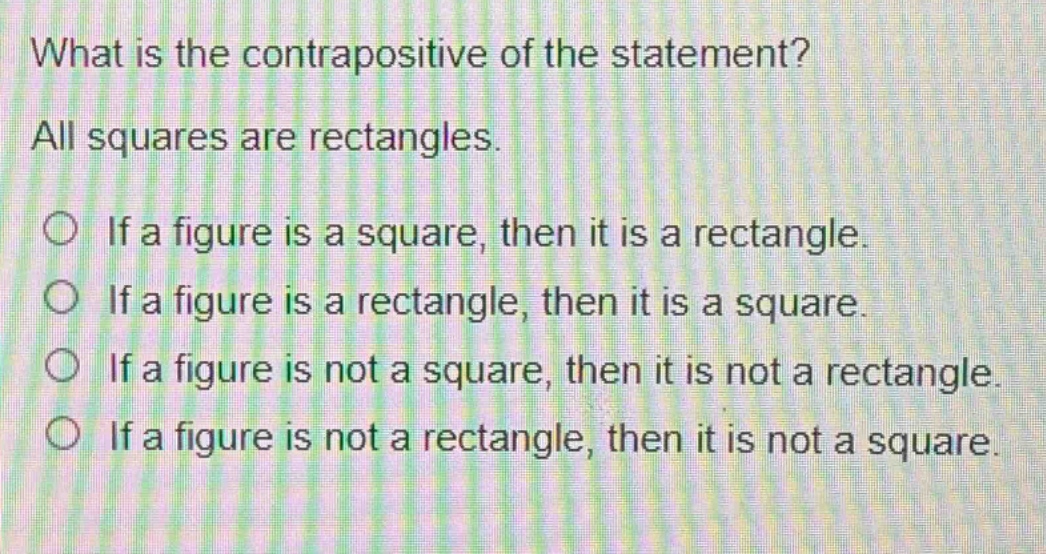
what is the contrapositive of the statement? all squares are rectangles. \bigcirc if a figure is a square, then it is a rectangle. \bigcirc if a figure is a rectangle, then it is a square. \bigcirc if a figure is not a square, then it is not a rectangle. \bigcirc if a figure is not a rectangle, then it is not a square.
To find the contrapositive of a conditional statement \( p \to q \) (where \( p \) is the hypothesis and \( q \) is the conclusion), we use the rule: the contrapositive is \(
eg q \to
eg p \).
First, rewrite "All squares are rectangles" as a conditional statement: "If a figure is a square (\( p \)), then it is a rectangle (\( q \))".
Now, find \(
eg q \) (not a rectangle) and \(
eg p \) (not a square). The contrapositive should be "If a figure is not a rectangle (\(
eg q \)), then it is not a square (\(
eg p \))".
Let's analyze the options:
- Option 1: This is the original conditional statement, not the contrapositive.
- Option 2: This is the converse (swapping \( p \) and \( q \)), not the contrapositive.
- Option 3: This is the inverse (negating both \( p \) and \( q \) but not reversing them), not the contrapositive.
- Option 4: This matches \(
eg q \to
eg p \), so it is the contrapositive.

Snap & solve any problem in the app
Get step-by-step solutions on Sovi AI
Photo-based solutions with guided steps
Explore more problems and detailed explanations
D. If a figure is not a rectangle, then it is not a square.