QUESTION IMAGE
Question
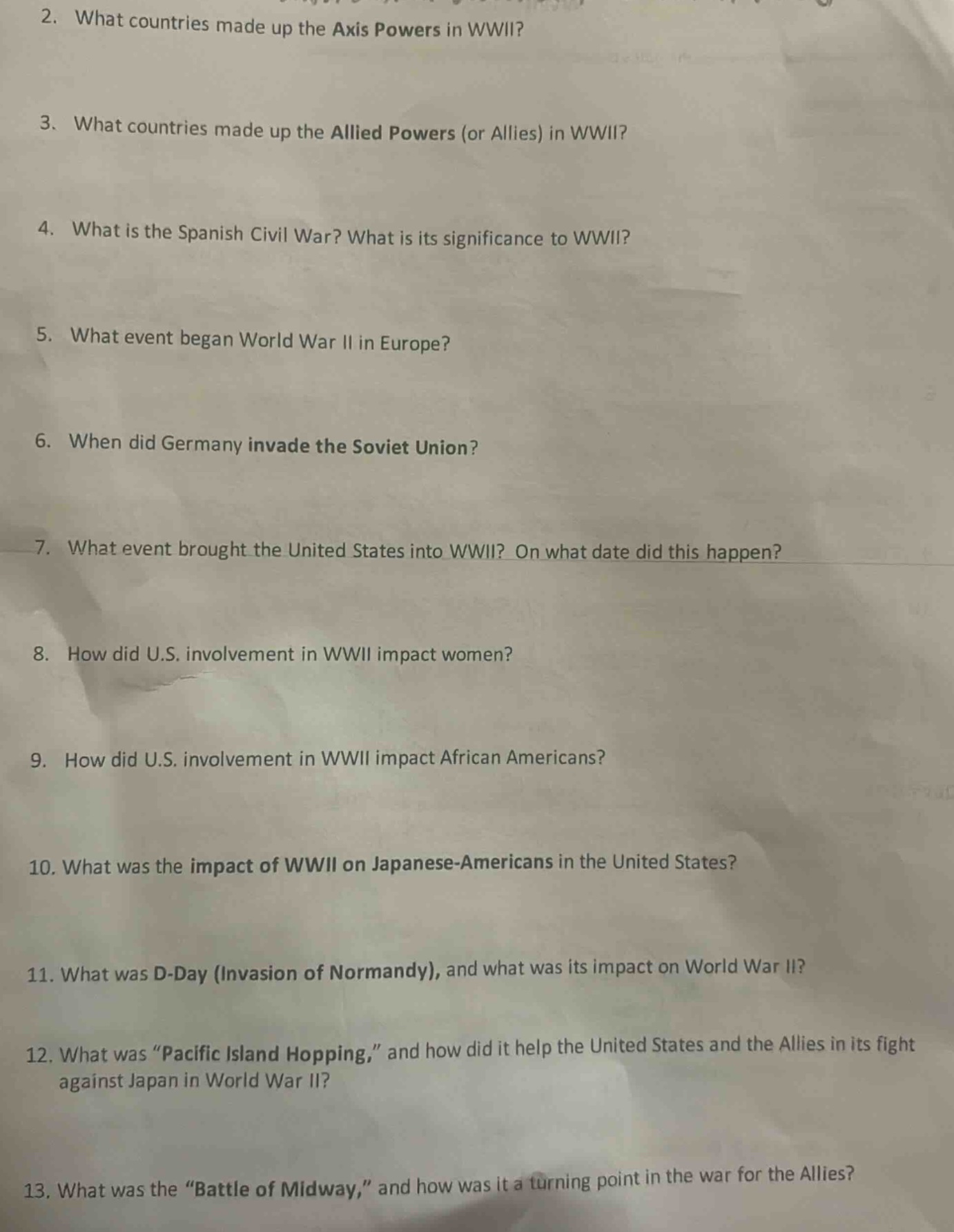
- what countries made up the axis powers in wwii?
- what countries made up the allied powers (or allies) in wwii?
- what is the spanish civil war? what is its significance to wwii?
- what event began world war ii in europe?
- when did germany invade the soviet union?
- what event brought the united states into wwii? on what date did this happen?
- how did u.s. involvement in wwii impact women?
- how did u.s. involvement in wwii impact african americans?
- what was the impact of wwii on japanese-americans in the united states?
- what was d-day (invasion of normandy), and what was its impact on world war ii?
- what was \pacific island hopping,\ and how did it help the united states and the allies in its fight against japan in world war ii?
- what was the \battle of midway,\ and how was it a turning point in the war for the allies?
Brief Explanations
- The Axis Powers were the main fascist alliance in WWII.
- The Allied Powers were the coalition opposing the Axis.
- The Spanish Civil War was a domestic conflict that served as a testing ground for WWII weapons and tactics, and helped solidify Axis cooperation.
- The official start of WWII in Europe is tied to Germany's aggressive invasion of a neighboring country.
- Germany broke a non-aggression pact to launch this large-scale invasion.
- A surprise attack on a U.S. naval base directly led to U.S. entry into the war.
- U.S. wartime labor shortages opened new employment paths for women.
- WWII created new economic and military opportunities for African Americans, while also highlighting racial inequalities.
- Japanese-Americans faced widespread suspicion and forced relocation due to anti-Japanese sentiment.
- D-Day was a massive amphibious invasion that opened a critical second front in Europe.
- Pacific Island Hopping was a military strategy to bypass heavily fortified Japanese-held islands.
- The Battle of Midway was a naval battle that crippled Japan's carrier fleet, shifting the balance of power in the Pacific.

Snap & solve any problem in the app
Get step-by-step solutions on Sovi AI
Photo-based solutions with guided steps
Explore more problems and detailed explanations
- The primary Axis Powers were Nazi Germany, Fascist Italy, and Imperial Japan.
- The core Allied Powers were the United States, the United Kingdom, the Soviet Union, and China; many other countries joined the coalition over the course of the war.
- The Spanish Civil War (1936-1939) was a conflict between the nationalist forces led by Francisco Franco (backed by Germany and Italy) and the Republican government (backed by the Soviet Union). Its significance to WWII: it allowed the Axis powers to test military equipment and tactics, it demonstrated the failure of Western appeasement, and it hardened ideological divides that fueled WWII.
- The invasion of Poland by Nazi Germany on September 1, 1939, which prompted Britain and France to declare war on Germany, began World War II in Europe.
- Germany invaded the Soviet Union on June 22, 1941, as part of Operation Barbarossa.
- The surprise Japanese attack on the U.S. naval base at Pearl Harbor brought the United States into WWII. This happened on December 7, 1941.
- U.S. involvement in WWII led to a massive demand for labor, opening up millions of factory jobs (in war production) for women that were previously closed to them; the iconic "Rosie the Riveter" symbolized this shift. It also challenged traditional gender roles, though many women were pushed back into domestic work after the war.
- WWII created new job opportunities in war industries for African Americans, and over one million served in the U.S. military. However, they faced segregation and discrimination both at home and in the military. This experience helped fuel the post-war civil rights movement.
- Japanese-Americans, particularly those living on the West Coast, were subjected to forced relocation and internment in prison camps under Executive Order 9066, signed in 1942. Thousands lost their homes, businesses, and personal property, and faced long-term psychological and economic harm.
- D-Day (June 6, 1944) was the large-scale amphibious invasion of Normandy, France, by Allied forces. It opened a critical second front in Western Europe, forcing Germany to fight a two-front war, and marked the beginning of the end of Nazi control over Western Europe.
- "Pacific Island Hopping" was a U.S. military strategy in the Pacific Theater where forces captured strategically important Japanese-held islands (while bypassing heavily fortified ones) to establish air and naval bases closer to Japan. It allowed the Allies to gradually move toward Japan, cut off Japanese supply lines, and reduce the strength of Japan's military with fewer casualties than a direct attack on every island.
- The Battle of Midway (June 4-7, 1942) was a major naval battle in the Pacific Theater, where U.S. forces defeated a Japanese fleet planning to attack the Midway Atoll. It was a turning point because the U.S. destroyed four of Japan's aircraft carriers (a critical part of its naval power), eliminating Japan's ability to launch large-scale offensive operations in the Pacific and shifting the strategic advantage to the Allies.