QUESTION IMAGE
Question
- what is the definition of force?
- what is the unit of force?
- what are the units of acceleration?
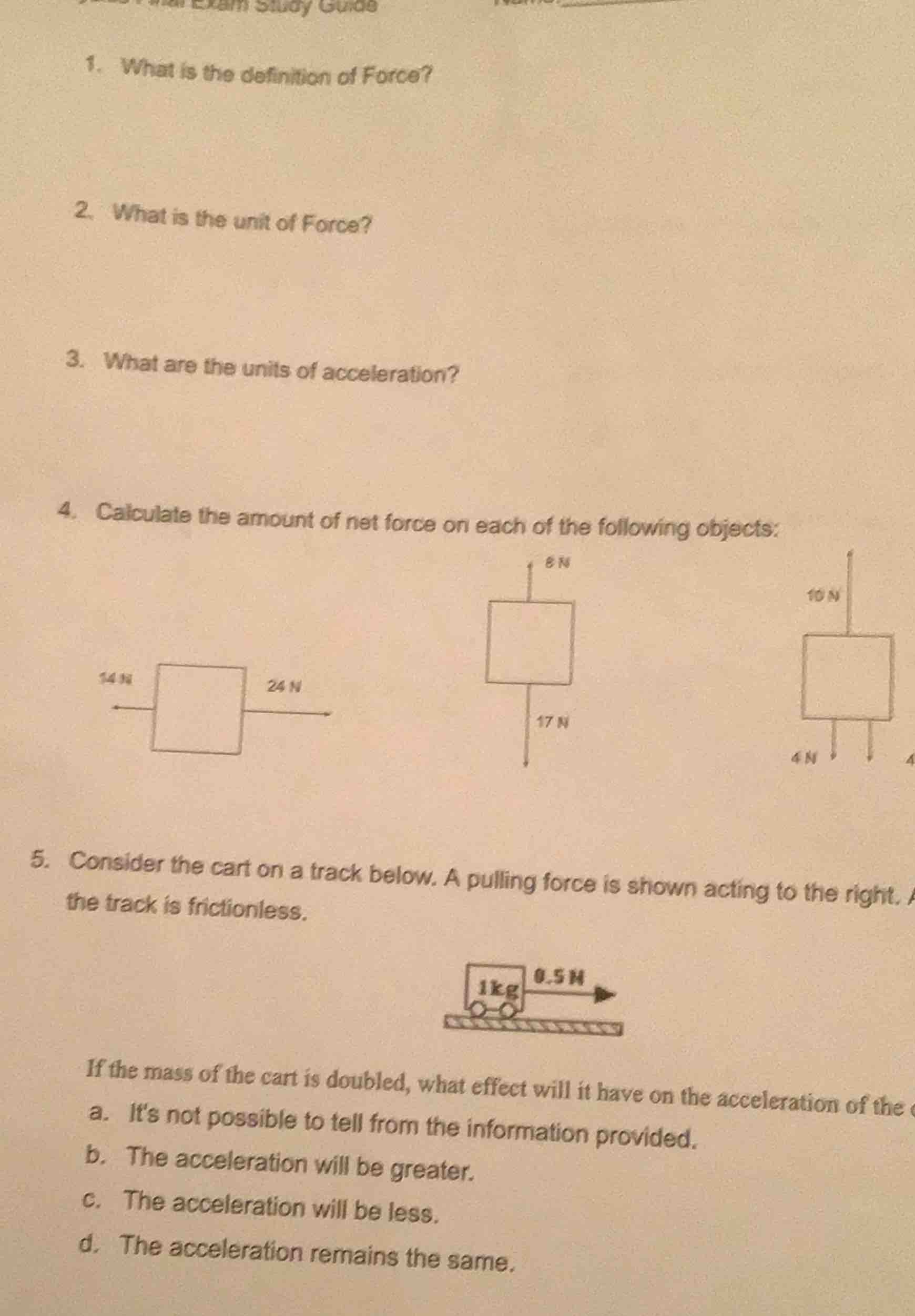
- calculate the amount of net force on each of the following objects:
(images of force diagrams on objects)
- consider the cart on a track below. a pulling force is shown acting to the right. the track is frictionless.
(images of a 1kg cart with 0.5n force to the right)
if the mass of the cart is doubled, what effect will it have on the acceleration of the cart?
a. it’s not possible to tell from the information provided.
b. the acceleration will be greater.
c. the acceleration will be less.
d. the acceleration remains the same.
Question 1:
Force is a physical quantity that can change the state of motion of an object or deform it. In physics, it is defined as a push or pull acting on an object, and it is related to mass and acceleration by Newton's second law \( F = ma \), where \( F \) is force, \( m \) is mass, and \( a \) is acceleration.
The unit of force in the International System of Units (SI) is the newton (symbol: N). One newton is defined as the force required to accelerate a mass of one kilogram at a rate of one meter per second squared (\( 1\ N=1\ kg\cdot m/s^{2} \)).
Acceleration is the rate of change of velocity. The SI unit of velocity is meters per second (\( m/s \)), so the unit of acceleration (change in velocity per unit time) is meters per second squared (\( m/s^{2} \)). In some contexts, other units like centimeters per second squared (\( cm/s^{2} \)) can be used, but \( m/s^{2} \) is the standard SI unit.

Snap & solve any problem in the app
Get step-by-step solutions on Sovi AI
Photo-based solutions with guided steps
Explore more problems and detailed explanations
Force is a push or pull on an object that can cause it to accelerate (change its velocity) or deform, described by Newton's second law \( F = ma \) (where \( F \) = force, \( m \) = mass, \( a \) = acceleration).