QUESTION IMAGE
Question
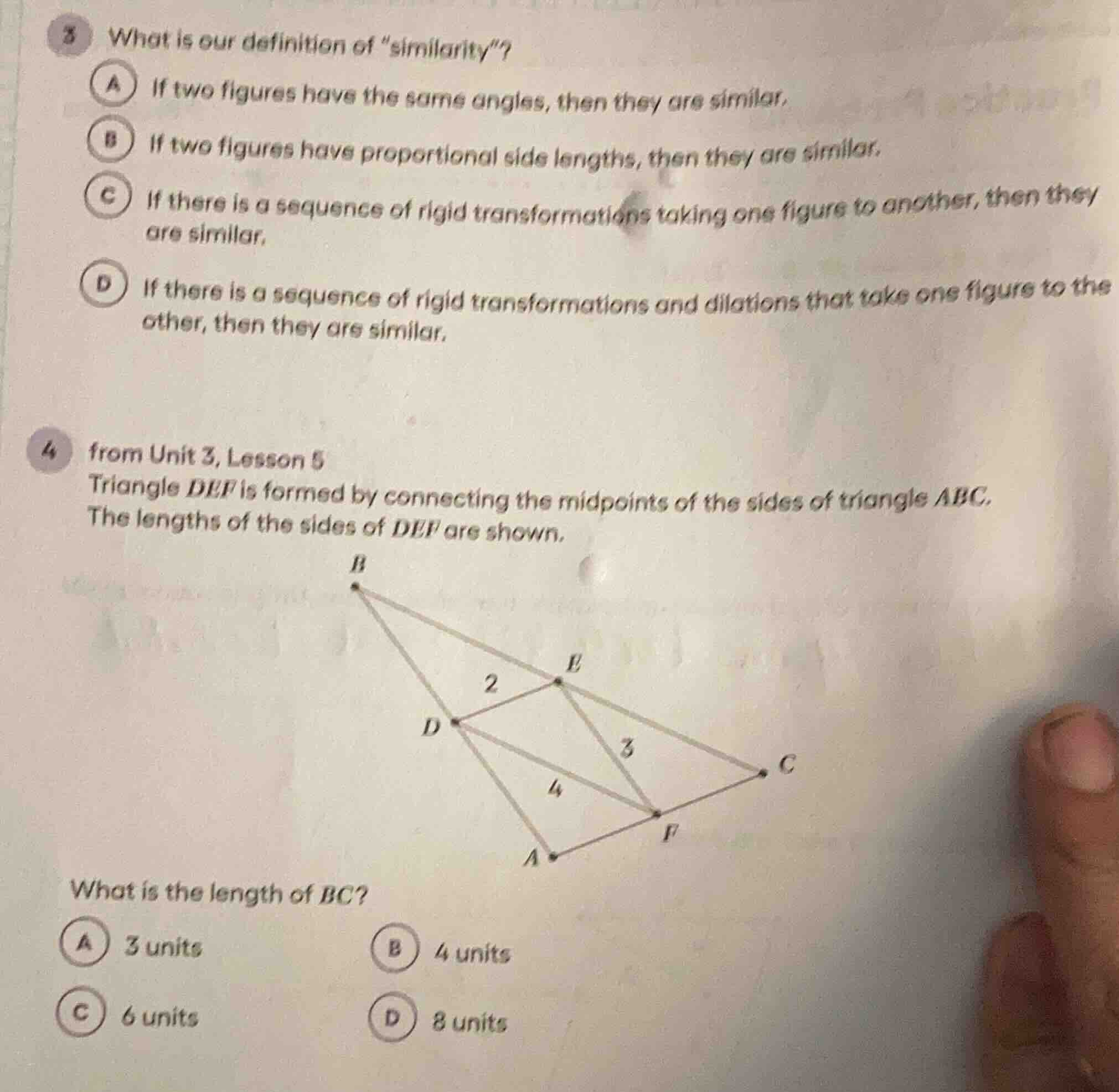
3 what is our definition of \similarity\? a if two figures have the same angles, then they are similar. b if two figures have proportional side lengths, then they are similar. c if there is a sequence of rigid transformations taking one figure to another, then they are similar. d if there is a sequence of rigid transformations and dilations that take one figure to the other, then they are similar. 4 from unit 3, lesson 5 triangle def is formed by connecting the midpoints of the sides of triangle abc. the lengths of the sides of def are shown. what is the length of bc? a 3 units b 4 units c 6 units d 8 units
For Question 3:
Similar figures require both shape preservation (via rigid transformations: translations, rotations, reflections) and size scaling (via dilations). Options A and B only address one condition, and option C describes congruent figures, not similar ones.
Step1: Apply Midsegment Theorem
The segment connecting midpoints of a triangle's sides (midsegment) is half the length of the third parallel side. Here, $DF$ is the midsegment parallel to $BC$, so $BC = 2 \times DF$.
Step2: Substitute given length
$DF = 4$, so $BC = 2 \times 4$

Snap & solve any problem in the app
Get step-by-step solutions on Sovi AI
Photo-based solutions with guided steps
Explore more problems and detailed explanations
D. If there is a sequence of rigid transformations and dilations that take one figure to the other, then they are similar.
---