QUESTION IMAGE
Question
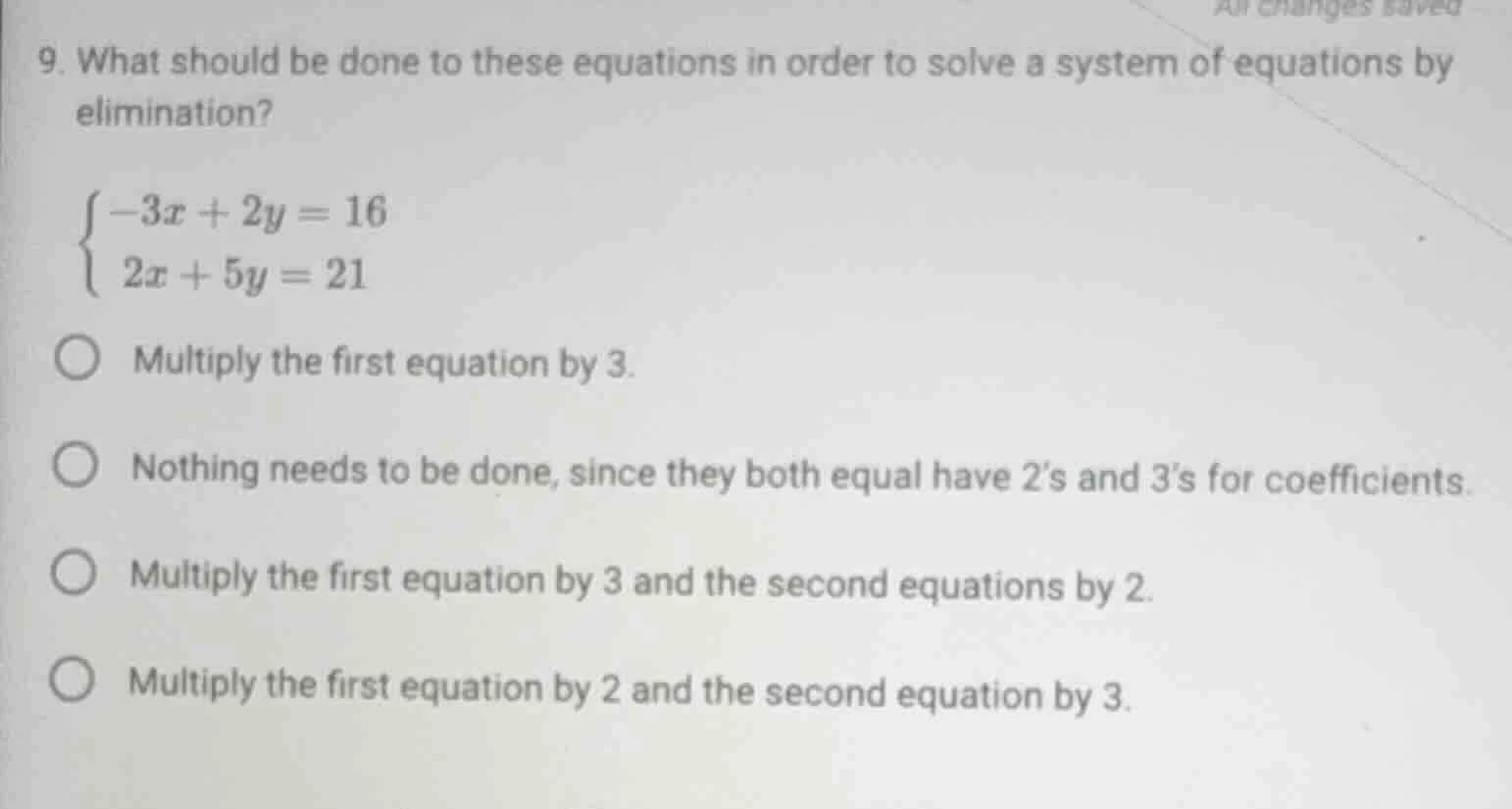
- what should be done to these equations in order to solve a system of equations by elimination?\
\bigcirc multiply the first equation by 3.\bigcirc nothing needs to be done, since they both equal have 2s and 3s for coefficients.\bigcirc multiply the first equation by 3 and the second equations by 2.\bigcirc multiply the first equation by 2 and the second equation by 3.
Step1: Recall elimination method goal
The elimination method requires creating opposite coefficients for one variable so they cancel when equations are added.
Step2: Analyze x-coefficients
First equation x-coefficient: $-3$; second: $2$. We need to make their absolute values equal.
Step3: Find common multiple
The least common multiple of 3 and 2 is 6. Multiply first equation by 2: $2(-3x + 2y) = 2(16) \implies -6x + 4y = 32$. Multiply second equation by 3: $3(2x + 5y) = 3(21) \implies 6x + 15y = 63$. Now x-coefficients are $-6$ and $6$, which are opposites.
Step4: Evaluate options
Only the last option matches this required operation.

Snap & solve any problem in the app
Get step-by-step solutions on Sovi AI
Photo-based solutions with guided steps
Explore more problems and detailed explanations
D. Multiply the first equation by 2 and the second equation by 3.