QUESTION IMAGE
Question
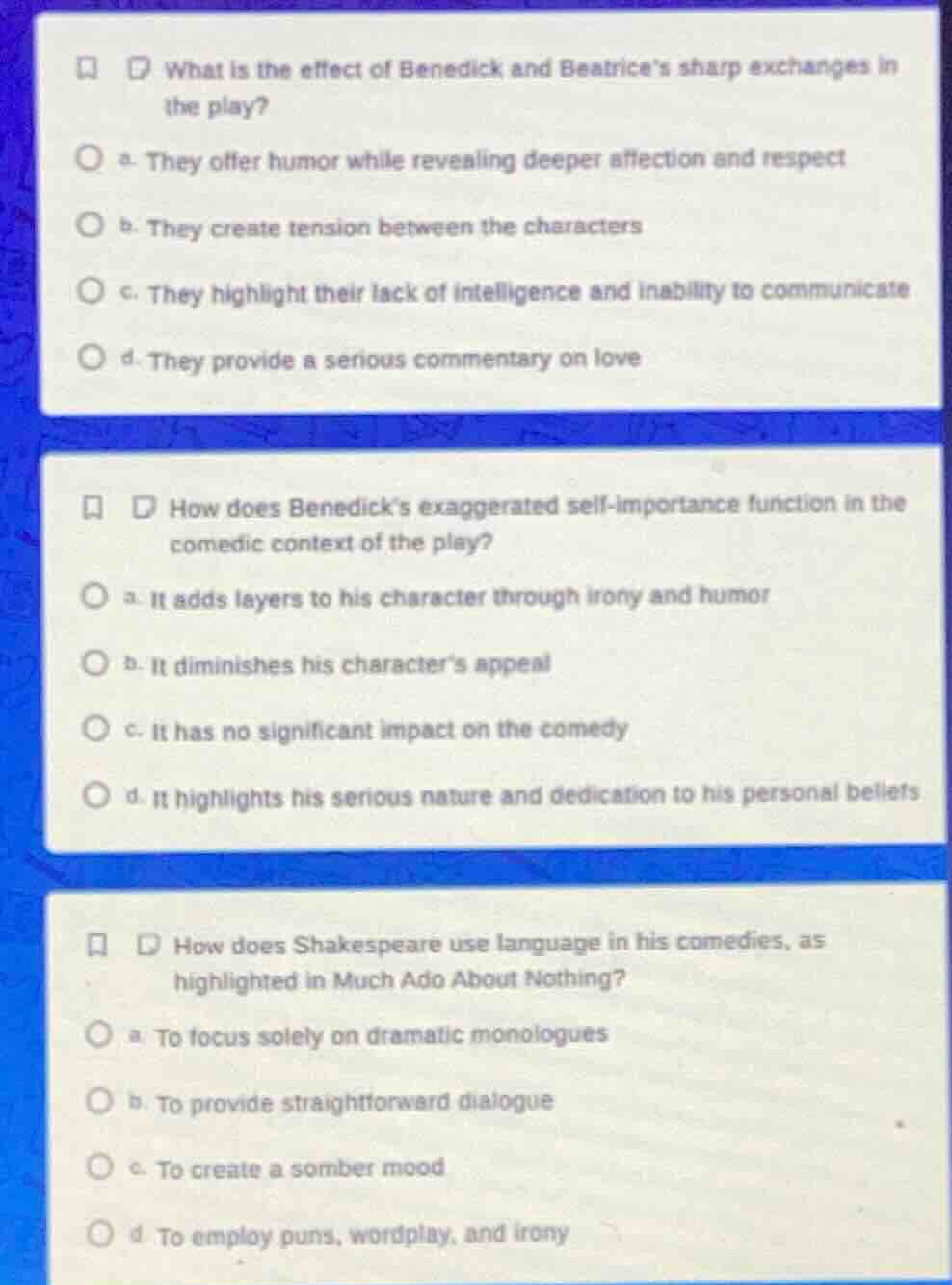
what is the effect of benedick and beatrice’s sharp exchanges in the play?
a. they offer humor while revealing deeper affection and respect
b. they create tension between the characters
c. they highlight their lack of intelligence and inability to communicate
d. they provide a serious commentary on love
how does benedick’s exaggerated self - importance function in the comedic context of the play?
a. it adds layers to his character through irony and humor
b. it diminishes his character’s appeal
c. it has no significant impact on the comedy
d. it highlights his serious nature and dedication to his personal beliefs
how does shakespeare use language in his comedies, as highlighted in much ado about nothing?
a. to focus solely on dramatic monologues
b. to provide straightforward dialogue
c. to create a somber mood
d. to employ puns, wordplay, and irony
First Question:
In Much Ado About Nothing, Benedick and Beatrice’s sharp exchanges (verbal sparring) are witty, providing humor. Beneath the banter, their interactions reveal underlying affection and respect (e.g., their eventual romantic union). Option b is incorrect as the tension is playful, not hostile. Option c is wrong—they are intelligent and communicate cleverly. Option d is incorrect as their exchanges are humorous, not a serious commentary. So a is correct.
Benedick’s exaggerated self - importance in the comedic context of the play is ironic. This irony and the humorous way he presents his self - regard add depth to his character. Option b is wrong as it actually makes him more appealing. Option c is incorrect as it does impact the comedy. Option d is wrong as his self - importance is part of the comedy, not a sign of seriousness. So a is correct.
In Much Ado About Nothing and his comedies, Shakespeare uses language with puns, wordplay, and irony. Option a is wrong as he doesn't focus solely on dramatic monologues. Option b is incorrect as his dialogue is not straightforward (it's witty and layered). Option c is wrong as comedies are not somber. So d is correct.

Snap & solve any problem in the app
Get step-by-step solutions on Sovi AI
Photo-based solutions with guided steps
Explore more problems and detailed explanations
a. They offer humor while revealing deeper affection and respect