QUESTION IMAGE
Question
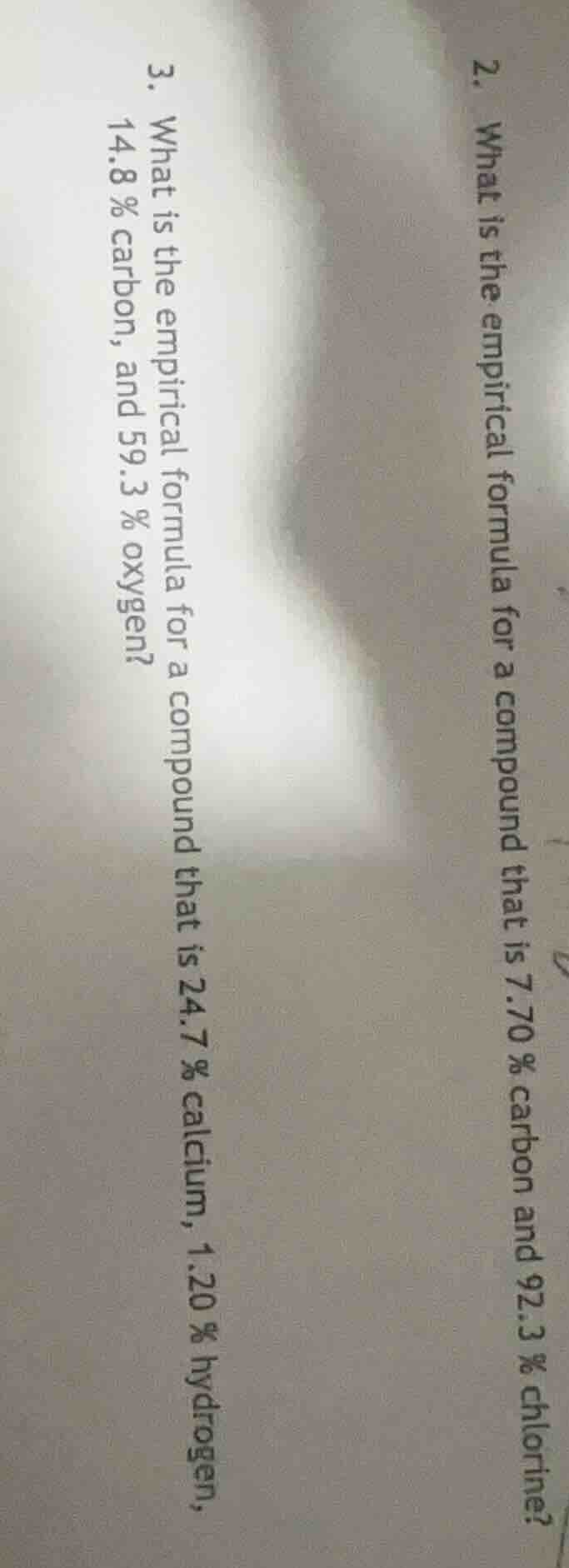
- what is the empirical formula for a compound that is 7.70 % carbon and 92.3 % chlorine? 3. what is the empirical formula for a compound that is 24.7 % calcium, 1.20 % hydrogen, 14.8 % carbon, and 59.3 % oxygen?
Step1: Assume 100g sample, list masses
Mass of Ca = 24.7 g, H = 1.20 g, C = 14.8 g, O = 59.3 g
Step2: Calculate moles of each element
Moles of Ca: $\frac{24.7}{40.08} \approx 0.616$
Moles of H: $\frac{1.20}{1.008} \approx 1.19$
Moles of C: $\frac{14.8}{12.01} \approx 1.23$
Moles of O: $\frac{59.3}{16.00} \approx 3.71$
Step3: Divide by smallest mole value
Divide all by 0.616:
Ca: $\frac{0.616}{0.616} = 1$
H: $\frac{1.19}{0.616} \approx 2$
C: $\frac{1.23}{0.616} \approx 2$
O: $\frac{3.71}{0.616} \approx 6$
Step1: Assume 100g sample, list masses
Mass of C = 7.70 g, Cl = 92.3 g
Step2: Calculate moles of each element
Moles of C: $\frac{7.70}{12.01} \approx 0.641$
Moles of Cl: $\frac{92.3}{35.45} \approx 2.60$
Step3: Divide by smallest mole value
Divide both by 0.641:
C: $\frac{0.641}{0.641} = 1$
Cl: $\frac{2.60}{0.641} \approx 4$

Snap & solve any problem in the app
Get step-by-step solutions on Sovi AI
Photo-based solutions with guided steps
Explore more problems and detailed explanations
$\text{CaH}_2\text{C}_2\text{O}_6$ (or $\text{Ca(HCO}_3\text{)}_2$)
---