QUESTION IMAGE
Question
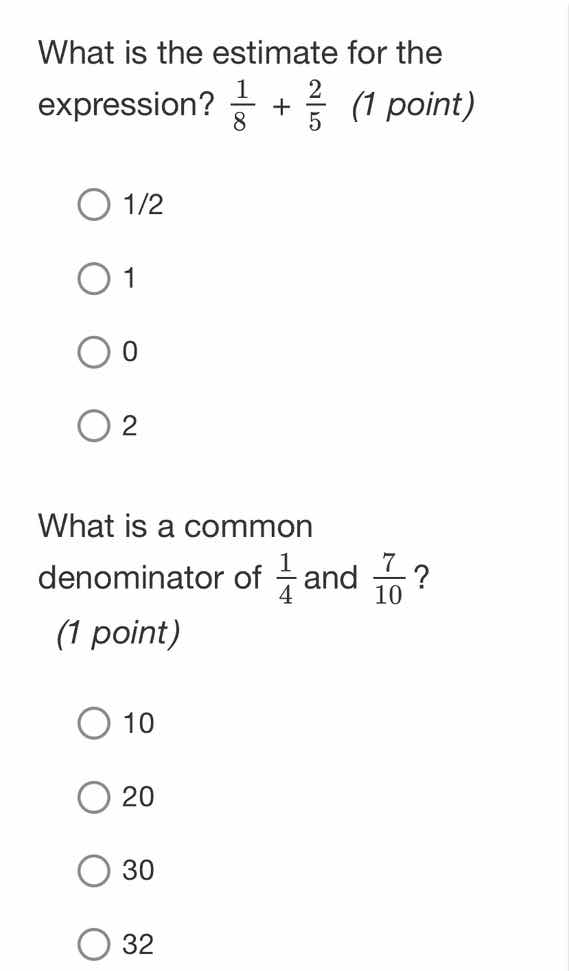
what is the estimate for the expression? \\(\frac{1}{8} + \frac{2}{5}\\) (1 point)
\\(\bigcirc\\) 1/2
\\(\bigcirc\\) 1
\\(\bigcirc\\) 0
\\(\bigcirc\\) 2
what is a common denominator of \\(\frac{1}{4}\\) and \\(\frac{7}{10}\\)?
(1 point)
\\(\bigcirc\\) 10
\\(\bigcirc\\) 20
\\(\bigcirc\\) 30
\\(\bigcirc\\) 32
First Question: Estimate for \(\boldsymbol{\frac{1}{8} + \frac{2}{5}}\)
Step1: Estimate each fraction
\(\frac{1}{8}\) is close to \(0\) (since \(1/8 = 0.125\)), and \(\frac{2}{5}=0.4\), which is close to \(0.5\) (or \(\frac{1}{2}\)).
Step2: Add the estimated values
Adding the estimated values: \(0 + 0.5=\frac{1}{2}\). Also, calculating the actual sum: \(\frac{1}{8}+\frac{2}{5}=\frac{5 + 16}{40}=\frac{21}{40}=0.525\), which is close to \(\frac{1}{2}\).
To find a common denominator, we can find the least common multiple (LCM) of the denominators \(4\) and \(10\). Prime factorize \(4 = 2\times2\) and \(10 = 2\times5\). The LCM is \(2\times2\times5 = 20\). We can also check by seeing which option is a multiple of both \(4\) and \(10\). \(10\) is not a multiple of \(4\) (\(10\div4 = 2.5\)), \(20\) is a multiple of \(4\) (\(20\div4 = 5\)) and \(10\) (\(20\div10 = 2\)), \(30\) is not a multiple of \(4\) (\(30\div4 = 7.5\)), \(32\) is not a multiple of \(10\) (\(32\div10 = 3.2\)).

Snap & solve any problem in the app
Get step-by-step solutions on Sovi AI
Photo-based solutions with guided steps
Explore more problems and detailed explanations
\(\frac{1}{2}\) (the option corresponding to \(1/2\))