QUESTION IMAGE
Question
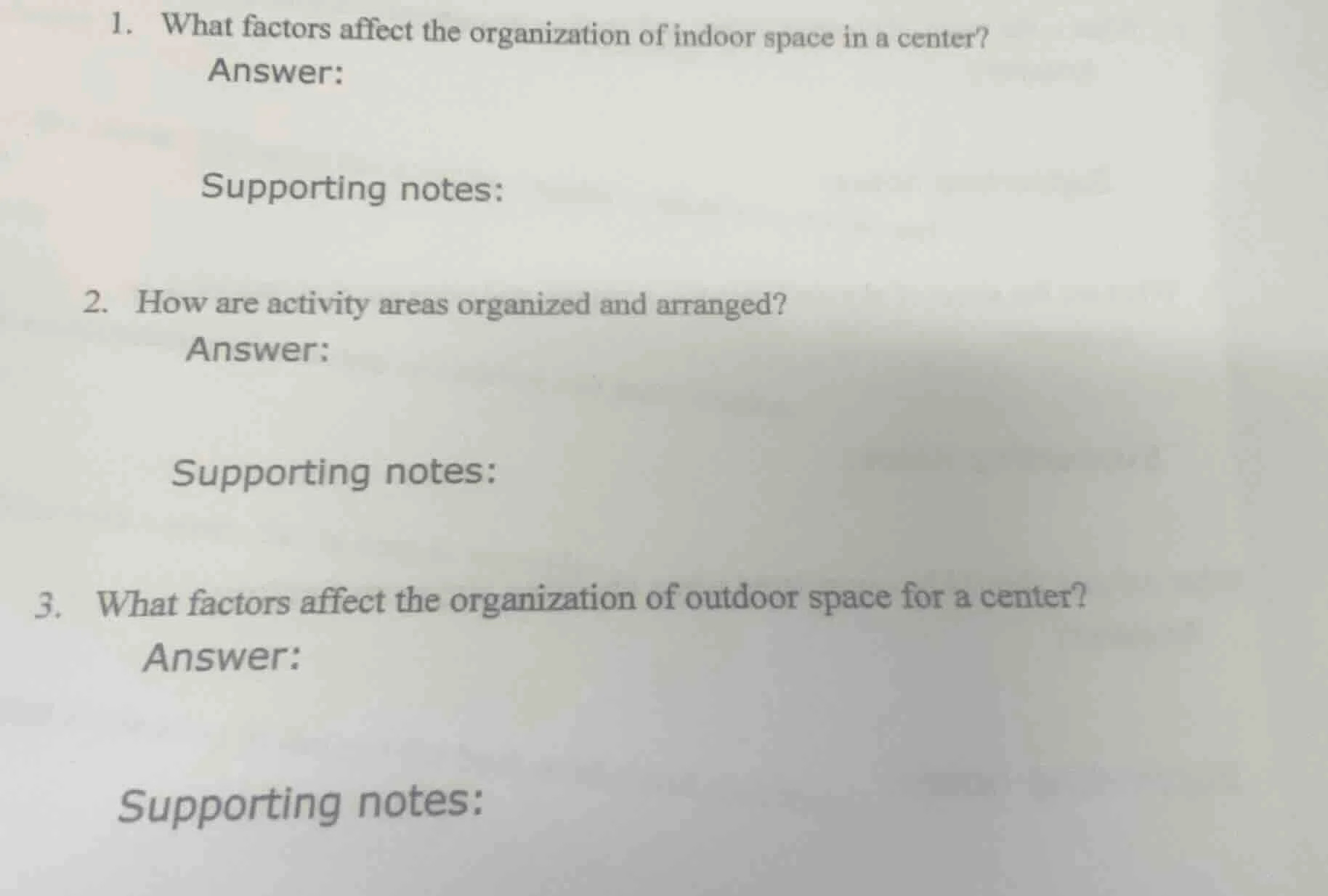
- what factors affect the organization of indoor space in a center?
answer:
supporting notes:
- how are activity areas organized and arranged?
answer:
supporting notes:
- what factors affect the organization of outdoor space for a center?
answer:
supporting notes:
Question 1
Factors affecting indoor space organization include the center's purpose (e.g., educational, recreational), user needs (age, abilities of users), available area (size/shape of the building), functional requirements (e.g., need for private vs. open spaces), safety regulations (e.g., fire exits, accessibility), and aesthetic preferences (design style, color schemes). Also, infrastructure like plumbing, electrical layouts, and HVAC systems influence space division.
Activity areas are organized based on function (grouping similar activities, e.g., quiet study near library, active play near gym), flow (ensuring smooth movement between areas, minimizing congestion), adjacency (placing related areas close, e.g., cafeteria near kitchen), privacy needs (separating private activities like counseling from public ones), and user experience (considering visibility, noise control, and accessibility). Spatial hierarchy (defining primary/secondary areas) and flexibility (modular spaces for multi - use) also play a role.
For outdoor space organization, factors include the center's purpose (e.g., a sports center needs fields, a daycare needs play areas), site topography (slope, elevation affects layout), climate (e.g., shading in hot areas, windbreaks in windy regions), landscaping (vegetation for aesthetics, erosion control), access (pedestrian/vehicle entry points), safety (e.g., fencing, non - slip surfaces), and regulatory requirements (e.g., setbacks, environmental protection rules). Also, the relationship with the surrounding environment (e.g., integrating with nearby parks or streets) matters.

Snap & solve any problem in the app
Get step-by-step solutions on Sovi AI
Photo-based solutions with guided steps
Explore more problems and detailed explanations
Factors affecting indoor space organization of a center include the center’s purpose (e.g., educational, recreational), user needs (age, abilities of users), available indoor area (size/shape of the building), functional requirements (e.g., private vs. open spaces), safety regulations (e.g., fire exits, accessibility), aesthetic preferences, and infrastructure (plumbing, electrical, HVAC layouts).