QUESTION IMAGE
Question
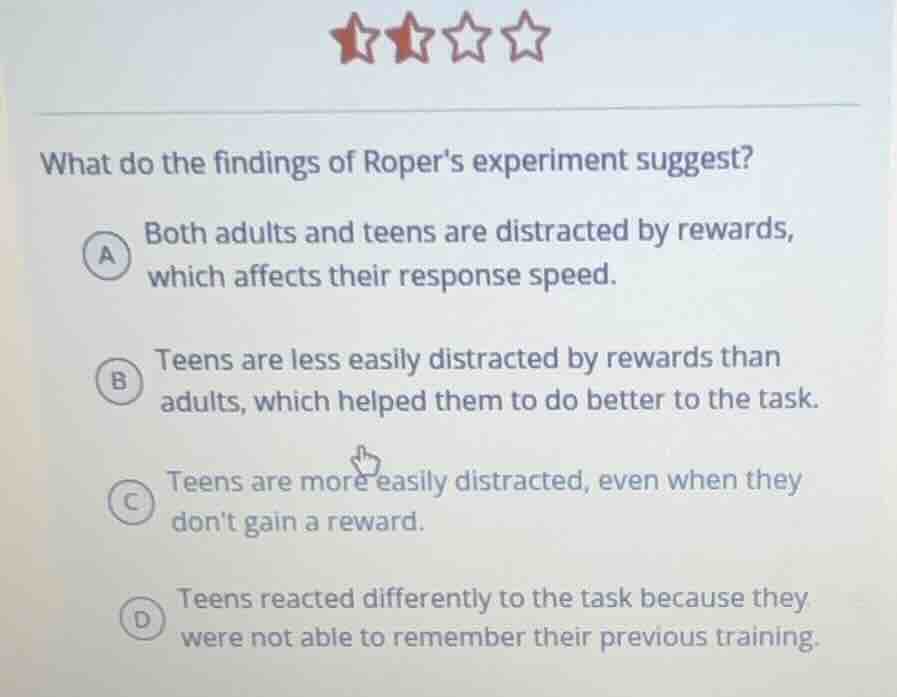
what do the findings of ropers experiment suggest? a both adults and teens are distracted by rewards, which affects their response speed. b teens are less easily distracted by rewards than adults, which helped them to do better to the task. c teens are more easily distracted, even when they dont gain a reward. d teens reacted differently to the task because they were not able to remember their previous training.
Roper's experiment on reward distraction found that adolescents (teens) show greater distractibility from reward cues compared to adults, even when the reward is no longer obtainable. Option A is incorrect because the experiment highlights a difference between teens and adults, not a shared distraction effect impacting response speed equally. Option B is wrong as teens are more easily distracted, not less. Option D is incorrect because memory of prior training was not the key variable in the experiment's findings.

Snap & solve any problem in the app
Get step-by-step solutions on Sovi AI
Photo-based solutions with guided steps
Explore more problems and detailed explanations
C. Teens are more easily distracted, even when they don't gain a reward.