QUESTION IMAGE
Question
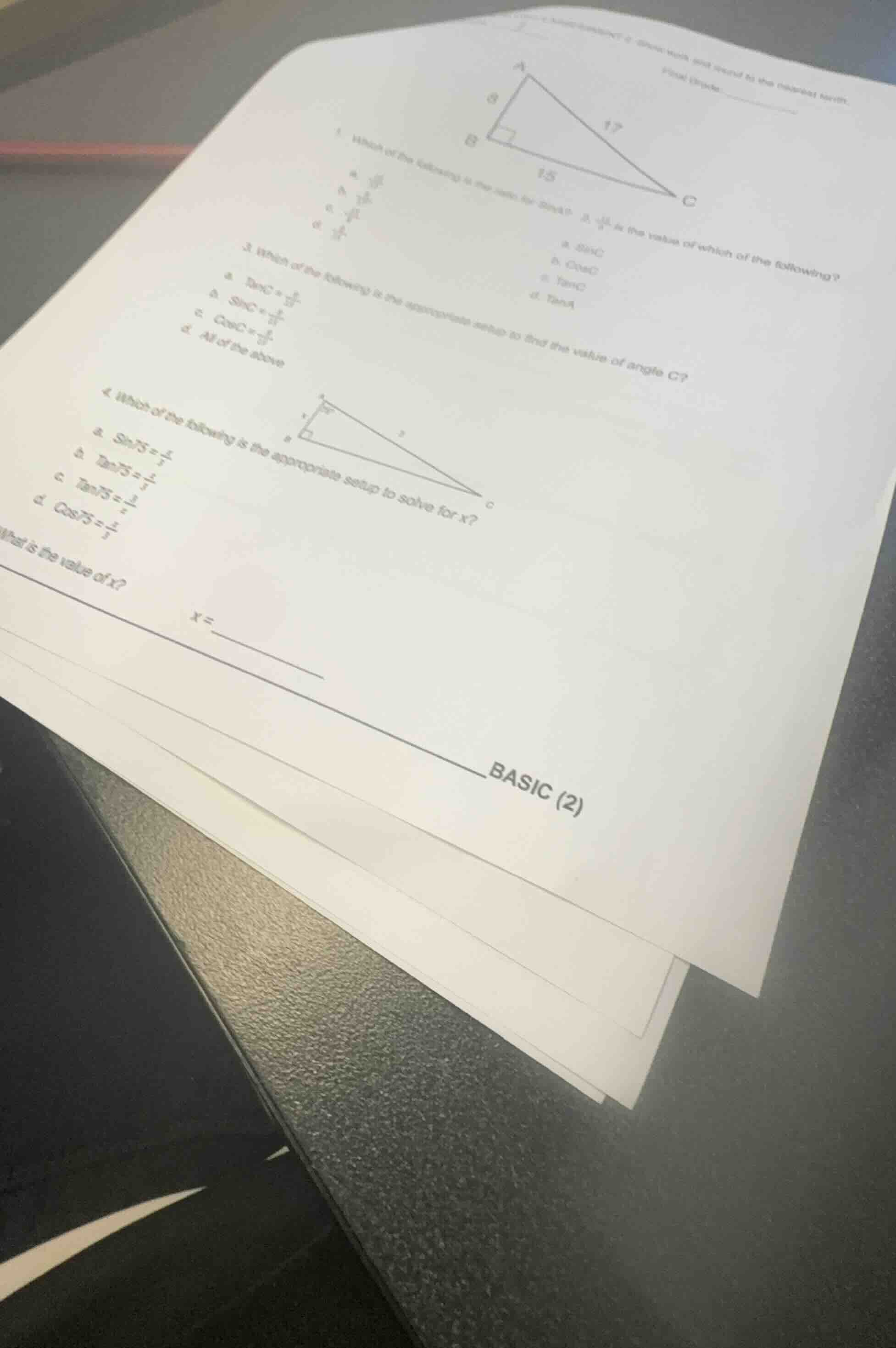
- what of the following is the ratio for - (partially obscured) a. (8/17) is the value of which of the following?
a. sinc
b. cosc
c. tanc
d. tana
- which of the following is the appropriate setup to find the value of angle c?
a. secc = (17/15)
b. sinc = (8/17)
c. cosc = (8/17)
d. all of the above
- which of the following is the appropriate setup to solve for x?
a. sin75° = (x/7)
b. tan75° = (7/x)
c. tan75° = (x/7)
d. cos75° = (x/7)
what is the value of x?
x =
basic (2)
Let's tackle the problem about finding the value of \( x \) in the right triangle (question 4). First, we need to identify the trigonometric ratio that relates the given angle (\( 75^\circ \)), the side opposite or adjacent to it, and the hypotenuse or the other leg.
Step 1: Identify the sides relative to the \( 75^\circ \) angle
Looking at the triangle, we have a right angle, an angle of \( 75^\circ \), a side labeled \( x \) (let's assume it's the opposite side to \( 75^\circ \)), and a side labeled \( 7 \) (let's assume it's the adjacent side to \( 75^\circ \)). Wait, actually, let's check the trigonometric ratios. The options are \( \sin 75^\circ = \frac{x}{7} \), \( \tan 75^\circ = \frac{x}{7} \), \( \tan 75^\circ = \frac{7}{x} \), or \( \cos 75^\circ = \frac{x}{7} \).
Wait, let's recall:
- \( \sin \theta = \frac{\text{opposite}}{\text{hypotenuse}} \)
- \( \cos \theta = \frac{\text{adjacent}}{\text{hypotenuse}} \)
- \( \tan \theta = \frac{\text{opposite}}{\text{adjacent}} \)
Assuming the triangle has a right angle, angle \( 75^\circ \), the side adjacent to \( 75^\circ \) is \( 7 \), and the side opposite is \( x \). Then \( \tan 75^\circ = \frac{\text{opposite}}{\text{adjacent}} = \frac{x}{7} \). Wait, but let's check the options. Wait, the options are:
a. \( \sin 75^\circ = \frac{x}{7} \)
b. \( \tan 75^\circ = \frac{x}{7} \)
c. \( \tan 75^\circ = \frac{7}{x} \)
d. \( \cos 75^\circ = \frac{x}{7} \)
Wait, maybe the side labeled \( 7 \) is the adjacent, and \( x \) is the opposite. Then \( \tan 75^\circ = \frac{x}{7} \), which is option b? Wait, no, let's re-examine. Wait, maybe the hypotenuse is \( 7 \)? No, the options have \( x \) over \( 7 \) or \( 7 \) over \( x \). Wait, maybe the side adjacent is \( x \) and opposite is \( 7 \)? No, the question is to solve for \( x \). Let's assume the angle is \( 75^\circ \), the side opposite is \( 7 \), and the side adjacent is \( x \)? No, the options are about \( x \). Wait, maybe the triangle has a right angle, angle \( 75^\circ \), the side adjacent to \( 75^\circ \) is \( 7 \), and the side opposite is \( x \). Then \( \tan 75^\circ = \frac{x}{7} \), so \( x = 7 \tan 75^\circ \). Let's calculate \( \tan 75^\circ \). \( \tan 75^\circ = \tan (45^\circ + 30^\circ) = \frac{\tan 45 + \tan 30}{1 - \tan 45 \tan 30} = \frac{1 + \frac{1}{\sqrt{3}}}{1 - 1 \cdot \frac{1}{\sqrt{3}}} = \frac{\sqrt{3} + 1}{\sqrt{3} - 1} \). Rationalizing the denominator: \( \frac{(\sqrt{3} + 1)^2}{(\sqrt{3})^2 - 1^2} = \frac{3 + 2\sqrt{3} + 1}{3 - 1} = \frac{4 + 2\sqrt{3}}{2} = 2 + \sqrt{3} \approx 3.732 \). Then \( x = 7 \times (2 + \sqrt{3}) \approx 7 \times 3.732 \approx 26.124 \). Wait, but maybe I got the sides wrong. Alternatively, if the hypotenuse is \( 7 \), then \( \sin 75^\circ = \frac{x}{7} \), so \( x = 7 \sin 75^\circ \). \( \sin 75^\circ = \sin (45^\circ + 30^\circ) = \sin 45 \cos 30 + \cos 45 \sin 30 = \frac{\sqrt{2}}{2} \cdot \frac{\sqrt{3}}{2} + \frac{\sqrt{2}}{2} \cdot \frac{1}{2} = \frac{\sqrt{6} + \sqrt{2}}{4} \approx 0.9659 \). Then \( x = 7 \times 0.9659 \approx 6.761 \). But the options are about the setup. Wait, the question first asks "What of the following is the appropriate setup to solve for \( x \)?" So let's focus on the setup.
Assuming the triangle has a right angle, angle \( 75^\circ \), the side opposite to \( 75^\circ \) is \( x \), and the side adjacent is \( 7 \). Then \( \tan 75^\circ = \frac{\text{opposite}}{\text{adjacent}} = \frac{x}{7} \), so the setup is \( \tan 75^\circ = \frac{x}{7} \), which is option b. Wait, but let's check the options again. The options…

Snap & solve any problem in the app
Get step-by-step solutions on Sovi AI
Photo-based solutions with guided steps
Explore more problems and detailed explanations
The appropriate setup is \( \tan 75^\circ = \frac{x}{7} \) (option b), and the value of \( x \) is approximately \( 26.12 \) (or \( 7(2 + \sqrt{3}) \approx 26.12 \)).