QUESTION IMAGE
Question
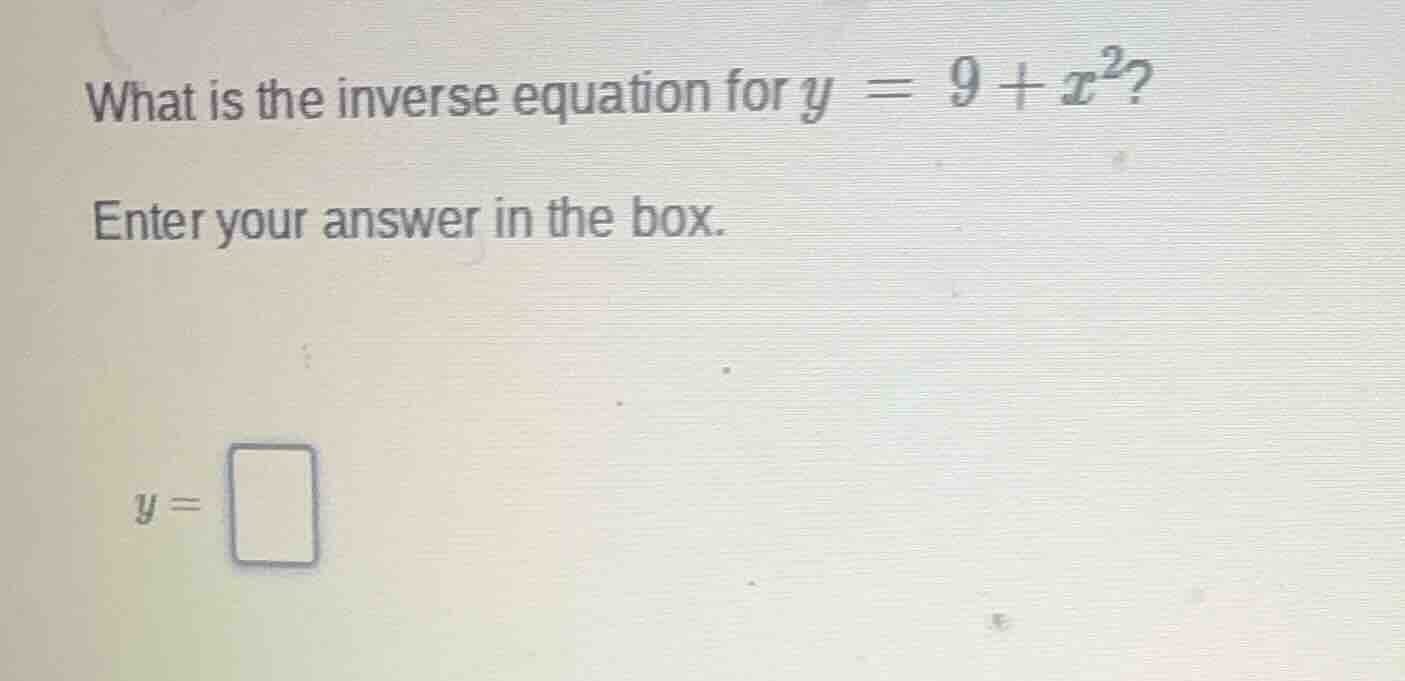
what is the inverse equation for $y = 9 + x^2$?
enter your answer in the box.
$y = \square$
Step1: Swap x and y
To find the inverse of a function, we first swap the roles of \( x \) and \( y \) in the original equation. The original equation is \( y = 9 + x^2 \), so after swapping, we get \( x = 9 + y^2 \).
Step2: Solve for y
Next, we solve the new equation for \( y \). Subtract 9 from both sides: \( x - 9 = y^2 \). Then, take the square root of both sides. Since we are finding the inverse, we consider the positive and negative square roots (assuming we are dealing with the principal square root or the appropriate inverse relation). So \( y=\pm\sqrt{x - 9} \). But we usually express the inverse function (or relation) in terms of \( y \) as the dependent variable. However, we should note that the original function \( y = 9 + x^2 \) is not one - to - one over the entire real number line (it is a parabola opening upwards), but if we restrict the domain (for example, \( x\geq0 \) or \( x\leq0 \)), we can have an inverse function. If we assume we are finding the inverse relation, the equation is \( y=\pm\sqrt{x - 9} \). But if we consider the function with a restricted domain (say \( x\geq0 \) for the original function, then the inverse function would be \( y = \sqrt{x - 9} \); if \( x\leq0 \), it would be \( y=-\sqrt{x - 9} \)). But from the problem's context, we can proceed with the inverse relation.

Snap & solve any problem in the app
Get step-by-step solutions on Sovi AI
Photo-based solutions with guided steps
Explore more problems and detailed explanations
\( \pm\sqrt{x - 9} \) (or if we consider a restricted domain, for example, if the original function has domain \( x\geq0 \), the inverse function is \( \sqrt{x - 9} \); if domain \( x\leq0 \), it is \( -\sqrt{x - 9} \))