QUESTION IMAGE
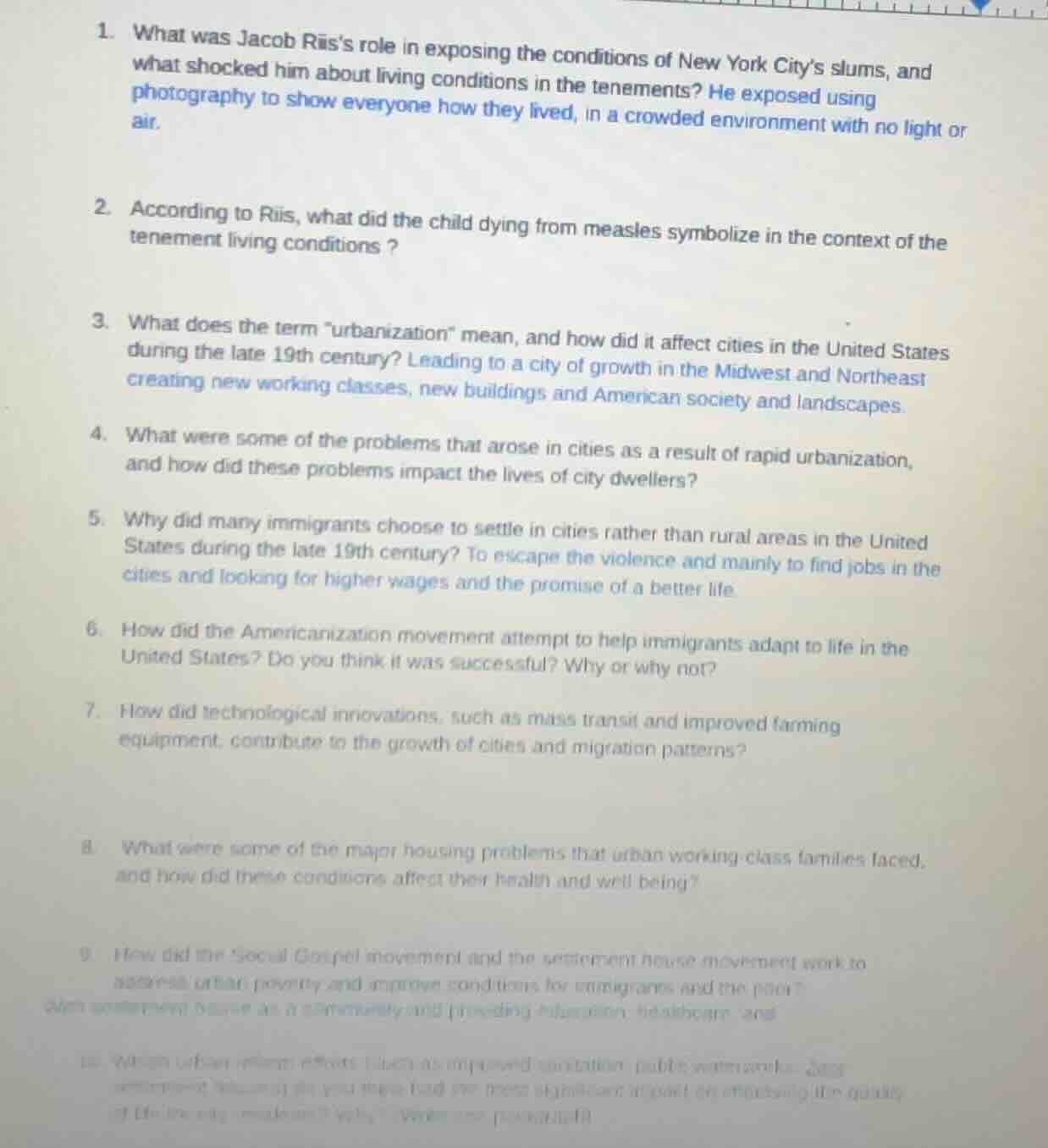
Question
- what was jacob riis’s role in exposing the conditions of new york city’s slums, and what shocked him about living conditions in the tenements? he exposed using photography to show everyone how they lived, in a crowded environment with no light or air.
- according to riis, what did the child dying from measles symbolize in the context of the tenement living conditions?
- what does the term “urbanization” mean, and how did it affect cities in the united states during the late 19th century? leading to a city of growth in the midwest and northeast creating new working classes, new buildings and american society and landscapes.
- what were some of the problems that arose in cities as a result of rapid urbanization, and how did these problems impact the lives of city dwellers?
- why did many immigrants choose to settle in cities rather than rural areas in the united states during the late 19th century? to escape the violence and mainly to find jobs in the cities and looking for higher wages and the promise of a better life.
- how did the americanization movement attempt to help immigrants adapt to life in the united states? do you think it was successful? why or why not?
- how did technological innovations, such as mass transit and improved farming equipment, contribute to the growth of cities and migration patterns?
- what were some of the major housing problems that urban working - class families faced, and how did these conditions affect their health and well - being?
- how did the social gospel movement and the settlement house movement work to address urban poverty and improve conditions for immigrants and the poor? (some content seems incomplete here: “sett... providing education, healthcare, and”)
- which urban reform efforts (such as improved sanitation, public waterworks, etc.) do you think had the most significant impact on improving the quality of life for city residents? why? explain your perspective.
Question 2
In the context of tenement living conditions, the child dying from measles symbolized the dire health consequences of overcrowded, unsanitary, and neglected urban slum environments. Tenements had poor ventilation, lack of clean water, and close quarters, which facilitated the spread of infectious diseases like measles. The child’s death represented the vulnerability of the poor, especially children, to preventable illnesses due to inadequate living conditions, highlighting the broader social and economic inequalities of the time.
Urbanization means the growth of cities as people move from rural to urban areas. In the late 19th - century US, it led to rapid city growth (especially Midwest/Northeast), created new working - class populations, spurred construction of new buildings, and transformed American society and landscapes (e.g., rise of industrial cities, changes in social structures).
Problems from rapid urbanization included overcrowding (tenements, poor living space), unsanitary conditions (no clean water, poor sewage, spread of disease), lack of public services (inadequate transit, schools, police), and crime. These impacted city dwellers by causing high disease rates, poor health, unsafe living, limited access to services, and economic struggles (low wages, job competition).

Snap & solve any problem in the app
Get step-by-step solutions on Sovi AI
Photo-based solutions with guided steps
Explore more problems and detailed explanations
The child dying from measles symbolized the dire health consequences of unsanitary, overcrowded tenement living conditions, representing the vulnerability of the poor (especially children) to preventable diseases due to neglectful urban slum environments and highlighting social/economic inequalities.