QUESTION IMAGE
Question
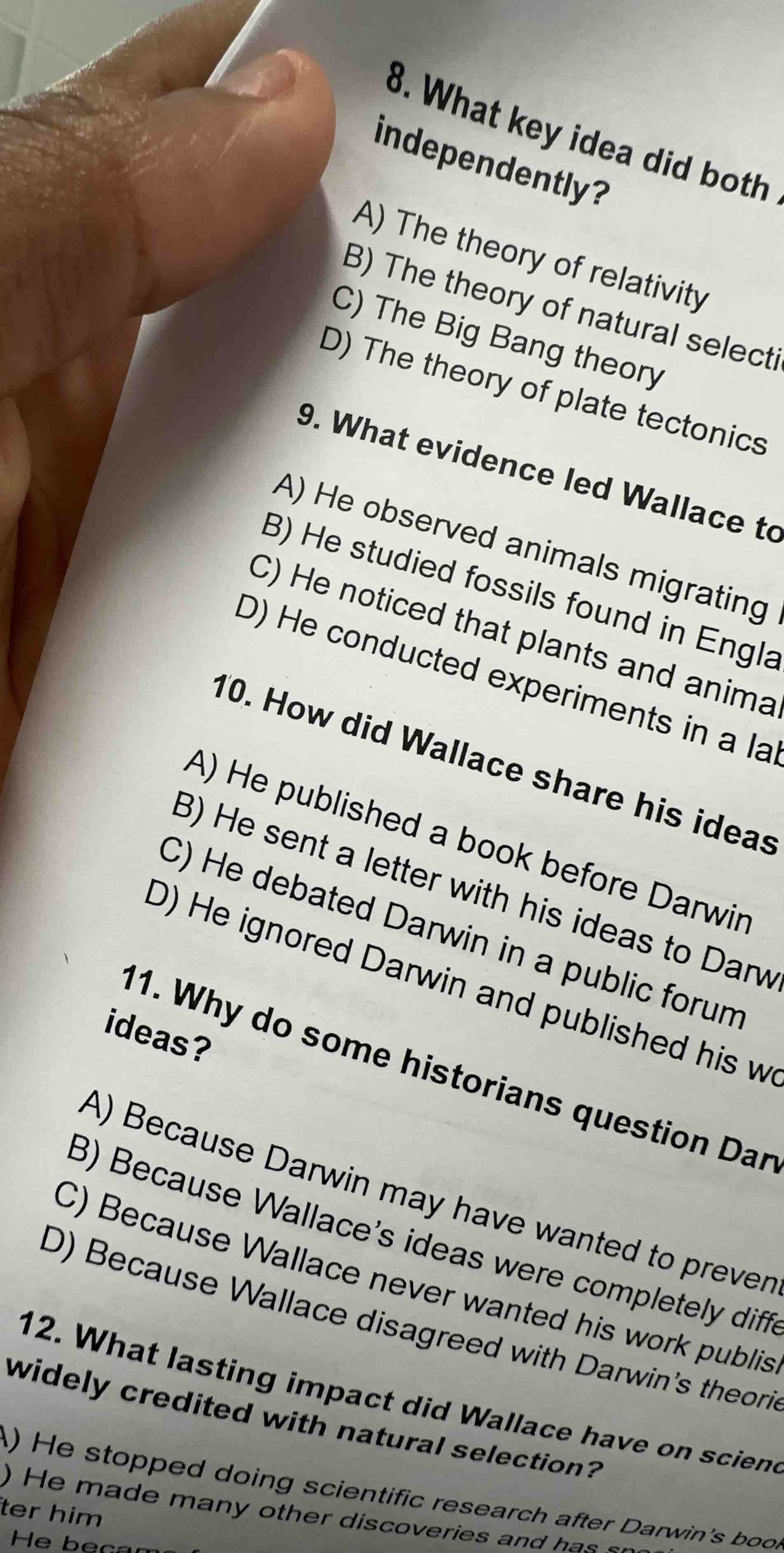
- what key idea did both independently?
a) the theory of relativity
b) the theory of natural selecti
c) the big bang theory
d) the theory of plate tectonics
- what evidence led wallace to
a) he observed animals migrating
b) he studied fossils found in engla
c) he noticed that plants and anima
d) he conducted experiments in a lab
- how did wallace share his ideas
a) he published a book before darwin
b) he sent a letter with his ideas to darw
c) he debated darwin in a public forum
d) he ignored darwin and published his wo
- why do some historians question dar ideas?
a) because darwin may have wanted to prevent
b) because wallace’s ideas were completely diffe
c) because wallace never wanted his work publis
d) because wallace disagreed with darwin’s theorie
- what lasting impact did wallace have on scienc widely credited with natural selection?
a) he stopped doing scientific research after darwin’s book
b) he made many other discoveries and has sp after him
Question 8
The key idea that both Darwin and Wallace independently developed is the theory of natural selection. The theory of relativity is by Einstein, the Big Bang theory is about the origin of the universe, and the theory of plate tectonics is about Earth's crust movement. So the correct option is related to natural selection.
Wallace was influenced by his observations of plants and animals (biogeographical observations) across different regions. Studying fossils in England, observing animal migration (in a limited sense not as key), or lab experiments (Wallace did fieldwork) are not the main evidence. His key evidence came from noticing patterns in plants and animals' distribution and characteristics.
Wallace shared his ideas by sending a letter with his ideas to Darwin. He did not publish a book before Darwin, debate in public, or ignore Darwin. The letter led to the joint presentation of their ideas on natural selection.

Snap & solve any problem in the app
Get step-by-step solutions on Sovi AI
Photo-based solutions with guided steps
Explore more problems and detailed explanations
B. The theory of natural selection