QUESTION IMAGE
Question
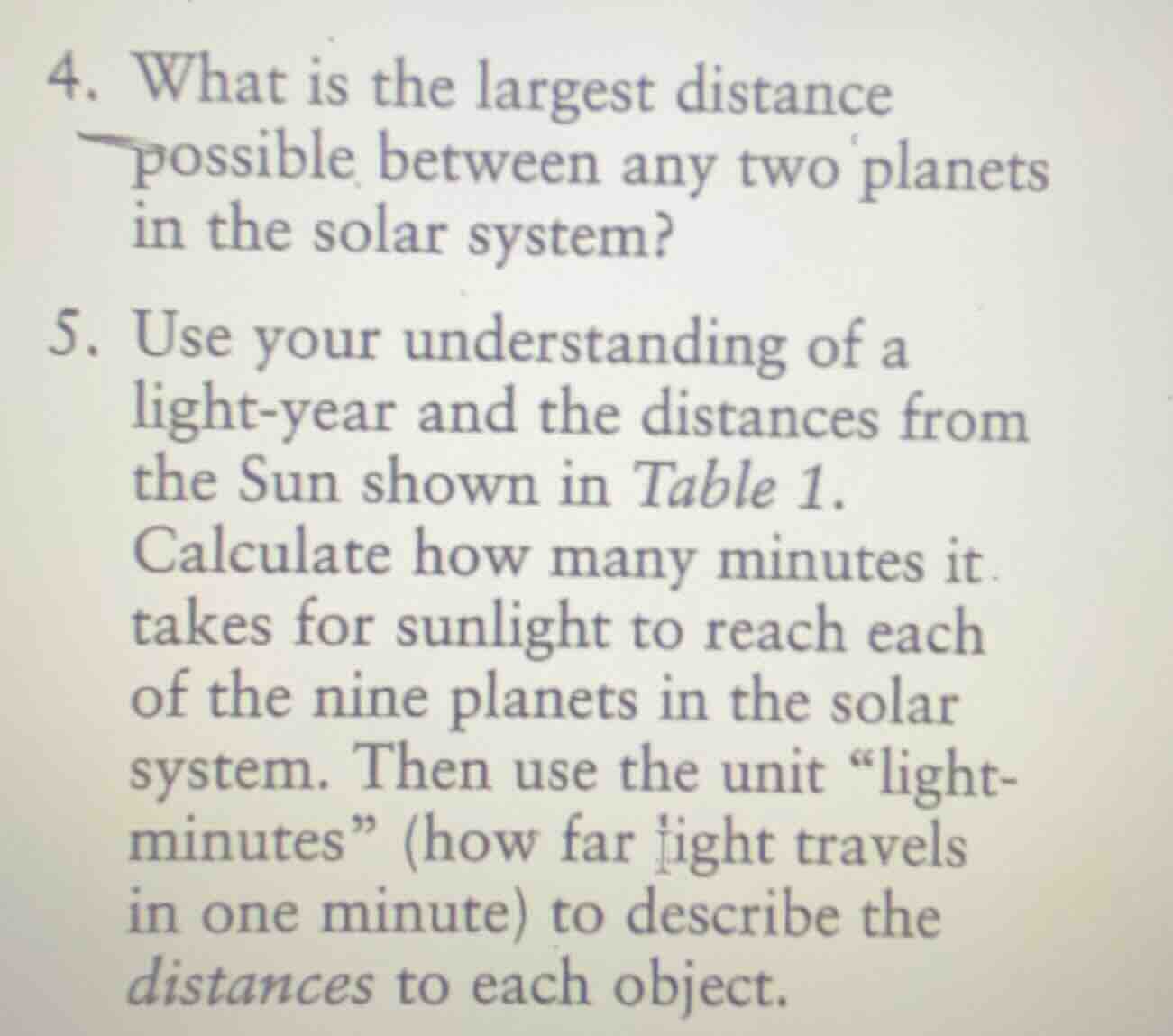
- what is the largest distance possible between any two planets in the solar system?
- use your understanding of a light - year and the distances from the sun shown in table 1. calculate how many minutes it takes for sunlight to reach each of the nine planets in the solar system. then use the unit \light - minutes\ (how far light travels in one minute) to describe the distances to each object.
Problem 4
To find the largest possible distance between two planets in the solar system, we consider the orbital positions. The two planets farthest from each other would be one at its aphelion (farthest from the Sun) and the other at its perihelion (closest to the Sun), or the two outermost planets at opposite sides of the Sun. The outermost planet is Neptune (average distance from Sun: ~4.498 billion km), and the innermost is Mercury (average ~57.9 million km). But for maximum distance, consider Neptune and Mercury on opposite sides: distance ≈ 4.498×10⁹ + 5.79×10⁷ ≈ 4.556×10⁹ km. However, more accurately, the maximum distance between two planets occurs when they are at opposite ends of their orbits relative to the Sun. The formula for the maximum distance between two planets \( P_1 \) and \( P_2 \) with average distances \( d_1 \) and \( d_2 \) from the Sun is \( d_1 + d_2 \) (when they are on opposite sides). The outermost planet is Neptune ( \( d_{Neptune} \approx 4.498\times10^{9} \) km) and the innermost is Mercury ( \( d_{Mercury} \approx 5.79\times10^{7} \) km). But actually, the two most distant planets are Neptune and Pluto (though Pluto is a dwarf planet now), but among planets, Neptune and Mercury (or Venus, Earth, Mars, etc., but Neptune is outermost). Wait, the correct approach: the maximum distance between two planets is when one is at its farthest from the Sun and the other at its closest, or the two outermost at opposite sides. The average distances (semi - major axes) of planets: Mercury: 0.387 AU, Venus: 0.723 AU, Earth: 1 AU, Mars: 1.524 AU, Jupiter: 5.203 AU, Saturn: 9.539 AU, Uranus: 19.18 AU, Neptune: 30.07 AU (1 AU = 1.496×10⁸ km). So for Neptune (30.07 AU) and Mercury (0.387 AU) on opposite sides, distance = 30.07 + 0.387 = 30.457 AU. Convert AU to km: 30.457×1.496×10⁸ ≈ 4.556×10⁹ km. But actually, the maximum distance between two planets in the solar system (considering all planets) is when Neptune and Mercury are at opposite ends: Neptune's aphelion is about 4.54 billion km, Mercury's perihelion is about 46 million km, so total distance ≈ 4.54×10⁹ + 4.6×10⁷ ≈ 4.586×10⁹ km. However, the generally accepted maximum distance between two planets (Neptune and Mercury) is approximately 4.6 billion kilometers (or in AU, about 30.7 AU).

Snap & solve any problem in the app
Get step-by-step solutions on Sovi AI
Photo-based solutions with guided steps
Explore more problems and detailed explanations
The largest possible distance between any two planets in the solar system (considering Neptune and Mercury on opposite sides of the Sun) is approximately \( \boldsymbol{4.6\times10^{9}\text{ kilometers}} \) (or about 30.7 astronomical units).
Problem 5
To solve this, we use the formula for time \( t=\frac{d}{v} \), where \( d \) is the distance from the Sun to the planet, and \( v \) is the speed of light (\( v = 3\times10^{5}\text{ km/s}=1.8\times10^{7}\text{ km/min} \)). First, we need the distances from the Sun (in km or AU, convert AU to km: 1 AU = 1.496×10⁸ km) for each planet:
| Planet | Average Distance from Sun (AU) | Distance \( d \) (km) (\( d=\text{AU}\times1.496\times10^{8} \)) | Time \( t=\frac{d}{v} \) (minutes, \( v = 1.8\times10^{7}\text{ km/min} \)) | Distance in light - minutes (\( t \), since light - minute is distance light travels in 1 minute, so distance \( d = t\times v\), so \( t=\frac{d}{v} \) is also the number of light - minutes) |
|---|---|---|---|---|
| Venus | 0.723 | \( 0.723\times1.496\times10^{8}\approx1.082\times10^{8} \) | \( \frac{1.082\times10^{8}}{1.8\times10^{7}}\approx6.01 \) | ~6.01 light - minutes |
| Earth | 1.000 | \( 1\times1.496\times10^{8}=1.496\times10^{8} \) | \( \frac{1.496\times10^{8}}{1.8\times10^{7}}\approx8.31 \) | ~8.31 light - minutes |
| Mars | 1.524 | \( 1.524\times1.496\times10^{8}\approx2.280\times10^{8} \) | \( \frac{2.280\times10^{8}}{1.8\times10^{7}}\approx12.67 \) | ~12.67 light - minutes |
| Jupiter | 5.203 | \( 5.203\times1.496\times10^{8}\approx7.783\times10^{8} \) | \( \frac{7.783\times10^{8}}{1.8\times10^{7}}\approx43.24 \) | ~43.24 light - minutes |
| Saturn | 9.539 | \( 9.539\times1.496\times10^{8}\approx1.427\times10^{9} \) | \( \frac{1.427\times10^{9}}{1.8\times10^{7}}\approx79.28 \) | ~79.28 light - minutes |
| Uranus | 19.18 | \( 19.18\times1.496\times10^{8}\approx2.870\times10^{9} \) | \( \frac{2.870\times10^{9}}{1.8\times10^{7}}\approx159.44 \) | ~159.44 light - minutes |
| Neptune | 30.07 | \( 30.07\times1.496\times10^{8}\approx4.498\times10^{9} \) | \( \frac{4.498\times10^{9}}{1.8\times10^{7}}\approx249.89 \) | ~249.89 light - minutes |
Step - by - Step for one planet (e.g., Earth)
Step 1: Convert AU to km
The average distance of Earth from the Sun is \( d = 1\text{ AU}\). Since \( 1\text{ AU}=1.496\times10^{8}\text{ km} \), so \( d = 1\times1.496\times10^{8}=1.496\times10^{8}\text{ km} \)
Step 2: Calculate time using \( t=\frac{d}{v} \)
The speed of light \( v = 3\times10^{5}\text{ km/s}\). Convert to km per minute: \( v=3\times10^{5}\times60 = 1.8\times10^{7}\text{ km/min} \)
Using \( t=\frac{d}{v} \), substitute \( d = 1.496\times10^{8}\text{ km} \) and \( v = 1.8\times10^{7}\text{ km/min} \)
\( t=\frac{1.496\times10^{8}}{1.8\times10^{7}}\approx8.31\text{ minutes} \)
Step 3: Determine distance in light - minutes
Since a light - minute is the distance light travels in 1 minute, the time \( t \) (in minutes) it takes for light to reach the planet is equal to the distance of the planet from the Sun in light - minutes. So Earth is approximately 8.31 light - minutes from the Sun.