QUESTION IMAGE
Question
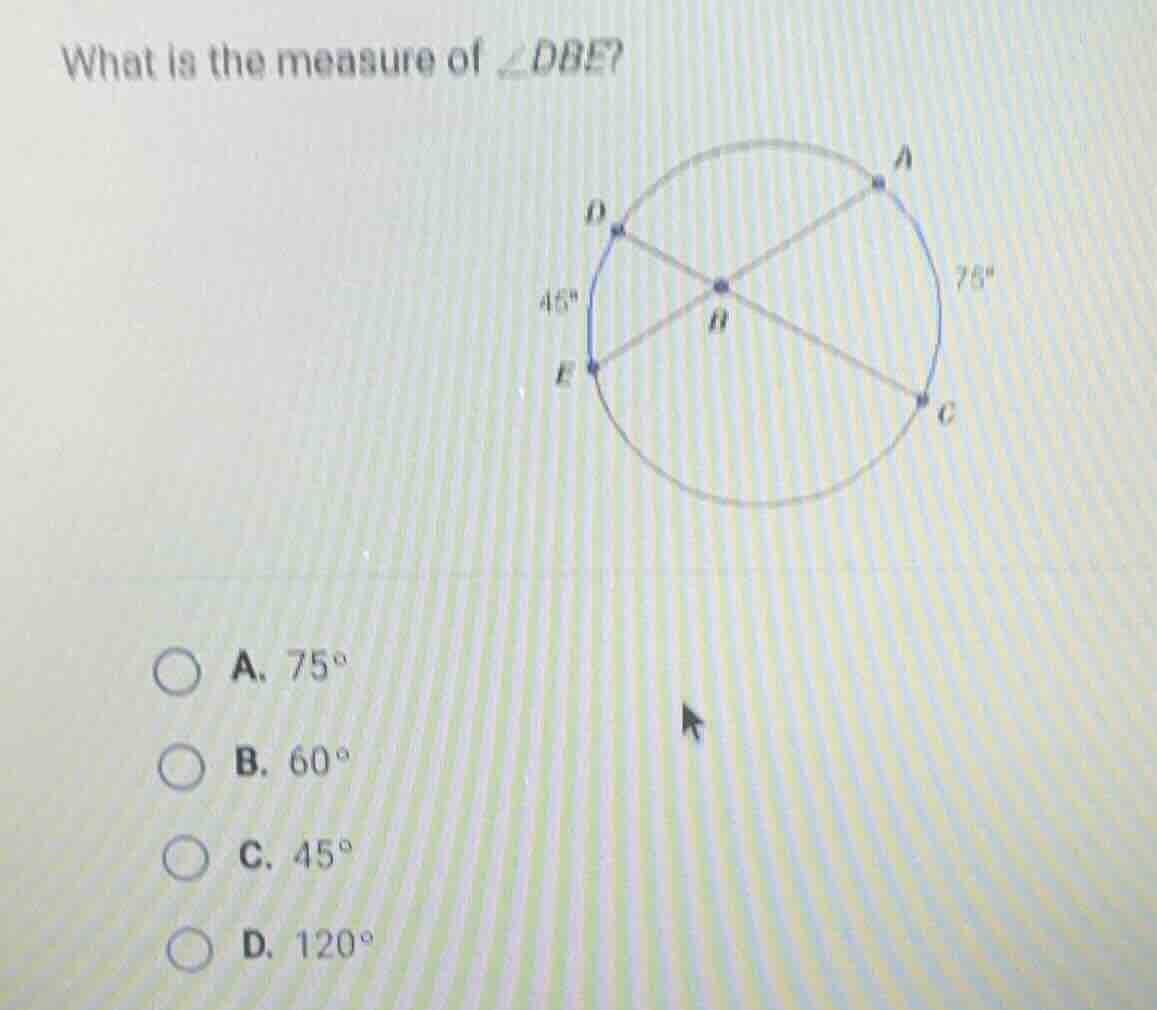
what is the measure of \\(\angle dbe\\)? \\(\circ\\) a. \\(75^\circ\\) \\(\circ\\) b. \\(60^\circ\\) \\(\circ\\) c. \\(45^\circ\\) \\(\circ\\) d. \\(120^\circ\\)
Step1: Recall circle angle properties
In a circle, the measure of a central angle is equal to the measure of its intercepted arc. Also, vertical angles are equal, and the sum of arcs around a circle is \(360^\circ\), but here we can use the fact that \(\angle DBE\) is a central angle intercepting arc \(DE\). Wait, no, wait—wait, actually, first, let's check the arcs. Wait, the arc \(DE\) is given as \(45^\circ\)? Wait, no, maybe I misread. Wait, the diagram: points \(D\), \(E\), \(A\), \(C\) on the circle, center \(B\). So \( \angle DBE \) is a central angle, so its measure is equal to the measure of arc \(DE\). Wait, but let's check the other arcs. Wait, arc \(AC\) is \(75^\circ\), so its vertical angle arc \(DE\)? No, wait, vertical angles: \(\angle ABC\) and \(\angle DBE\) are vertical? Wait, no, maybe not. Wait, actually, the arc \(DE\) is labeled \(45^\circ\)? Wait, the problem shows arc \(DE\) as \(45^\circ\)? Wait, no, the user's diagram: "45°" next to arc \(DE\), and "75°" next to arc \(AC\). Wait, no, maybe I made a mistake. Wait, no—wait, the central angle \(\angle DBE\) intercepts arc \(DE\), so if arc \(DE\) is \(45^\circ\)? No, that can't be, because the options don't match. Wait, maybe I misread. Wait, no, let's re-express. Wait, the sum of arcs: arc \(DE\) (45°), arc \(EA\), arc \(AC\) (75°), arc \(CD\). But actually, \(\angle DBE\) is a central angle, so its measure is equal to the measure of arc \(DE\). Wait, but the options have 45° as option C. Wait, maybe the arc \(DE\) is 45°, so \(\angle DBE\) is 45°? Wait, but let's check again. Wait, the diagram: \(B\) is the center, so \(DB\), \(EB\), \(AB\), \(CB\) are radii. So \(\angle DBE\) is a central angle, so its measure is equal to the measure of arc \(DE\). The arc \(DE\) is labeled 45°, so \(\angle DBE = 45^\circ\). Wait, but let's confirm. Alternatively, maybe vertical angles: \(\angle ABC\) and \(\angle DBE\) are vertical? No, \(\angle ABC\) intercepts arc \(AC\) (75°), so \(\angle ABC = 75^\circ\), then \(\angle DBE\) would be equal to \(\angle ABC\) if vertical? No, that's not right. Wait, no, maybe I messed up. Wait, the sum of arcs: arc \(DE\) (45°), arc \(EA\), arc \(AC\) (75°), arc \(CD\). The total around the circle is \(360^\circ\), but maybe \(\angle DBE\) is equal to arc \(DE\). Wait, the problem's diagram: "45°" is next to arc \(DE\), so the central angle \(\angle DBE\) (with vertex at \(B\), sides \(DB\) and \(EB\)) intercepts arc \(DE\), so its measure is equal to arc \(DE\), which is \(45^\circ\). So the answer should be 45°, option C.
Wait, but let's check again. Maybe I made a mistake. Wait, the options: A.75, B.60, C.45, D.120. So if arc DE is 45°, then central angle DBE is 45°, so option C.
Step2: Confirm central angle - arc relationship
The measure of a central angle is equal to the measure of its intercepted arc. Since \(\angle DBE\) is a central angle intercepting arc \(DE\), and arc \(DE\) is \(45^\circ\), then \(m\angle DBE = 45^\circ\).

Snap & solve any problem in the app
Get step-by-step solutions on Sovi AI
Photo-based solutions with guided steps
Explore more problems and detailed explanations
C. \(45^\circ\)