QUESTION IMAGE
Question
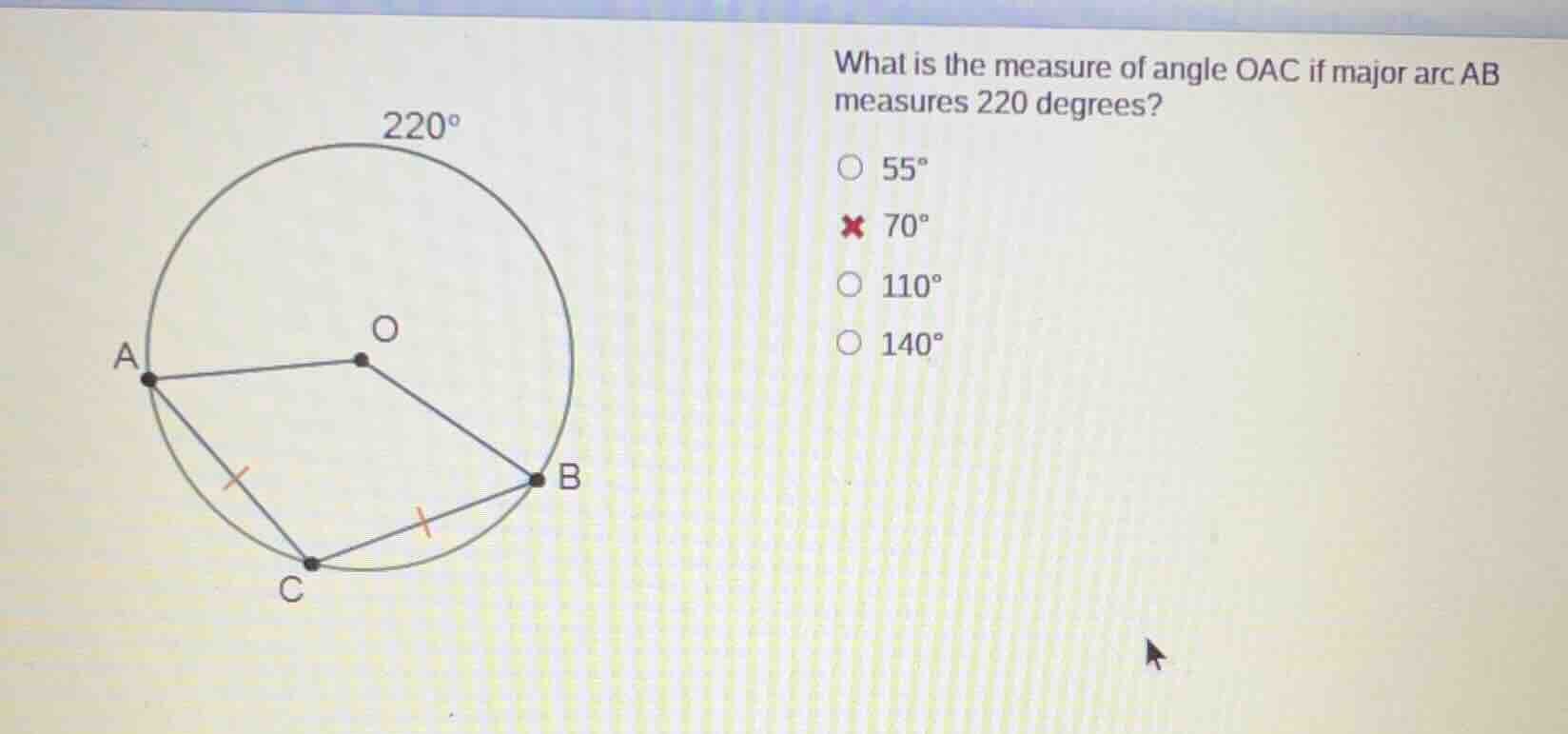
what is the measure of angle oac if major arc ab measures 220 degrees?
55°
70°
110°
140°
Step1: Find minor arc AB
The total degrees in a circle is \(360^\circ\). Given major arc AB is \(220^\circ\), so minor arc AB is \(360^\circ - 220^\circ = 140^\circ\).
Step2: Find central angle AOB
The central angle AOB is equal to the measure of minor arc AB, so \(\angle AOB = 140^\circ\).
Step3: Analyze triangle OAC and OBC
OA and OB are radii, so OA = OB. Also, AC = BC (marked with ticks), and OC is common. So triangle OAC ≅ triangle OBC (SSS congruence).
Step4: Find angle OAC
In triangle OAC, OA = OC (radii), so it's isosceles. The central angle AOB is \(140^\circ\), so the angle at O for triangle OAC: since OC bisects the angle between OA and OB? Wait, no. Wait, the inscribed angle or the angle at A. Wait, OA and OC are radii, so OA = OC. The angle AOC: since major arc AB is \(220^\circ\), the arc ACB? Wait, maybe better: the central angle for minor arc AB is \(140^\circ\), so the angle AOB is \(140^\circ\). Then, since AC = BC, point C is on the perpendicular bisector of AB, so OC bisects angle AOB? Wait, no, maybe the triangle OAC: OA = OC, so it's isosceles. The angle at O: angle AOC. Wait, the total around O: 360, but maybe we can find angle OAC.
Wait, another approach: The measure of an inscribed angle is half the central angle. But angle OAC: OA is radius, AC is a chord. Wait, OA and OC are radii, so triangle OAC is isosceles with OA = OC. The central angle for arc AC: wait, major arc AB is \(220^\circ\), so minor arc AB is \(140^\circ\), so the remaining arc (AC + CB) is \(360 - 220 = 140^\circ\)? No, wait, arc AB is \(140^\circ\) (minor), so arc AC and arc CB: since AC = BC, arc AC = arc CB. So arc AC = arc CB = \(\frac{360 - 220}{2} = 70^\circ\)? Wait, no, major arc AB is \(220^\circ\), so minor arc AB is \(140^\circ\), so the other two arcs (AC and CB) sum to \(360 - 220 = 140^\circ\), and since AC = BC, each is \(70^\circ\). Then, the central angle for arc AC is \(70^\circ\), so in triangle OAC, OA = OC (radii), so angle OAC = angle OCA. The central angle AOC is \(70^\circ\), so the base angles: (180 - 70)/2 = 55? Wait, no, that's not right. Wait, maybe I messed up.
Wait, major arc AB is \(220^\circ\), so minor arc AB is \(360 - 220 = 140^\circ\). The central angle for minor arc AB is \(140^\circ\) (angle AOB). Now, AC = BC, so triangle ABC is isosceles with AC = BC. OA = OB = OC (radii). So triangle OAC and OBC are congruent (SSS: OA=OB, AC=BC, OC=OC). So angle OAC = angle OBC. Now, in triangle OAB, OA=OB, so it's isosceles with angle OAB = angle OBA. The angle at O is \(140^\circ\), so angle OAB = (180 - 140)/2 = 20? No, that can't be. Wait, I think I made a mistake.
Wait, let's start over. The total degrees in a circle: \(360^\circ\). Major arc AB is \(220^\circ\), so minor arc AB is \(360 - 220 = 140^\circ\). The central angle corresponding to minor arc AB is \(\angle AOB = 140^\circ\). Now, OA and OC are radii, so OA = OC. AC = BC (given, marked with ticks), so triangle OAC ≅ triangle OBC (SSS: OA=OB, AC=BC, OC=OC). Therefore, \(\angle AOC = \angle BOC\). Since \(\angle AOB = 140^\circ\), then \(\angle AOC + \angle BOC = 360^\circ - 140^\circ = 220^\circ\)? No, that's not right. Wait, no, \(\angle AOB\) is \(140^\circ\), so the remaining angle around O is \(360 - 140 = 220^\circ\), but since triangle OAC ≅ triangle OBC, \(\angle AOC = \angle BOC = \frac{360 - 140}{2} = 110^\circ\)? Wait, that can't be. I'm confused.
Wait, maybe the angle OAC: OA is radius, AC is a chord. The measure of angle OAC: in triangle OAC, OA = OC (radii), so it's isosceles. The central angle for arc AC: if major arc AB is…

Snap & solve any problem in the app
Get step-by-step solutions on Sovi AI
Photo-based solutions with guided steps
Explore more problems and detailed explanations
\(55^\circ\)