QUESTION IMAGE
Question
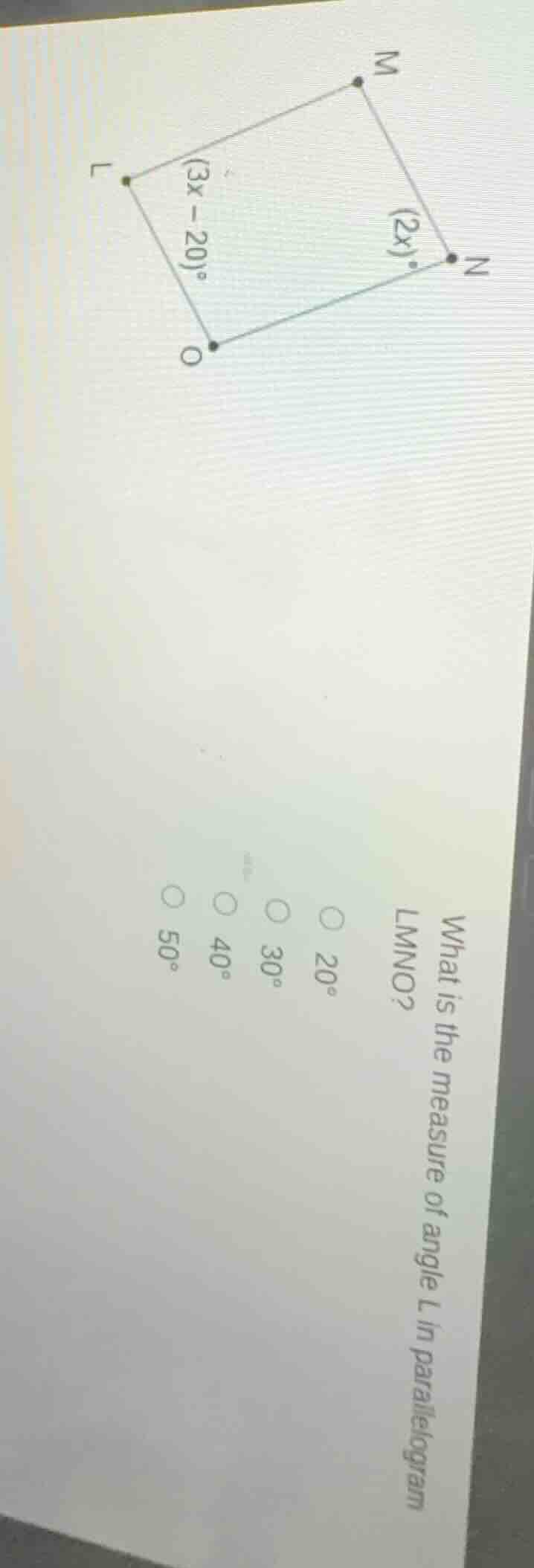
what is the measure of angle l in parallelogram lmno?
options: 20° 30° 40° 50°
(in the parallelogram lmno, angle at n is (2x)°, angle at l is (3x - 20)°)
Step1: Recall parallelogram angle property
In a parallelogram, consecutive angles are supplementary (sum to \(180^\circ\))? Wait, no, actually in a parallelogram, adjacent angles are supplementary? Wait, no, in a parallelogram, opposite angles are equal, and consecutive angles are supplementary. Wait, looking at the diagram, angle at N is \(2x\) and angle at L is \(3x - 20\). Wait, maybe in parallelogram LMNO, angle N and angle L are consecutive? Wait, no, in a parallelogram, consecutive angles are supplementary. Wait, maybe angle N and angle L are same - side interior angles? Wait, actually, in a parallelogram, adjacent angles are supplementary. Wait, maybe the correct property is that consecutive angles in a parallelogram are supplementary. Wait, let's re - examine. The parallelogram is LMNO, so sides LM is parallel to ON, and LN (wait, no, the vertices are L, M, N, O. So LM is parallel to ON, and LO is parallel to MN. So angle at N (\(2x\)) and angle at L (\(3x - 20\)): are they consecutive angles? Wait, maybe they are same - side interior angles, so they should be supplementary? Wait, no, maybe opposite angles? Wait, no, in a parallelogram, opposite angles are equal. Wait, maybe I made a mistake. Wait, the problem is about parallelogram LMNO. Let's assume that angle N and angle L are consecutive angles, so they are supplementary? Wait, no, maybe angle N and angle L are same - side interior angles, so \(2x+(3x - 20)=180\)? Wait, no, that would be if they are consecutive. Wait, but maybe the correct property is that in a parallelogram, consecutive angles are supplementary. Wait, let's solve.
Wait, maybe the angles at N and L are consecutive angles, so \(2x+(3x - 20)=180\)? Wait, no, let's check the answer options. The answer options are 20, 30, 40, 50. Let's try another approach. Maybe the angles at N and L are equal? Wait, no, that would be opposite angles. Wait, maybe I misread the diagram. Wait, the diagram shows angle at N is \(2x\) and angle at L is \(3x - 20\). Let's assume that they are same - side interior angles, so \(2x = 3x - 20\)? Wait, that would give \(x = 20\), then angle N is \(2x=40\), angle L is \(3x - 20 = 40\). Wait, that would mean they are equal, so they are opposite angles. Ah! In a parallelogram, opposite angles are equal. So \(2x=3x - 20\).
Step2: Solve the equation \(2x = 3x - 20\)
Subtract \(2x\) from both sides: \(0=x - 20\)
Add 20 to both sides: \(x = 20\)
Step3: Find the measure of angle L
Now, angle L is \(3x - 20\). Substitute \(x = 20\) into \(3x - 20\): \(3\times20-20=60 - 20 = 40\)? Wait, no, wait, if \(x = 20\), then angle N is \(2x = 40\), and angle L is \(3x - 20=40\). Wait, but the question is "What is the measure of angle L in parallelogram LMNO?". Wait, maybe I made a mistake in the property. Wait, let's check again. If opposite angles in a parallelogram are equal, then \(2x=3x - 20\), so \(x = 20\), then angle L is \(3x - 20=3\times20 - 20 = 40\).

Snap & solve any problem in the app
Get step-by-step solutions on Sovi AI
Photo-based solutions with guided steps
Explore more problems and detailed explanations
\(40^\circ\)