QUESTION IMAGE
Question
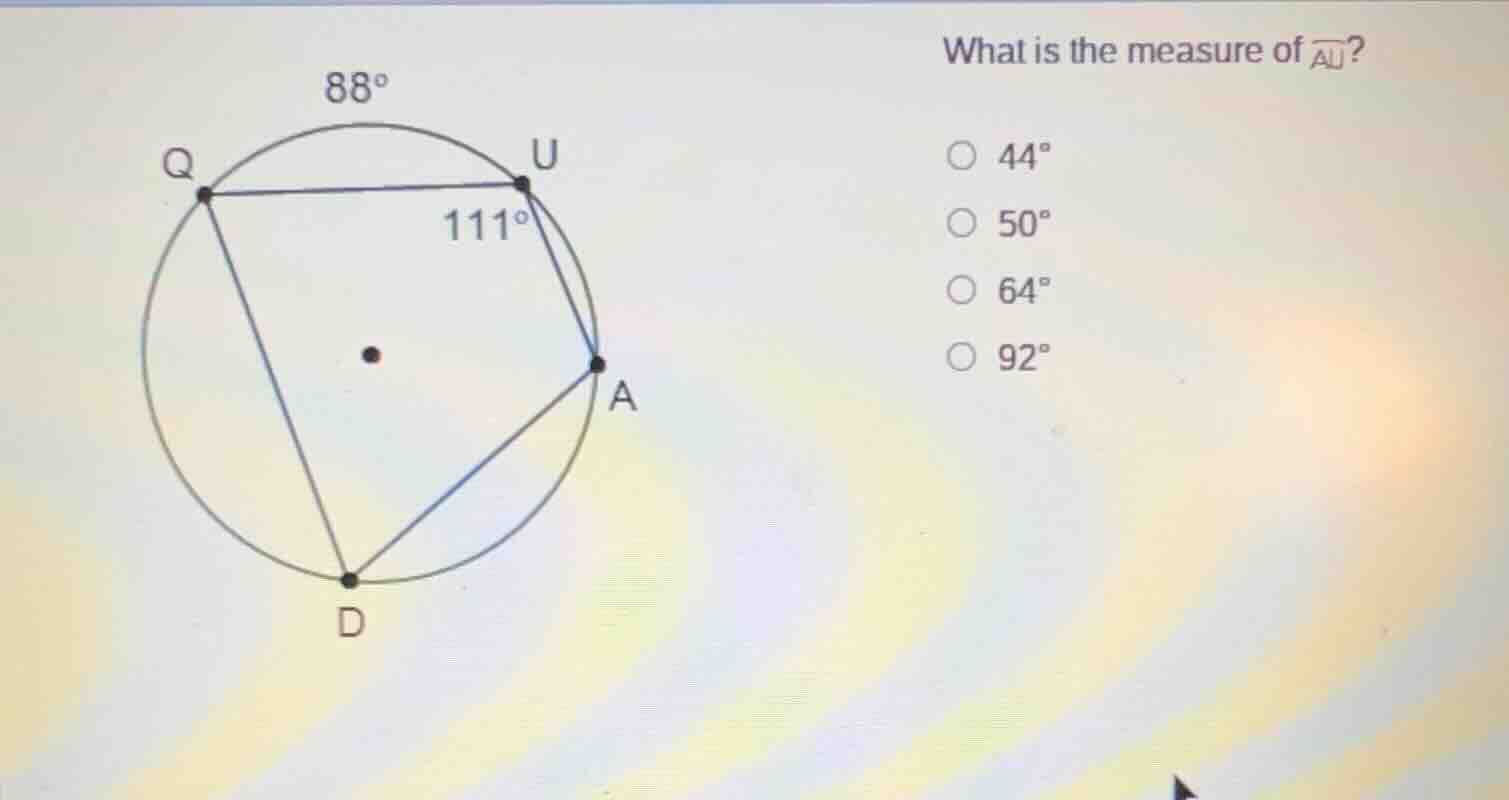
what is the measure of \\(\widehat{au}\\)? \\(\bigcirc\\) \\(44^{\circ}\\) \\(\bigcirc\\) \\(50^{\circ}\\) \\(\bigcirc\\) \\(64^{\circ}\\) \\(\bigcirc\\) \\(92^{\circ}\\) (with a circle diagram having points q, u, a, d; arc qu is 88°, angle at u is 111°)
Step1: Recall the property of a cyclic quadrilateral (or the total degrees in a circle)
The sum of the measures of the arcs in a circle is \(360^\circ\). Also, in a cyclic quadrilateral, the sum of opposite angles is \(180^\circ\), but here we can use the fact that the sum of all arcs should be \(360^\circ\). Wait, actually, the inscribed angle or the arc measures: Wait, the given angle at \(U\) is \(111^\circ\), and the arc \(QU\) is \(88^\circ\). Wait, maybe we can use the property that the sum of the measures of the arcs corresponding to the angles in a cyclic quadrilateral? Wait, no, let's think again.
Wait, the total circumference (in terms of degrees) is \(360^\circ\). Let's denote the arc \(AU\) as \(x\), arc \(AD\) as something, but maybe we can use the fact that in a cyclic quadrilateral, the sum of the measures of the arcs between the vertices should add up to \(360^\circ\). Wait, the arc \(QU\) is \(88^\circ\), the angle at \(U\) is \(111^\circ\), but maybe we need to find the arc \(AU\). Wait, another approach: The sum of the measures of the arcs in a circle is \(360^\circ\). Let's assume that the quadrilateral \(QUAD\) is cyclic (since all points are on the circle). Then, the measure of an inscribed angle is half the measure of its intercepted arc. Wait, the angle at \(U\) is \(111^\circ\), which is an inscribed angle? Wait, no, the angle at \(U\) is formed by chords \(UQ\) and \(UA\), so the inscribed angle at \(U\) intercepts arc \(QA\). Wait, maybe I made a mistake. Let's try to find the arc \(AU\).
Wait, the arc \(QU\) is \(88^\circ\). Let's denote arc \(AU = x\), arc \(AD = y\), arc \(DQ = z\). Then \(88 + x + y + z = 360\). Also, the angle at \(U\) is \(111^\circ\), which is an inscribed angle intercepting arc \(QD\) (since in a cyclic quadrilateral, the angle is half the measure of the opposite arc). Wait, in a cyclic quadrilateral, the measure of an angle is half the measure of the arc opposite to it. So angle at \(U\) (\(111^\circ\)) intercepts arc \(QD\), so arc \(QD = 2 \times 111^\circ = 222^\circ\)? Wait, no, that can't be, because \(222 + 88 = 310\), and then \(x + y = 50\), but that doesn't match. Wait, maybe the angle at \(U\) is not an inscribed angle but a central angle? No, the center is marked, but the angle at \(U\) is a vertex of the quadrilateral on the circle. Wait, maybe I messed up. Let's try again.
Wait, the arc \(QU\) is \(88^\circ\). Let's find the arc opposite to the angle at \(U\). In a cyclic quadrilateral, the sum of a pair of opposite angles is \(180^\circ\). So angle at \(U\) is \(111^\circ\), so the angle at \(D\) should be \(180 - 111 = 69^\circ\). But maybe that's not helpful. Wait, the total of all arcs is \(360^\circ\). Let's assume that the arc \(QU\) is \(88^\circ\), and we need to find arc \(AU\). Wait, maybe the angle at \(U\) is related to the arc \(QD\). Wait, the inscribed angle theorem: the measure of an inscribed angle is half the measure of its intercepted arc. So if angle at \(U\) is \(111^\circ\), then the arc \(QD\) (which is opposite to angle \(U\)) is \(2 \times 111 = 222^\circ\). Then, the remaining arcs \(QU\) and \(AU + AD\)? Wait, no, arc \(QU\) is \(88^\circ\), arc \(QD\) is \(222^\circ\), so the remaining arcs \(AU + AD\) would be \(360 - 88 - 222 = 50^\circ\)? No, that doesn't make sense. Wait, maybe the arc \(AU\) is \(64^\circ\)? Wait, no, let's check the answer options. The options are \(44^\circ\), \(50^\circ\), \(64^\circ\), \(92^\circ\). Wait, maybe I made a mistake in the approach. Let's try another way.
Wait, the sum of the measures of the arcs…

Snap & solve any problem in the app
Get step-by-step solutions on Sovi AI
Photo-based solutions with guided steps
Explore more problems and detailed explanations
\(50^\circ\)