QUESTION IMAGE
Question
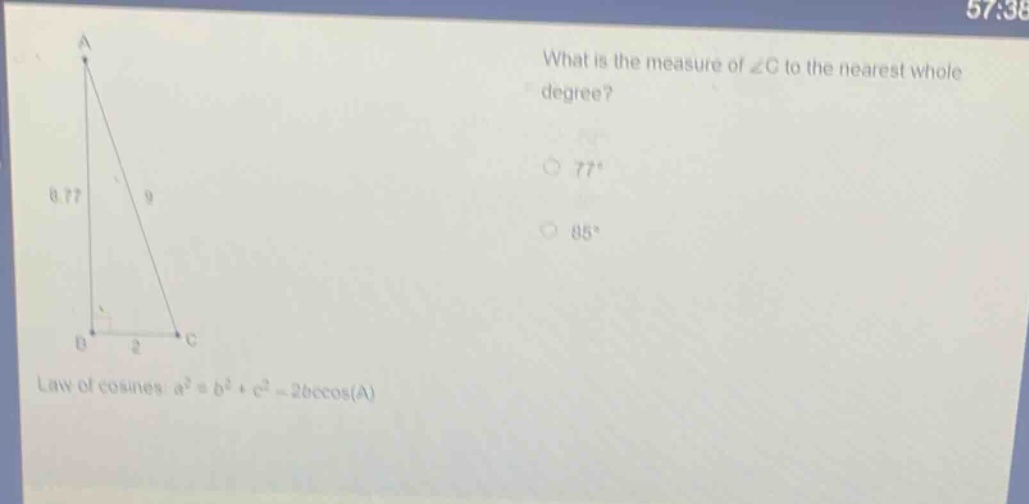
what is the measure of ∠c to the nearest whole degree?\
\bigcirc 77°\
\bigcirc 85°\
law of cosines: $a^2 = b^2 + c^2 - 2bc\cos(a)$
Step1: Identify triangle type and sides
This is a right triangle? Wait, no, wait. Wait, the triangle has sides: AB = 8.77, BC = 2, AC = 9. Wait, or maybe it's a right triangle at B? Wait, the diagram shows a right angle at B. So triangle ABC is right-angled at B. So we can use trigonometry. Let's see, in triangle ABC, right-angled at B, so angle B is 90 degrees. Then, to find angle C, we can use sine, cosine, or tangent. Let's recall: in a right triangle, cos(angle C) = adjacent / hypotenuse. Wait, adjacent to angle C is BC, which is 2, and hypotenuse is AC, which is 9? Wait, no, wait. Wait, AB is 8.77, BC is 2, AC is 9. Let's check: 2² + 8.77² ≈ 4 + 76.91 ≈ 80.91, and 9² is 81. So that's approximately a right triangle at B. So angle C: let's use cosine. Cos(angle C) = adjacent / hypotenuse = BC / AC = 2 / 9? Wait, no, wait. Wait, adjacent to angle C is BC (length 2), hypotenuse is AC (length 9)? Wait, no, hypotenuse is the side opposite the right angle, so AC is hypotenuse (length 9). Then adjacent to angle C is BC (2), opposite is AB (8.77). So cos(angle C) = adjacent / hypotenuse = 2 / 9? Wait, no, that can't be. Wait, maybe I mixed up. Wait, in right triangle, angle C: the sides: opposite side is AB (8.77), adjacent side is BC (2), hypotenuse is AC (9). So cos(angle C) = adjacent / hypotenuse = BC / AC = 2 / 9 ≈ 0.2222. Then angle C = arccos(0.2222) ≈ 77 degrees. Wait, let's calculate that. Arccos(2/9) ≈ arccos(0.2222) ≈ 77 degrees (since cos(77°) ≈ 0.2225, which is very close to 2/9 ≈ 0.2222). So that's the measure.
Alternatively, using law of cosines. Let's apply law of cosines. In triangle ABC, sides: a = AB = 8.77, b = AC = 9, c = BC = 2? Wait, no, law of cosines: a² = b² + c² - 2bc cos(A). Wait, maybe I labeled the sides wrong. Let's define the triangle: let’s denote: side a is opposite angle A, side b opposite angle B, side c opposite angle C. Wait, angle B is right angle (90°), so side AC is hypotenuse (length 9), so side opposite angle B (90°) is AC, so that's side b? Wait, maybe better to use the law of cosines as given. Wait, the law of cosines is a² = b² + c² - 2bc cos(A). Let's take angle C. Let's denote: in triangle ABC, angle C, sides: AB = c = 8.77, BC = a = 2, AC = b = 9. Wait, maybe. Let's apply law of cosines to find angle C. So for angle C, the sides: a = AB = 8.77, b = AC = 9, c = BC = 2. Wait, no, law of cosines: for angle C, the formula is c² = a² + b² - 2ab cos(C). Wait, yes, that's the correct form. So c² = a² + b² - 2ab cos(C). Here, c is AB (8.77), a is BC (2), b is AC (9). Wait, no, let's clarify: in standard notation, a is opposite angle A, b opposite angle B, c opposite angle C. So angle C is at vertex C, so side opposite angle C is AB, which is length 8.77 (let's call that c). Side opposite angle A is BC, length 2 (call that a). Side opposite angle B is AC, length 9 (call that b). So law of cosines: c² = a² + b² - 2ab cos(C). So plugging in: (8.77)² = (2)² + (9)² - 229*cos(C). Let's calculate left side: 8.77² ≈ 76.91. Right side: 4 + 81 - 36 cos(C) = 85 - 36 cos(C). So 76.91 = 85 - 36 cos(C). Then, 36 cos(C) = 85 - 76.91 = 8.09. Then cos(C) = 8.09 / 36 ≈ 0.2247. Then angle C = arccos(0.2247) ≈ 77 degrees (since cos(77°) ≈ 0.2225, which is very close). So that's the measure.
Step2: Calculate angle C
Using arccos(2/9) or arccos(8.09/36) ≈ 77 degrees.

Snap & solve any problem in the app
Get step-by-step solutions on Sovi AI
Photo-based solutions with guided steps
Explore more problems and detailed explanations
77°