QUESTION IMAGE
Question
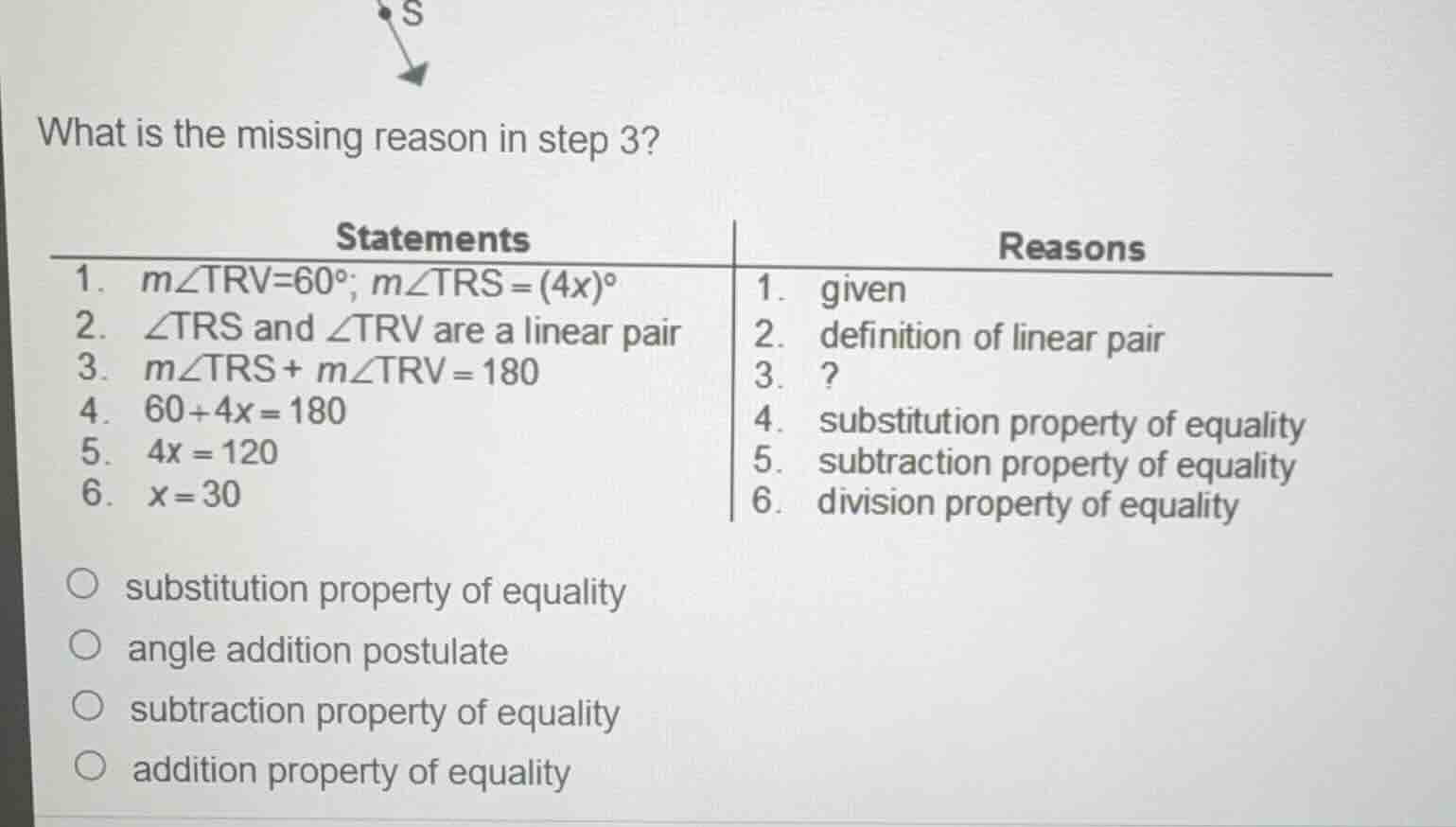
what is the missing reason in step 3?
statements
- $m\angle trv=60^\circ$; $m\angle trs=(4x)^\circ$
- $\angle trs$ and $\angle trv$ are a linear pair
- $m\angle trs + m\angle trv = 180$
- $60+4x=180$
- $4x = 120$
- $x=30$
reasons
- given
- definition of linear pair
- ?
- substitution property of equality
- subtraction property of equality
- division property of equality
$circ$ substitution property of equality
$circ$ angle addition postulate
$circ$ subtraction property of equality
$circ$ addition property of equality
Step 3 states that the sum of the measures of a linear pair of angles is 180°. This comes from the angle addition postulate, which defines that two adjacent angles forming a linear pair combine to form a straight angle (180°). The other options do not fit: substitution replaces values, subtraction/equality properties modify equations, not define angle sums for linear pairs.

Snap & solve any problem in the app
Get step-by-step solutions on Sovi AI
Photo-based solutions with guided steps
Explore more problems and detailed explanations
angle addition postulate