QUESTION IMAGE
Question
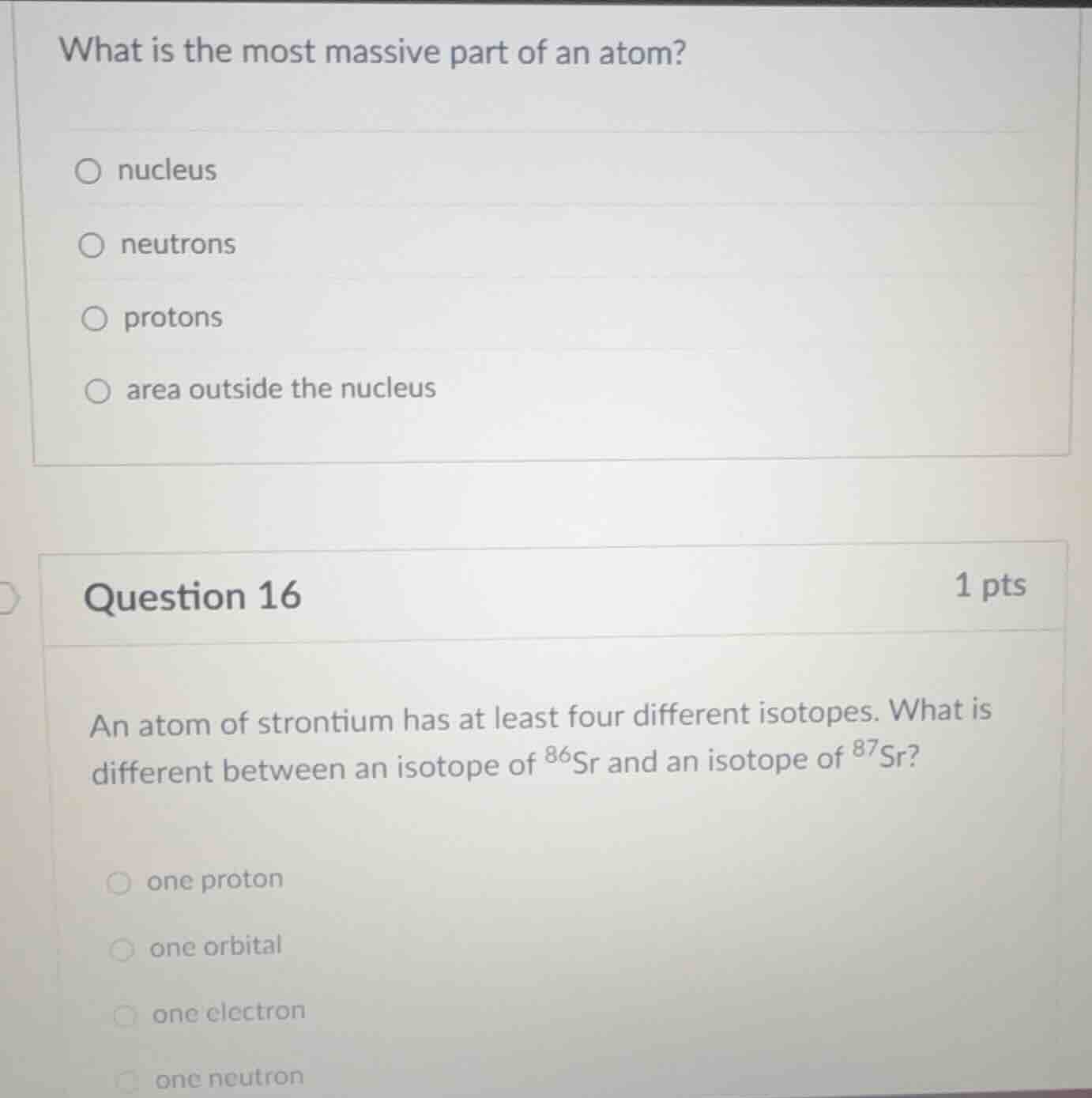
what is the most massive part of an atom?
○ nucleus
○ neutrons
○ protons
○ area outside the nucleus
question 16
1 pts
an atom of strontium has at least four different isotopes. what is different between an isotope of $^{86}$sr and an isotope of $^{87}$sr?
○ one proton
○ one orbital
○ one electron
○ one neutron
First Question (What is the most massive part of an atom?)
An atom consists of a nucleus (containing protons and neutrons) and electrons outside the nucleus. Electrons have negligible mass compared to protons and neutrons. The nucleus contains protons and neutrons, which have most of the atom's mass. Neutrons and protons are part of the nucleus, so the nucleus is the most massive part as it contains these massive particles.
Isotopes of an element have the same number of protons (same atomic number) but different mass numbers. The mass number is the sum of protons and neutrons. For \(^{86}\text{Sr}\) and \(^{87}\text{Sr}\), the atomic number of strontium is constant (so same number of protons). The difference in mass number (87 - 86 = 1) comes from a difference in the number of neutrons (since mass number = protons + neutrons, and protons are same). Protons, orbitals, and electrons don't differ between isotopes of the same element in this way.

Snap & solve any problem in the app
Get step-by-step solutions on Sovi AI
Photo-based solutions with guided steps
Explore more problems and detailed explanations
A. nucleus