QUESTION IMAGE
Question
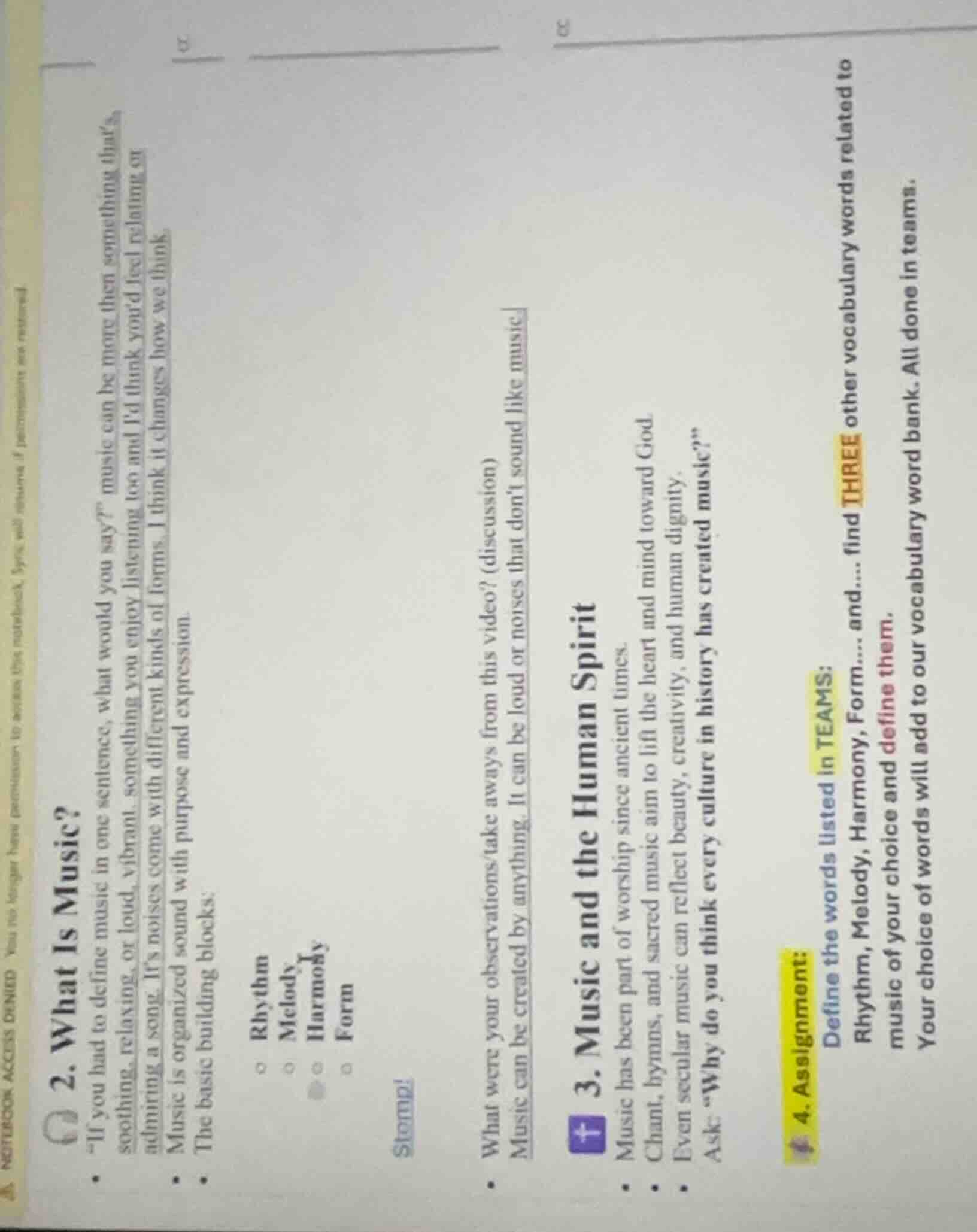
- what is music?
- if you had to define music in one sentence, what would you say? music can be more then something thats soothing, relaxing, or loud, vibrant, something you enjoy listening too and id think youd feel relating or admiring a song. its noises come with different kinds of forms, i think it changes how we think music is organized sound with purpose and expression.
the basic building blocks.
rhythm
melody
harmony
form
stompl
what were your observations take aways from this video? (discussion)
music can be created by anything. it can be loud or noises that dont sound like music
- music and the human spirit
music has been part of worship since ancient times.
chant, hymns, and sacred music aim to lift the heart and mind toward god.
even secular music can reflect beauty, creativity, and human dignity.
ask \why do you think every culture in history has created music?\
- assignment:
define the words listed in teams:
define the words listed in teams: and.... find three other vocabulary words related to rhythm, melody, harmony, form.... and.... find three other vocabulary words related to music of your choice and define them.
your choice of words will add to our vocabulary word bank. all done in teams.
For Question 2:
Combines the core traits of organized sound, emotional resonance, and structure into a single definition.
For Question 3:
Music is a universal human creation because it serves cross-cultural, emotional, and functional needs: it connects communities in worship, expresses shared human experiences (beauty, creativity, dignity), and acts as a timeless medium for cultural identity and emotional release across all eras.
For Assignment 4:
- Rhythm: The patterned arrangement of beats, rests, and tempo that gives music its sense of movement.
- Melody: A sequence of single musical notes that form a recognizable, coherent musical line.
- Harmony: The combination of simultaneous musical notes or chords that support and complement a melody.
- Form: The overall structural framework that organizes the sections of a piece of music (e.g., verse-chorus).
- Timbre: The unique quality of a sound that distinguishes different instruments or voices (e.g., the warm tone of a cello vs. a piano).
- Dynamics: The variation in volume (loudness or softness) within a piece of music.
- Tempo: The speed at which a piece of music is performed (e.g., fast allegro or slow adagio).

Snap & solve any problem in the app
Get step-by-step solutions on Sovi AI
Photo-based solutions with guided steps
Explore more problems and detailed explanations
Question 2:
Music is organized, purposeful sound in varied forms that shapes emotion and thought.
Question 3:
Every culture in history has created music because it fulfills universal human needs: it fosters spiritual connection, expresses shared beauty, creativity, and dignity, and serves as a timeless medium for cultural identity and emotional expression.
Assignment 4:
- Rhythm: Patterned beats/tempo driving music's movement.
- Melody: Sequenced single notes forming a distinct line.
- Harmony: Simultaneous notes/chords supporting melody.
- Form: Structural framework organizing a music piece.
- Timbre: Unique sound quality of an instrument/voice.
- Dynamics: Volume variation in a musical piece.
- Tempo: Speed of a musical performance.