QUESTION IMAGE
Question
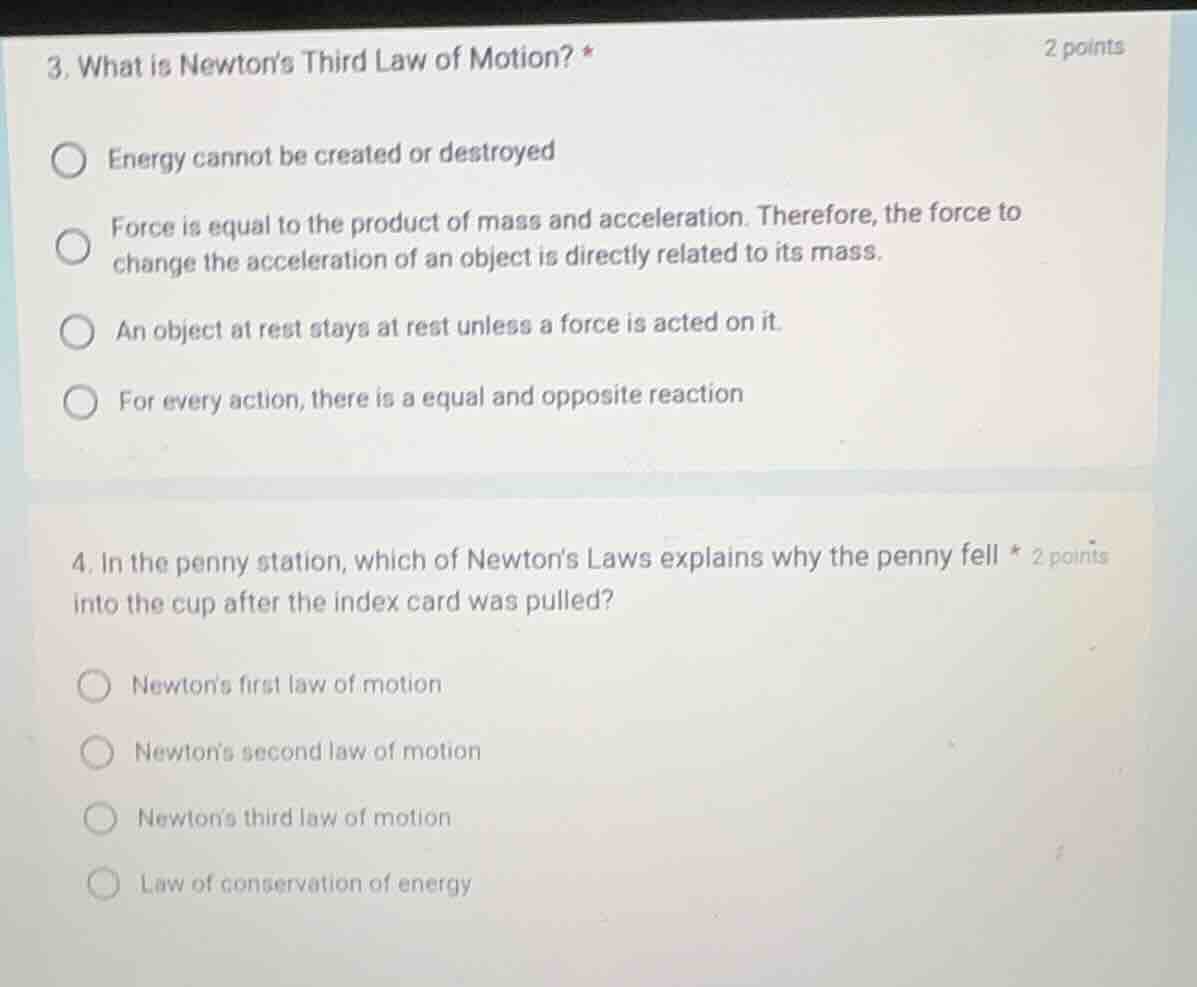
- what is newtons third law of motion? *
energy cannot be created or destroyed
force is equal to the product of mass and acceleration. therefore, the force to change the acceleration of an object is directly related to its mass.
an object at rest stays at rest unless a force is acted on it.
for every action, there is a equal and opposite reaction
- in the penny station, which of newtons laws explains why the penny fell into the cup after the index card was pulled?
newtons first law of motion
newtons second law of motion
newtons third law of motion
law of conservation of energy
Response
Question 3
Brief Explanations
- "Energy cannot be created or destroyed" is the law of conservation of energy, not Newton's third law.
- "Force is equal to the product of mass and acceleration..." is Newton's second law ($F = ma$).
- "An object at rest stays at rest unless a force is acted on it" is Newton's first law (law of inertia).
- "For every action, there is a equal and opposite reaction" is the definition of Newton's third law of motion.
Brief Explanations
- Newton's first law (law of inertia) states that an object at rest stays at rest (and an object in motion stays in motion) unless a net force acts on it. In the penny station experiment, the penny is at rest on the index card. When the card is pulled quickly, the penny tends to stay at rest due to inertia and then falls into the cup (due to gravity, but the initial tendency to stay at rest is explained by the first law).
- Newton's second law is about force, mass, and acceleration ($F = ma$) and does not explain the inertia here.
- Newton's third law is about action - reaction pairs and is not relevant to the inertia of the penny.
- The law of conservation of energy is about energy transformation and not about the motion of the penny in this context.

Snap & solve any problem in the app
Get step-by-step solutions on Sovi AI
Photo-based solutions with guided steps
Explore more problems and detailed explanations
D. For every action, there is a equal and opposite reaction