QUESTION IMAGE
Question
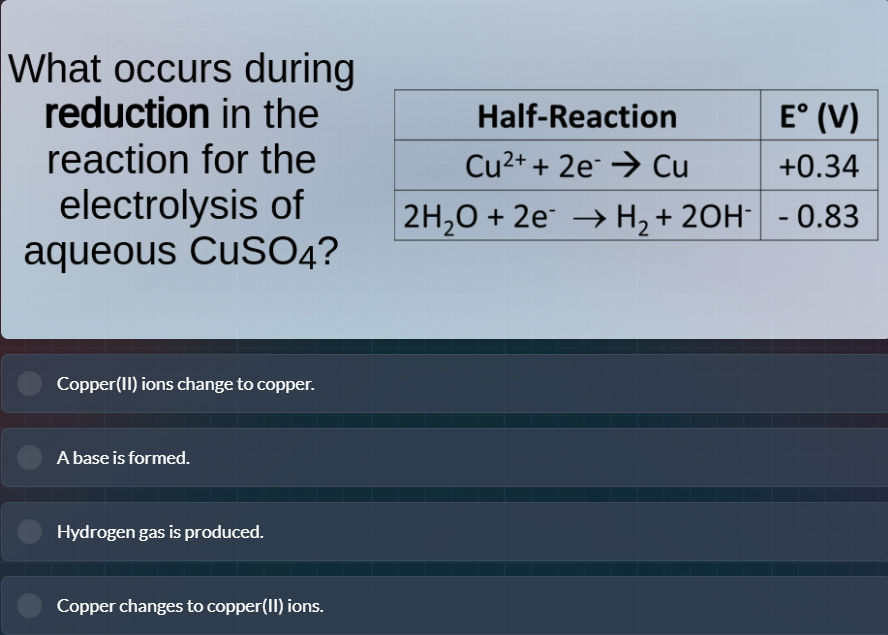
what occurs during reduction in the reaction for the electrolysis of aqueous cuso₄?
half-reaction | e° (v)
cu²⁺ + 2e⁻ → cu | +0.34
2h₂o + 2e⁻ → h₂ + 2oh⁻ | - 0.83
copper(ii) ions change to copper.
a base is formed.
hydrogen gas is produced.
copper changes to copper(ii) ions.
In electrolysis, reduction is the gain of electrons (or decrease in oxidation state). For the electrolysis of aqueous \(CuSO_4\), we compare the standard reduction potentials of the possible half - reactions. The half - reaction \(Cu^{2+}+2e^-\to Cu\) has a more positive \(E^{\circ}( + 0.34\ V)\) compared to \(2H_2O + 2e^-\to H_2+2OH^-\) (\(E^{\circ}=- 0.83\ V\)). A more positive reduction potential means the reaction is more likely to occur as a reduction (gain of electrons). So, \(Cu^{2+}\) ions will gain electrons and be reduced to \(Cu\) (copper metal).
- Option "A base is formed": The reduction of water to form \(H_2\) and \(OH^-\) is less favorable due to its lower \(E^{\circ}\), so base formation is not the main reduction process here.
- Option "Hydrogen gas is produced": The reduction of water to produce \(H_2\) is less favorable than the reduction of \(Cu^{2+}\) because of the lower \(E^{\circ}\) of the water - reduction half - reaction.
- Option "Copper changes to copper(II) ions": This is an oxidation process (loss of electrons), not reduction.

Snap & solve any problem in the app
Get step-by-step solutions on Sovi AI
Photo-based solutions with guided steps
Explore more problems and detailed explanations
Copper(II) ions change to copper.