QUESTION IMAGE
Question
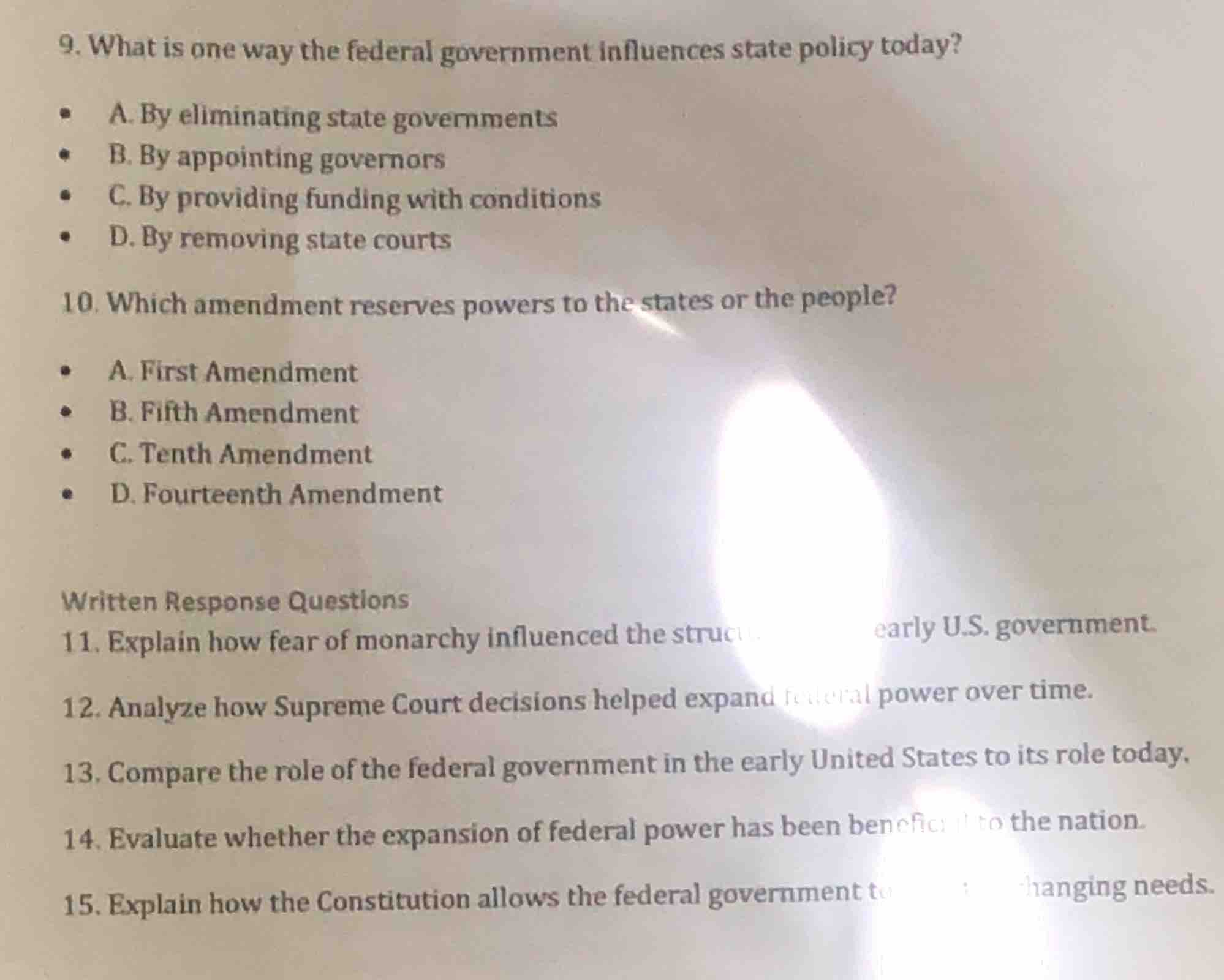
- what is one way the federal government influences state policy today?
a. by eliminating state governments
b. by appointing governors
c. by providing funding with conditions
d. by removing state courts
- which amendment reserves powers to the states or the people?
a. first amendment
b. fifth amendment
c. tenth amendment
d. fourteenth amendment
written response questions
- explain how fear of monarchy influenced the struct early u.s. government.
- analyze how supreme court decisions helped expand federal power over time.
- compare the role of the federal government in the early united states to its role today.
- evaluate whether the expansion of federal power has been beneficial to the nation.
- explain how the constitution allows the federal government to changing needs.
For Question 9:
The U.S. federal system prohibits eliminating state governments, appointing governors, or removing state courts. A key tool for federal influence is attaching conditions to grants (e.g., highway funding tied to drinking age laws).
For Question 10:
The First Amendment protects civil liberties, the Fifth covers due process, the Fourteenth deals with equal protection. The Tenth Amendment explicitly states powers not given to the federal government are reserved for states or the people.
For Question 11:
Fear of monarchy led to a weak central government under the Articles of Confederation first, then the Constitution established a separation of powers (legislative, executive, judicial) and checks and balances to prevent a single ruler from gaining too much authority, plus a republican form of government where officials are elected.
For Question 12:
Supreme Court cases like McCulloch v. Maryland (upheld implied powers of the federal government and supremacy clause) and Gibbons v. Ogden (expanded federal power over interstate commerce) broadened federal authority by interpreting the Constitution to allow federal action beyond explicit powers. Later cases like United States v. Lopez set limits but overall, many rulings expanded federal scope.
For Question 13:
Early U.S. federal government had limited powers, focused on national defense, foreign policy, and interstate commerce, with most governance left to states. Today, the federal government has a much larger role, including social welfare (Social Security, Medicare), economic regulation, environmental protection, and public health, due to expanded interpretations of constitutional powers and national crises.
For Question 14:
The expansion of federal power has been beneficial in many ways: it enabled national solutions to cross-state problems like economic depressions, environmental pollution, and civil rights enforcement. It also created a unified national safety net. However, critics argue it has eroded state autonomy and led to bureaucratic inefficiency, so the benefit depends on balancing national needs with state self-governance.
For Question 15:
The Constitution allows federal adaptation through the elastic clause (Necessary and Proper Clause), which lets Congress pass laws needed to execute its explicit powers. Additionally, the amendment process allows formal changes, and Supreme Court interpretations of the Constitution (like expanding the commerce clause) let the federal government address new issues such as technology regulation, climate change, and national public health emergencies.

Snap & solve any problem in the app
Get step-by-step solutions on Sovi AI
Photo-based solutions with guided steps
Explore more problems and detailed explanations
- C. By providing funding with conditions
- C. Tenth Amendment
- Fear of monarchy led to the U.S. Constitution's separation of powers, checks and balances, and a republican form of government, designed to prevent the concentration of power held by monarchs; initially, the Articles of Confederation created an extremely weak central government as a reaction to royal authority.
- Supreme Court decisions expanded federal power through rulings like McCulloch v. Maryland (upholding implied federal powers and federal supremacy) and Gibbons v. Ogden (broadening federal control over interstate commerce), interpreting the Constitution to allow federal action beyond its explicit text.
- Early U.S. federal government had narrow powers (focused on defense, foreign policy, interstate commerce) with most governance left to states; today, it has an expanded role including social welfare, economic regulation, environmental protection, and public health, driven by constitutional interpretation and national needs.
- The expansion of federal power has been largely beneficial: it enabled national solutions to cross-state crises (e.g., the Great Depression, civil rights), created a unified safety net, and addressed shared national challenges. However, it has also raised concerns about reduced state autonomy and bureaucratic overreach, so its benefit relies on balancing national and state interests.
- The Constitution allows federal adaptation via the Necessary and Proper (elastic) Clause, which lets Congress pass laws to execute its explicit powers; formal amendments; and evolving Supreme Court interpretations that expand federal authority to address new national needs, such as technological, environmental, and public health issues.