QUESTION IMAGE
Question
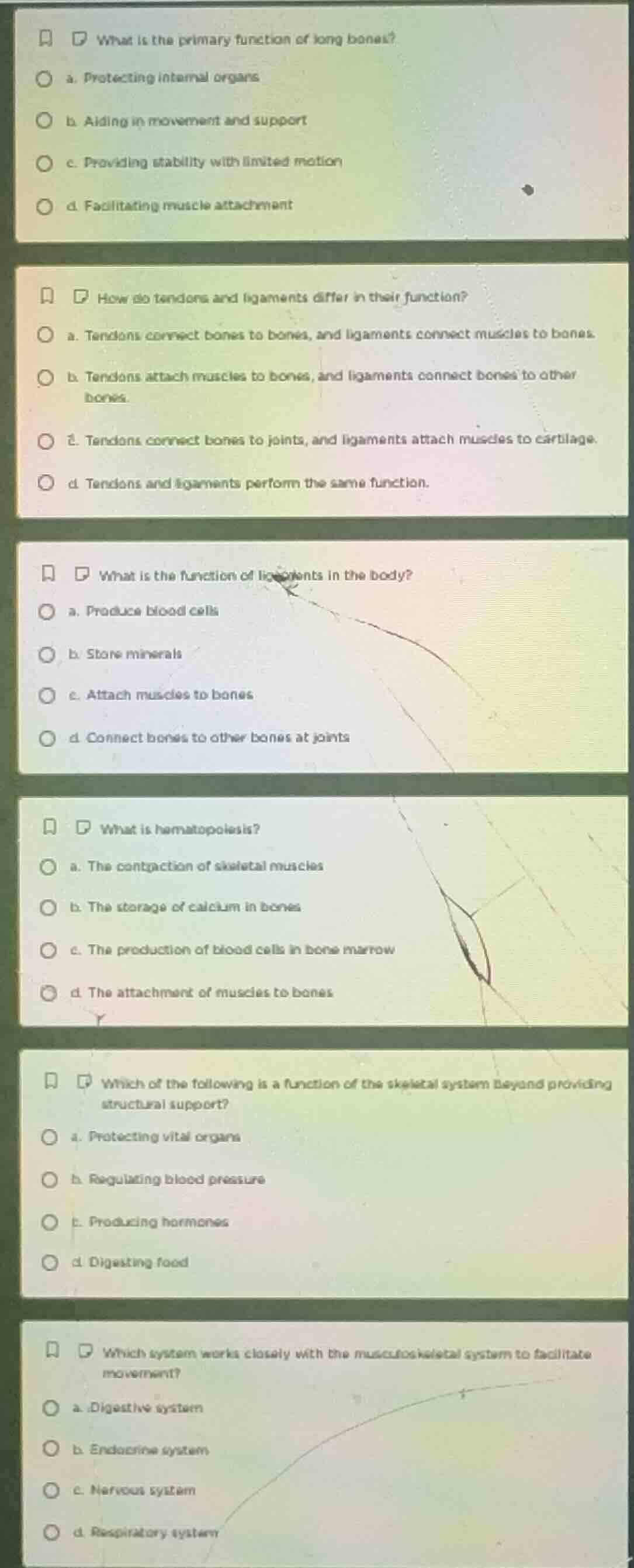
what is the primary function of long bones?
a. protecting internal organs
b. aiding in movement and support
c. providing stability with limited motion
d. facilitating muscle attachment
how do tendons and ligaments differ in their function?
a. tendons connect bones to bones, and ligaments connect muscles to bones.
b. tendons attach muscles to bones, and ligaments connect bones to other bones.
c. tendons connect bones to joints, and ligaments attach muscles to cartilage.
d. tendons and ligaments perform the same function.
what is the function of ligaments in the body?
a. produce blood cells
b. store minerals
c. attach muscles to bones
d. connect bones to other bones at joints
what is hematopoiesis?
a. the contraction of skeletal muscles
b. the storage of calcium in bones
c. the production of blood cells in bone marrow
d. the attachment of muscles to bones
which of the following is a function of the skeletal system beyond providing structural support?
a. protecting vital organs
b. regulating blood pressure
c. producing hormones
d. digesting food
which system works closely with the musculoskeletal system to facilitate movement?
a. digestive system
b. endocrine system
c. nervous system
d. respiratory system
- Long bones (e.g., femur, humerus) act as levers for muscles, enabling movement, and provide structural support for the body.
- Tendons are fibrous tissues that link skeletal muscles to bones, while ligaments connect bone to bone to stabilize joints.
- Ligaments are specialized connective tissues that anchor bones together at joints to maintain stability and guide movement.
- Hematopoiesis is the process of forming new blood cells (red blood cells, white blood cells, platelets) which occurs in the red bone marrow of bones.
- Beyond structural support, the skeletal system encloses and protects vital organs (e.g., skull protects the brain, ribcage protects the heart and lungs).
- The nervous system sends signals to skeletal muscles, which contract and pull on bones to initiate movement, working closely with the musculoskeletal system.

Snap & solve any problem in the app
Get step-by-step solutions on Sovi AI
Photo-based solutions with guided steps
Explore more problems and detailed explanations
- b. Aiding in movement and support
- b. Tendons attach muscles to bones, and ligaments connect bones to other bones.
- d. Connect bones to other bones at joints
- c. The production of blood cells in bone marrow
- a. Protecting vital organs
- c. Nervous system