QUESTION IMAGE
Question
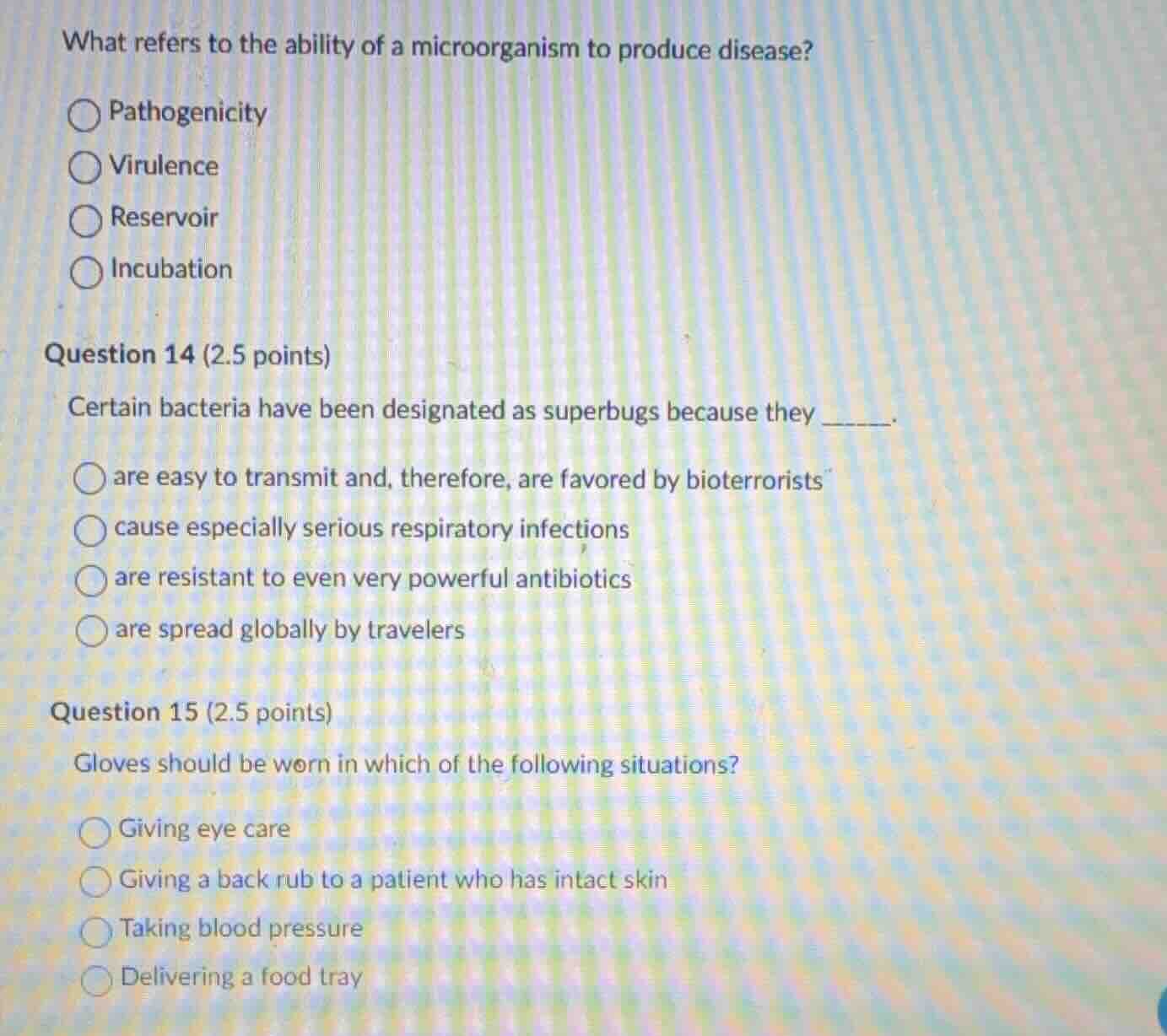
what refers to the ability of a microorganism to produce disease?
pathogenicity
virulence
reservoir
incubation
question 14 (2.5 points)
certain bacteria have been designated as superbugs because they ______.
are easy to transmit and, therefore, are favored by bioterrorists
cause especially serious respiratory infections
are resistant to even very powerful antibiotics
are spread globally by travelers
question 15 (2.5 points)
gloves should be worn in which of the following situations?
giving eye care
giving a back rub to a patient who has intact skin
taking blood pressure
delivering a food tray
Question (First one: What refers to the ability of a microorganism to produce disease?)
- Pathogenicity is defined as the ability of a microorganism to cause disease. Virulence refers to the degree of pathogenicity (how severe the disease is). A reservoir is a source of the microorganism, and incubation is the period before symptoms appear. So the correct term for the ability to produce disease is pathogenicity.
- Superbugs are bacteria that have developed resistance to multiple antibiotics, including very powerful ones. Being easy to transmit for bioterrorism, causing serious respiratory infections, or being spread by travelers are not the defining characteristics of superbugs. Their key trait is antibiotic resistance.
- Gloves are worn to prevent contact with bodily fluids or potential pathogens. Giving eye care may involve contact with eye secretions, so gloves are necessary. Giving a back rub to a patient with intact skin, taking blood pressure, or delivering a food tray do not typically require gloves as there's no direct contact with bodily fluids or high-risk exposure.

Snap & solve any problem in the app
Get step-by-step solutions on Sovi AI
Photo-based solutions with guided steps
Explore more problems and detailed explanations
A. Pathogenicity