QUESTION IMAGE
Question
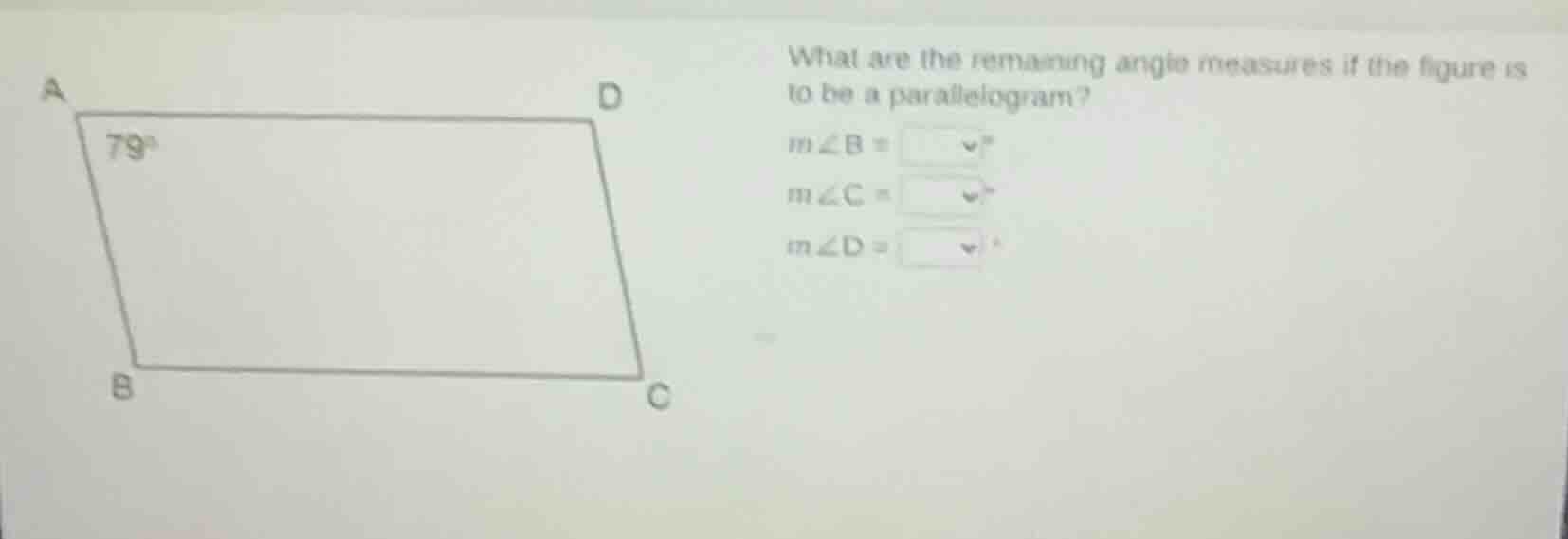
what are the remaining angle measures if the figure is to be a parallelogram?
m∠b =
°
m∠c =
°
m∠d =
°
Step1: Recall parallelogram angle properties
In a parallelogram, consecutive angles are supplementary (sum to \(180^\circ\)) and opposite angles are equal. So, \(\angle A\) and \(\angle B\) are consecutive, \(\angle A\) and \(\angle C\) are opposite, \(\angle A\) and \(\angle D\) are consecutive.
Step2: Find \(m\angle B\)
Since \(\angle A\) and \(\angle B\) are supplementary, \(m\angle B = 180^\circ - m\angle A\). Given \(m\angle A = 79^\circ\), so \(m\angle B = 180 - 79 = 101^\circ\).
Step3: Find \(m\angle C\)
Opposite angles in a parallelogram are equal, so \(m\angle C = m\angle A = 79^\circ\).
Step4: Find \(m\angle D\)
Opposite angles in a parallelogram are equal, so \(m\angle D = m\angle B = 101^\circ\). Also, we can check using supplementary angles: \(m\angle D = 180 - m\angle C = 180 - 79 = 101^\circ\).

Snap & solve any problem in the app
Get step-by-step solutions on Sovi AI
Photo-based solutions with guided steps
Explore more problems and detailed explanations
\(m\angle B = 101^\circ\), \(m\angle C = 79^\circ\), \(m\angle D = 101^\circ\)