QUESTION IMAGE
Question
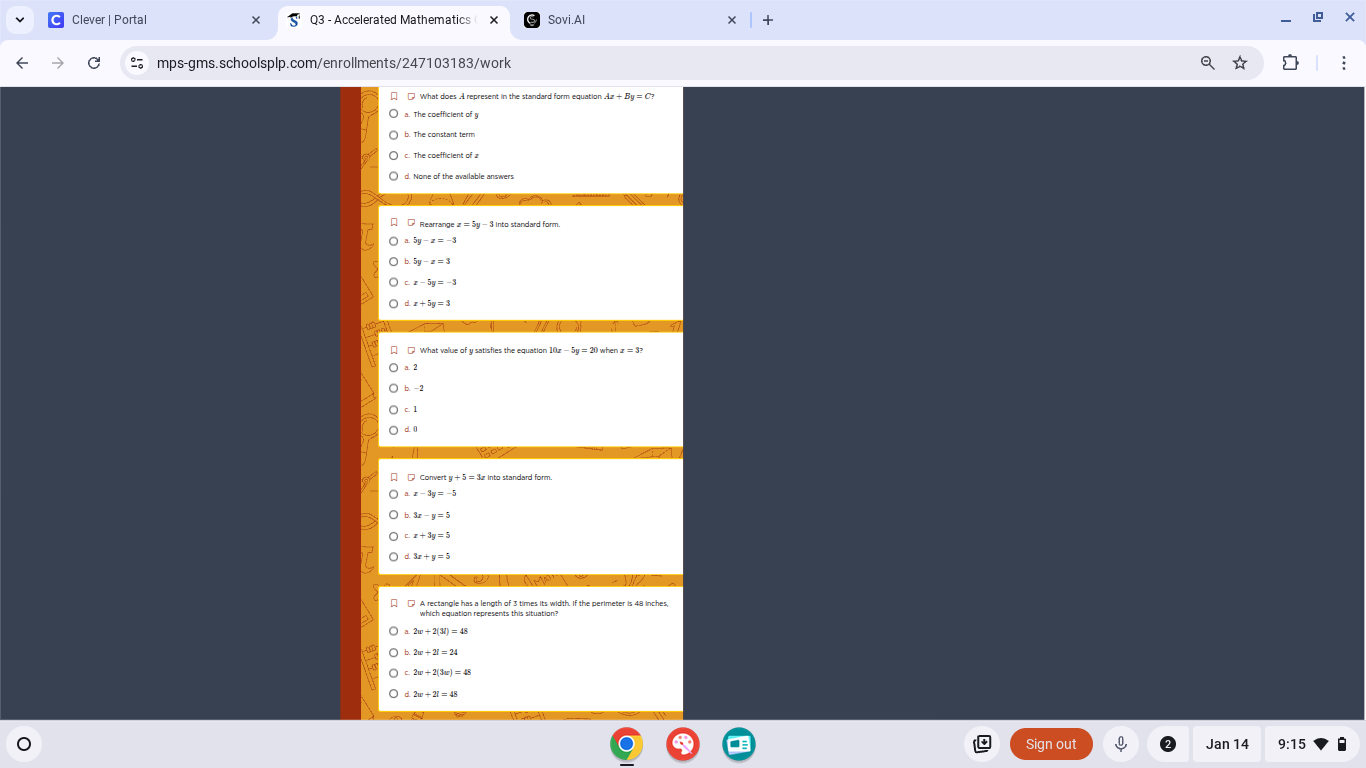
- what does a represent in the standard form equation, ax + by = c?
a. the coefficient of y
b. the constant term
c. the coefficient of x
d. none of the available answers
- rearrange x = 3y - 3 into standard form.
a. 5y - x = -3
b. 5y - x = 3
c. x - 5y = -3
d. x + 5y = 3
- what value of y satisfies the equation 10x - 5y = 20 when x = 3?
a. 2
b. -2
c. 1
d. 0
- convert y + 5 = 3x into standard form.
a. x - 3y = -5
b. 3x - y = 5
c. x + 3y = 5
d. 3x + y = 5
- a rectangle has a length of 2 times its width. if the perimeter is 48 inches, which equation represents this situation?
a. 2w + 2(2w) = 48
b. 2w + 2l = 24
c. 2w + 2(2|w|) = 48
d. 2w + 2l = 48
1. What does \( A \) represent in the standard form equation \( Ax + By = C \)?
In the standard form of a linear equation \( Ax + By = C \), \( A \), \( B \), and \( C \) are integers (with \( A \) non - negative usually), and \( A \) is the coefficient of the \( x \) - term. Option a says it's the coefficient of \( y \) (wrong), option b says it's the constant term (wrong), option d is incorrect as option c is correct.
The standard form of a linear equation is \( Ax+By = C \). Starting with \( x = 5y - 3 \), we subtract \( 5y \) from both sides to get \( x-5y=- 3 \). Let's check the options: option a: \( 5y - x = 3 \) is equivalent to \( -x + 5y=3 \) (not the same as our result), option b: \( 5y - x=-3 \) is equivalent to \( -x + 5y=-3 \) (wrong), option d: \( x + 5y = 3 \) (wrong).
Step 1: Substitute \( x = 3 \) into the equation
Substitute \( x = 3 \) into \( 10x-5y = 20 \), we get \( 10\times3-5y = 20 \).
Step 2: Simplify the left - hand side
\( 30-5y = 20 \)
Step 3: Solve for \( y \)
Subtract 30 from both sides: \( - 5y=20 - 30=-10 \). Then divide both sides by - 5: \( y=\frac{-10}{-5}=2 \).

Snap & solve any problem in the app
Get step-by-step solutions on Sovi AI
Photo-based solutions with guided steps
Explore more problems and detailed explanations
c. The coefficient of \( x \)