QUESTION IMAGE
Question
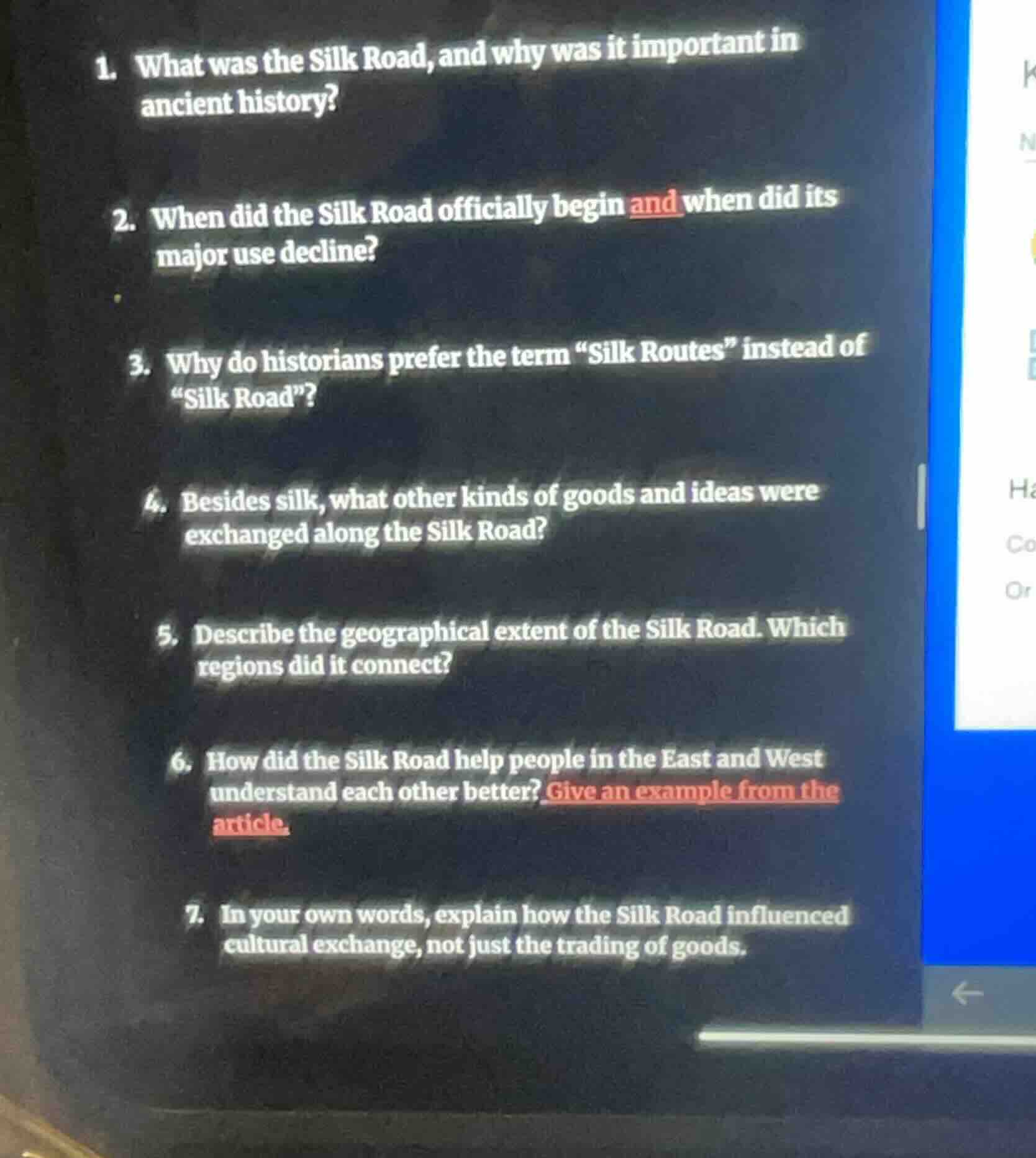
- what was the silk road, and why was it important in ancient history?
- when did the silk road officially begin and when did its major use decline?
- why do historians prefer the term \silk routes\ instead of \silk road\?
- besides silk, what other kinds of goods and ideas were exchanged along the silk road?
- describe the geographical extent of the silk road. which regions did it connect?
- how did the silk road help people in the east and west understand each other better? give an example from the article.
- in your own words, explain how the silk road influenced cultural exchange, not just the trading of goods.
Question 1
The Silk Road was a network of trade routes connecting East and West (Asia to Europe, Africa). It was important as it facilitated trade (silk, spices, etc.), cultural exchange (religions, ideas), and technological transfer (paper, gunpowder). It boosted economies, spread religions like Buddhism, Islam, and Christianity, and enabled scientific and artistic exchanges.
The Silk Road officially began around the 2nd century BCE during the Han Dynasty (when Zhang Qian's missions opened up trade with the West). Its major use declined around the 15th century CE with the rise of maritime trade (Vasco da Gama's sea route to India, etc.) and political changes (fall of Mongol Empire, which had protected the routes).
Historians prefer “Silk Routes” because the Silk Road was not a single road but a complex network of multiple land and maritime routes. The term “routes” better reflects the diversity of paths, directions, and the fact that trade occurred via many interconnected paths rather than one linear “road”.

Snap & solve any problem in the app
Get step-by-step solutions on Sovi AI
Photo-based solutions with guided steps
Explore more problems and detailed explanations
The Silk Road was a network of ancient trade routes (land and maritime) linking East (e.g., China) and West (e.g., Europe, Middle East, Africa). It was important for facilitating long - distance trade of goods (silk, spices, precious metals), spreading religions (Buddhism, Islam, Christianity), enabling cultural exchanges (art, architecture, languages), and transferring technologies (paper - making, gunpowder, agricultural techniques), which boosted economies and connected civilizations.