QUESTION IMAGE
Question
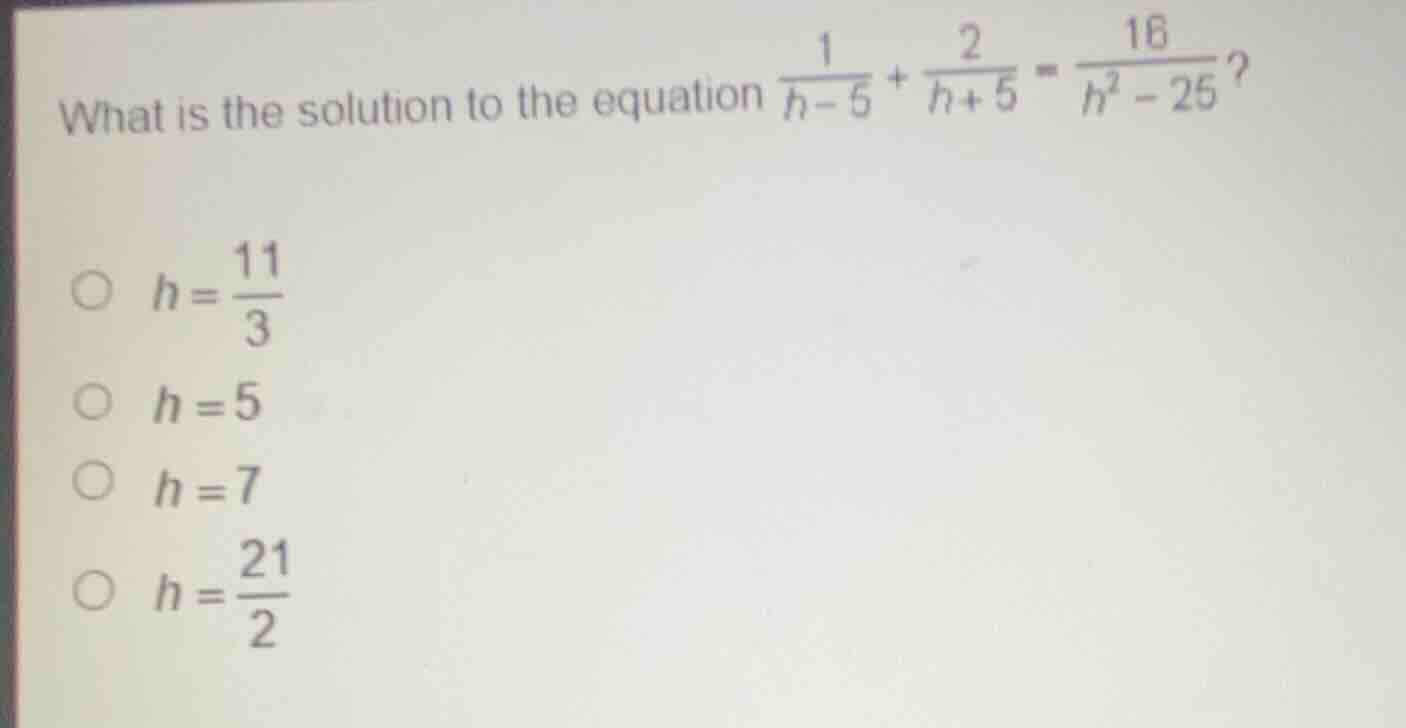
what is the solution to the equation \\(\frac{1}{h - 5} + \frac{2}{h + 5} = \frac{16}{h^2 - 25}\\)? \\(\bigcirc\\ h = \frac{11}{3}\\) \\(\bigcirc\\ h = 5\\) \\(\bigcirc\\ h = 7\\) \\(\bigcirc\\ h = \frac{21}{2}\\)
Step1: Factor denominator on right
Note that $h^2 -25=(h-5)(h+5)$
Step2: Multiply by common denominator
Multiply all terms by $(h-5)(h+5)$:
$$1\cdot(h+5) + 2\cdot(h-5) = 16$$
Step3: Expand and simplify left side
$$h+5 + 2h -10 = 16$$
$$3h -5 = 16$$
Step4: Solve for h
Add 5 to both sides:
$$3h = 16 + 5 = 21$$
Divide by 3:
$$h=\frac{21}{3}=7$$
Step5: Check for extraneous solutions
$h=5$ would make denominators zero, so it is invalid. $h=7$ does not make any denominator zero, so it is valid.

Snap & solve any problem in the app
Get step-by-step solutions on Sovi AI
Photo-based solutions with guided steps
Explore more problems and detailed explanations
$h=7$ (Option: $h=7$)