QUESTION IMAGE
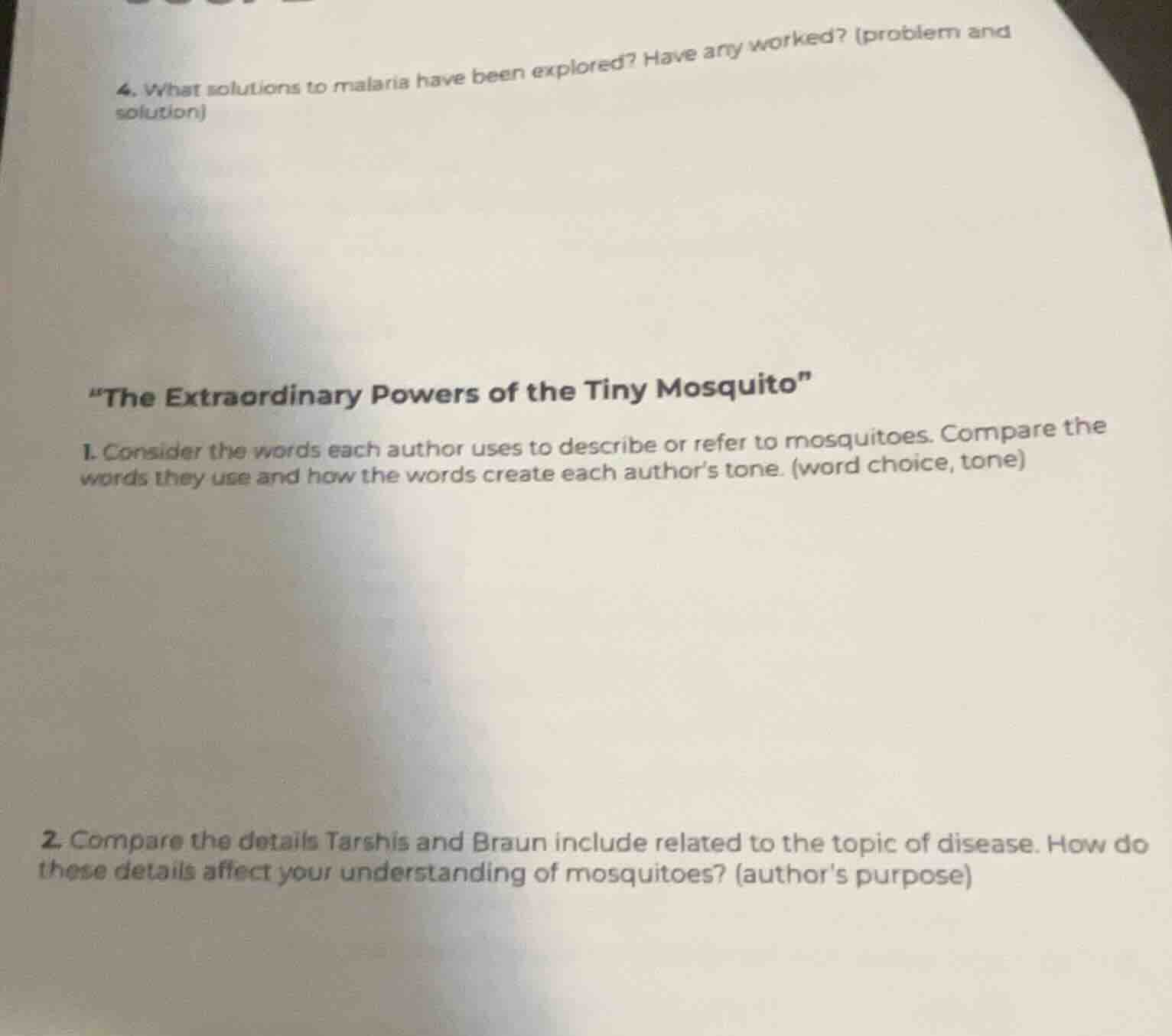
Question
- what solutions to malaria have been explored? have any worked? (problem and solution)
\the extraordinary powers of the tiny mosquito\
- consider the words each author uses to describe or refer to mosquitoes. compare the words they use and how the words create each author’s tone. (word choice, tone)
- compare the details tarshis and braun include related to the topic of disease. how do these details affect your understanding of mosquitoes? (authors purpose)
Question 4 (about malaria solutions)
To answer this, we analyze malaria solutions:
- Insecticide - Treated Bed Nets (ITNs): These repel or kill mosquitoes (malaria vectors) when they land on the nets. They've reduced malaria cases in many regions as they protect people while sleeping, a peak biting time for mosquitoes.
- Indoor Residual Spraying (IRS): Spraying insecticides on indoor walls. It kills mosquitoes resting on walls, reducing their population. In areas with consistent IRS programs, malaria transmission has decreased.
- Antimalarial Drugs: For prevention (e.g., chemoprophylaxis for travelers) and treatment (e.g., artemisinin - based combination therapies, ACTs). ACTs are effective against Plasmodium falciparum (a major malaria parasite) when used correctly, though drug resistance is a growing concern.
- Vaccines (e.g., RTS,S/ Mosquirix): The first malaria vaccine, it targets Plasmodium falciparum. It has shown moderate efficacy in reducing severe malaria in children, especially in sub - Saharan Africa, though it's not a standalone solution and is used with other interventions.
- Environmental Management: Reducing mosquito breeding sites (e.g., draining stagnant water, using larvicides in water bodies). This limits the number of mosquito larvae, but it's challenging in large, rural areas with many natural breeding sites.
Some solutions have worked: ITNs and IRS have significantly reduced malaria incidence in areas with high coverage. ACTs have been effective for treatment (when parasites are not resistant). The RTS,S vaccine is showing promise in reducing severe malaria in children. However, challenges like insecticide resistance (to ITN/IRS insecticides) and drug resistance (to antimalarials) limit their long - term effectiveness in some regions.
To answer, we analyze word choice and tone:
- Identify Authors' Words: First, list descriptive terms (e.g., "tiny", "deadly", "efficient", "menace") from each author.
- Analyze Connotations: Words like "tiny" (neutral - descriptive, shows size) vs. "deadly" (negative, emphasizes harm) vs. "extraordinary" (positive, highlights unique capabilities).
- Determine Tone: A word like "menace" creates a negative, alarmed tone (portraying mosquitoes as a threat). "Extraordinary" creates a fascinated, informative tone (focusing on their unique powers). "Efficient" (in breeding/transmission) can be neutral - analytical or slightly negative (if emphasizing their efficiency in spreading disease). By comparing connotations of words, we see how tone shifts (e.g., one author may be more alarmist, another more scientific - descriptive).
To answer:
- Identify Details: Find what Tarshis and Braun say about diseases (e.g., malaria, dengue, Zika) related to mosquitoes. Note details like transmission (how mosquitoes spread diseases), disease impact (mortality, symptoms), and mosquito - disease relationships (e.g., which mosquito species transmit which diseases).
- Analyze Impact on Understanding:
- If an author includes high malaria mortality rates, it emphasizes mosquitoes' role as deadly vectors.
- Details about multiple diseases (malaria, dengue) show mosquitoes as a vector for diverse, global health threats.
- Information on transmission (e.g., female mosquitoes need blood for eggs, spreading parasites/viruses) explains why mosquitoes are such effective disease spreaders.
- Compare details: If one author focuses on childhood malaria deaths, it highlights mosquitoes' impact on vulnerable populations. If another focuses on mosquito - virus co - evolution, it shows mosquitoes' adaptability in disease transmission. These details build a more complex view: mosquitoes are not just pests but complex, dangerous vectors with ecological and public health significance.

Snap & solve any problem in the app
Get step-by-step solutions on Sovi AI
Photo-based solutions with guided steps
Explore more problems and detailed explanations
Solutions Explored:
- Insecticide - Treated Bed Nets (ITNs): Repel/kill mosquitoes, protect sleepers.
- Indoor Residual Spraying (IRS): Kill resting mosquitoes, reduce population.
- Antimalarial Drugs: Prevent (chemoprophylaxis) and treat (e.g., ACTs for P. falciparum).
- Malaria Vaccine (RTS,S): Reduces severe malaria in children.
- Environmental Management: Reduce mosquito breeding sites (e.g., drain stagnant water).
Effectiveness:
ITNs, IRS, and ACTs (non - resistant areas) have worked, reducing malaria cases/severity. RTS,S shows promise for severe childhood malaria. Insecticide/drug resistance and implementation challenges limit some solutions.