QUESTION IMAGE
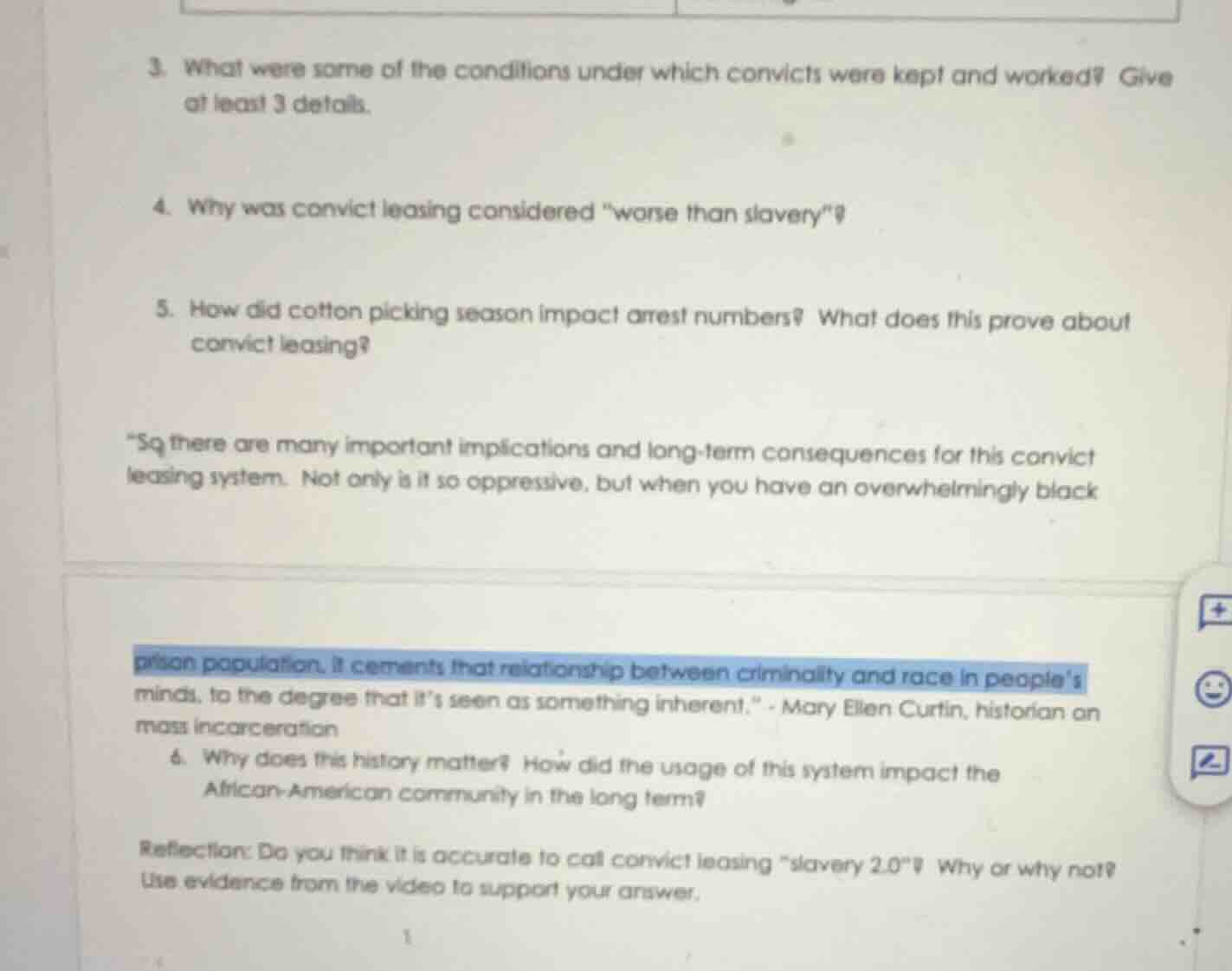
Question
- what were some of the conditions under which convicts were kept and worked? give at least 3 details.
- why was convict leasing considered \worse than slavery\?
- how did cotton picking season impact arrest numbers? what does this prove about convict leasing?
\so there are many important implications and long - term consequences for this convict leasing system. not only is it so oppressive, but when you have an overwhelmingly black prison population, it cements that relationship between criminality and race in peoples minds, to the degree that its seen as something inherent.\ - mary ellen curtin, historian on mass incarceration
- why does this history matter? how did the usage of this system impact the african - american community in the long term?
reflection: do you think it is accurate to call convict leasing \slavery 2.0\? why or why not? use evidence from the video to support your answer.
Question 3
To answer this, we recall details about convict leasing conditions. Convicts often faced: 1) Long work hours (e.g., 12+ hours daily) in harsh environments. 2) Inadequate food and shelter, leading to malnutrition and illness. 3) Physical abuse (whippings, beatings) for minor infractions. These details highlight the oppressive work and living conditions.
Convict leasing was “worse than slavery” because: 1) Slaves were property, so owners had an incentive to keep them alive; lessees had no such incentive (convicts were disposable). 2) Legal protections for slaves (minimal but some) did not apply to convicts—convicts could be worked to death. 3) Convicts faced arbitrary punishment and no guarantee of survival, unlike slaves (who were valued for labor).
Cotton picking season increased arrest numbers (especially of Black people) because: 1) Leasers needed labor for cotton harvest, so law enforcement arrested people (often on trivial charges) to supply convicts. 2) This proves convict leasing was a system of “legalized slavery”—arrests were weaponized to force Black people into unpaid labor, replicating slavery’s economic exploitation.

Snap & solve any problem in the app
Get step-by-step solutions on Sovi AI
Photo-based solutions with guided steps
Explore more problems and detailed explanations
- Long work hours (e.g., 12+ hours daily) in dangerous, harsh work environments (like mines or plantations).
- Inadequate food (meager rations, poor quality) and shelter (overcrowded, unsanitary quarters).
- Physical abuse (whippings, beatings) by overseers for minor rule violations.