QUESTION IMAGE
Question
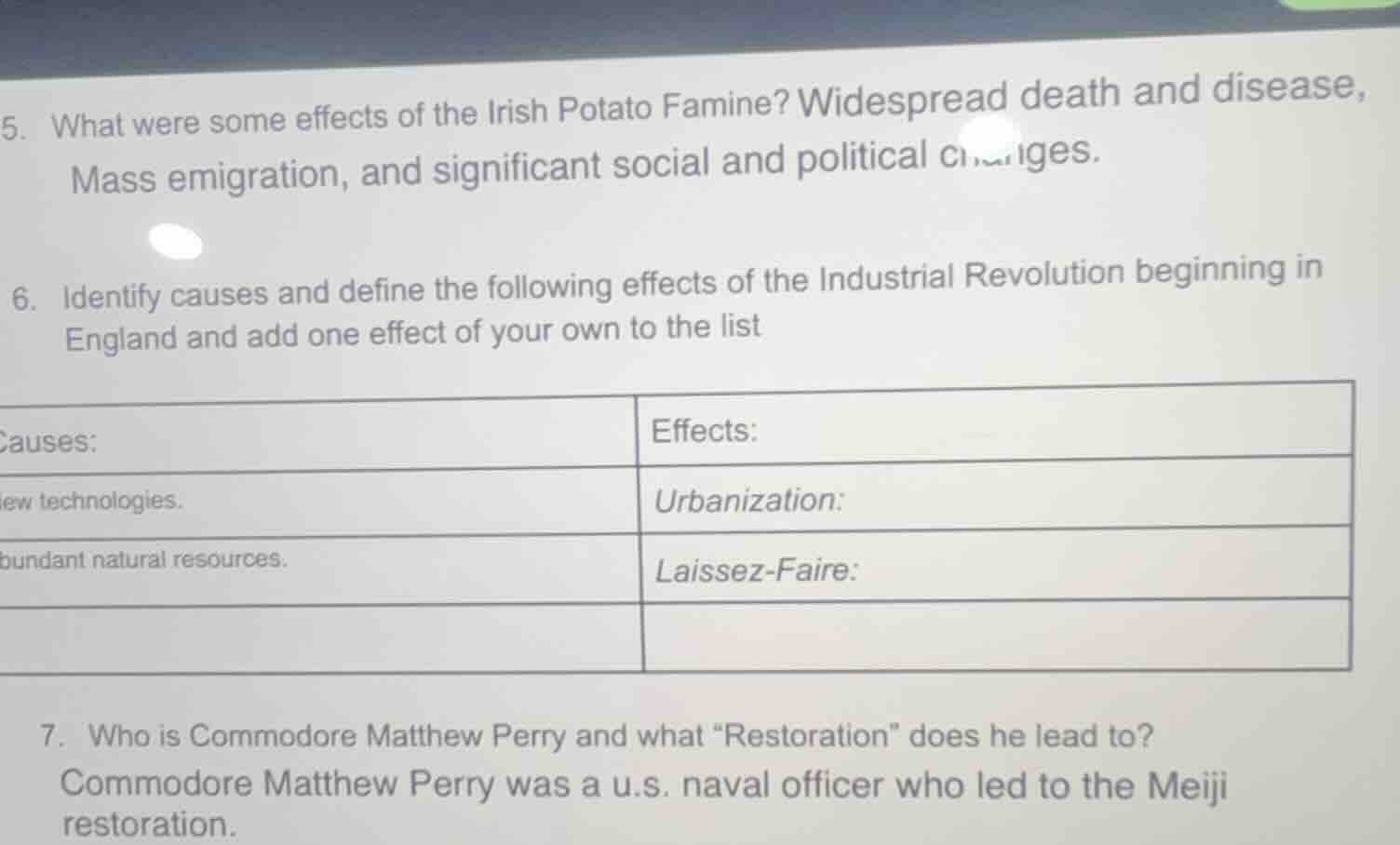
- what were some effects of the irish potato famine? widespread death and disease, mass emigration, and significant social and political changes.6. identify causes and define the following effects of the industrial revolution beginning in england and add one effect of your own to the listcauses:effects:new technologies.urbanization:abundant natural resources.laissez - faire:7. who is commodore matthew perry and what
estoration\ does he lead to?commodore matthew perry was a u.s. naval officer who led to the meiji restoration.
Question 5:
The Irish Potato Famine (1845-1852) was caused by a potato blight that destroyed the staple crop. The listed effects are well-documented:
- Widespread death and disease: Over 1 million people died from starvation and related illnesses like typhus.
- Mass emigration: Around 1.5 million Irish people fled to countries like the US, Canada, and Britain, creating a large Irish diaspora.
- Significant social and political changes: It fueled resentment of British rule, pushed for land reform, and altered Ireland's demographic and political landscape long-term.
Question 6:
Causes (completed with missing key cause):
- New technologies: Innovations like the steam engine, spinning jenny, and power loom mechanized production.
- Abundant natural resources: England had large coal and iron ore reserves to power factories and make machinery.
- Stable political system + access to colonial markets: England's centralized government supported business, and colonies provided raw materials and captive markets for goods.
Effects (defined, plus additional effect):
- Urbanization: The shift of population from rural areas to cities, as people moved to work in factory jobs, leading to the growth of industrial cities like Manchester.
- Laissez-Faire: An economic ideology that advocated for minimal government interference in the economy, letting free markets and private businesses operate with little regulation, which became dominant during the Industrial Revolution.
- Additional effect: Rise of the working class (proletariat): A new social group of factory workers emerged, facing poor working conditions, low wages, and long hours, which eventually led to the growth of labor movements and trade unions.
Question 7:
Commodore Matthew Perry was a U.S. naval officer who led two expeditions to Japan in 1853 and 1854. His arrival with a fleet of warships forced Japan to end its 200-year policy of isolation (sakoku) and open trade with the U.S. This external pressure contributed to political unrest in Japan, which led to the Meiji Restoration (1868): the overthrow of the Tokugawa shogunate, the restoration of imperial rule under Emperor Meiji, and Japan's rapid modernization and industrialization to match Western powers.

Snap & solve any problem in the app
Get step-by-step solutions on Sovi AI
Photo-based solutions with guided steps
Explore more problems and detailed explanations
Question 5:
The effects are confirmed as:
- Widespread death and disease (over 1 million fatalities from starvation and famine-related illnesses)
- Mass emigration (~1.5 million Irish people fled to other nations, creating a large global diaspora)
- Significant social and political changes (growing anti-British sentiment, demands for land reform, and permanent demographic shifts in Ireland)
Question 6:
| Causes: | Effects: |
|---|---|
| Abundant natural resources. | Laissez-Faire: An economic ideology supporting minimal government intervention in markets, letting businesses operate freely. |
| Stable political system + colonial market access. | Additional effect: Rise of labor movements: Factory workers formed unions to advocate for better wages, shorter hours, and safer working conditions. |
Question 7:
Commodore Matthew Perry was a U.S. naval officer who led naval expeditions to Japan in 1853-1854, forcing Japan to end its isolationist policies and open trade with the West. This event contributed to political upheaval in Japan that led to the Meiji Restoration (1868), which restored imperial rule under Emperor Meiji and launched Japan's rapid modernization and industrialization to become a major world power.