QUESTION IMAGE
Question
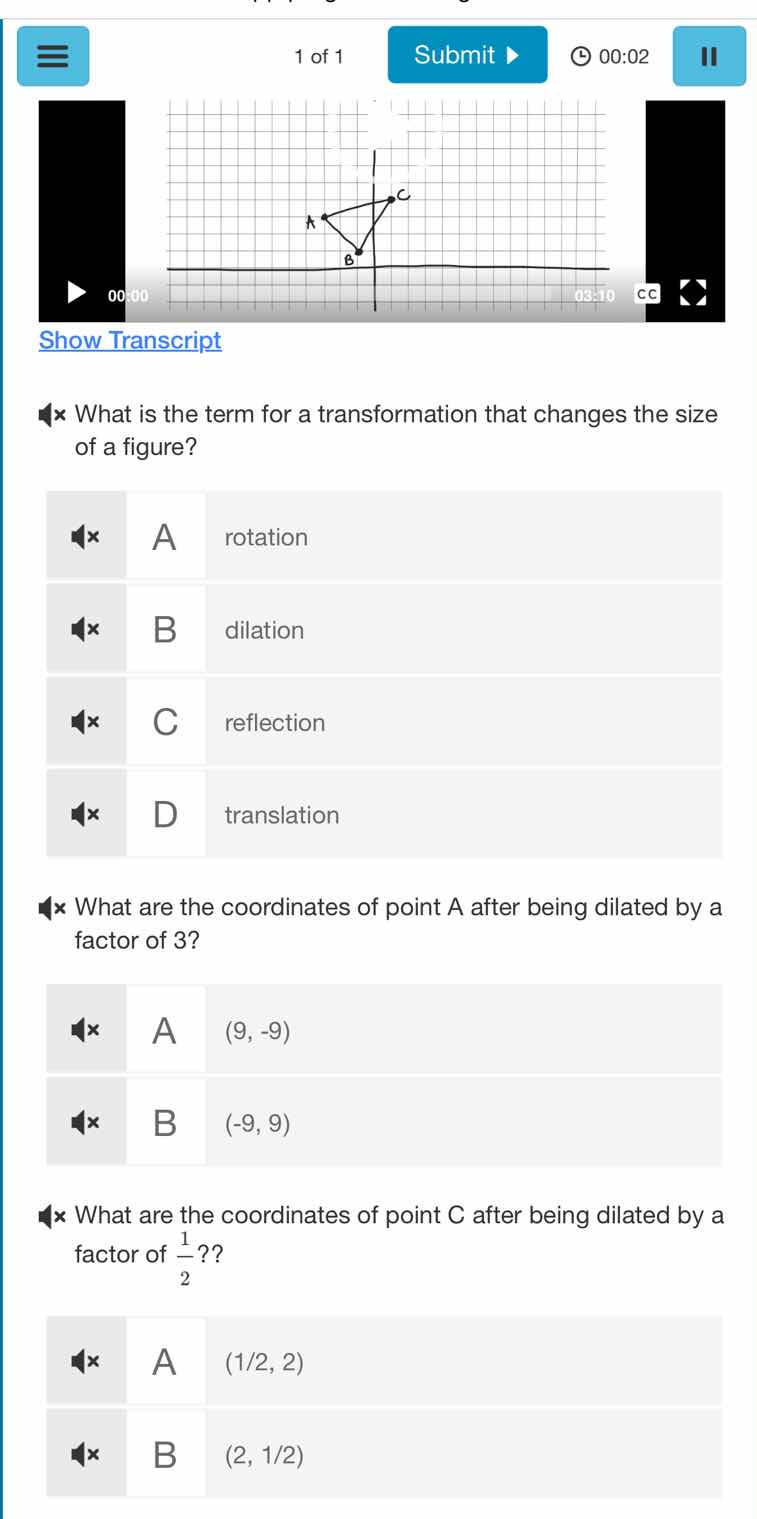
what is the term for a transformation that changes the size of a figure? a rotation b dilation c reflection d translation what are the coordinates of point a after being dilated by a factor of 3? a (9, -9) b (-9, 9) what are the coordinates of point c after being dilated by a factor of 1/2?? a (1/2, 2) b (2, 1/2)
First Question:
- Rotation (A) turns a figure around a point, not changing size.
- Dilation (B) is a transformation that scales a figure, changing its size (enlarging or reducing).
- Reflection (C) flips a figure over a line, size remains same.
- Translation (D) slides a figure, size remains same. So dilation is the term for size - changing transformation.
Step1: Recall dilation rule
To dilate a point \((x,y)\) by a factor \(k\), the new coordinates are \((k\times x, k\times y)\).
Step2: Apply dilation factor
Assume original coordinates of \(A\) are \((-3, 3)\). For dilation factor \(3\), new \(x\)-coordinate: \(3\times(-3)=-9\), new \(y\)-coordinate: \(3\times3 = 9\).
Step1: Recall dilation rule
To dilate a point \((x,y)\) by a factor \(k\), new coordinates are \((k\times x, k\times y)\).
Step2: Apply dilation factor
Assume original coordinates of \(C\) are \((1, 4)\). For dilation factor \(\frac{1}{2}\), new \(x\)-coordinate: \(\frac{1}{2}\times1=\frac{1}{2}\), new \(y\)-coordinate: \(\frac{1}{2}\times4 = 2\).

Snap & solve any problem in the app
Get step-by-step solutions on Sovi AI
Photo-based solutions with guided steps
Explore more problems and detailed explanations
B. dilation
Second Question:
(Assuming original coordinates of point A are \((-3, 3)\) as a common case for such problems, since dilating by factor 3: multiply each coordinate by 3. \(-3\times3=-9\), \(3\times3 = 9\), so new coordinates \((-9, 9)\))