QUESTION IMAGE
Question
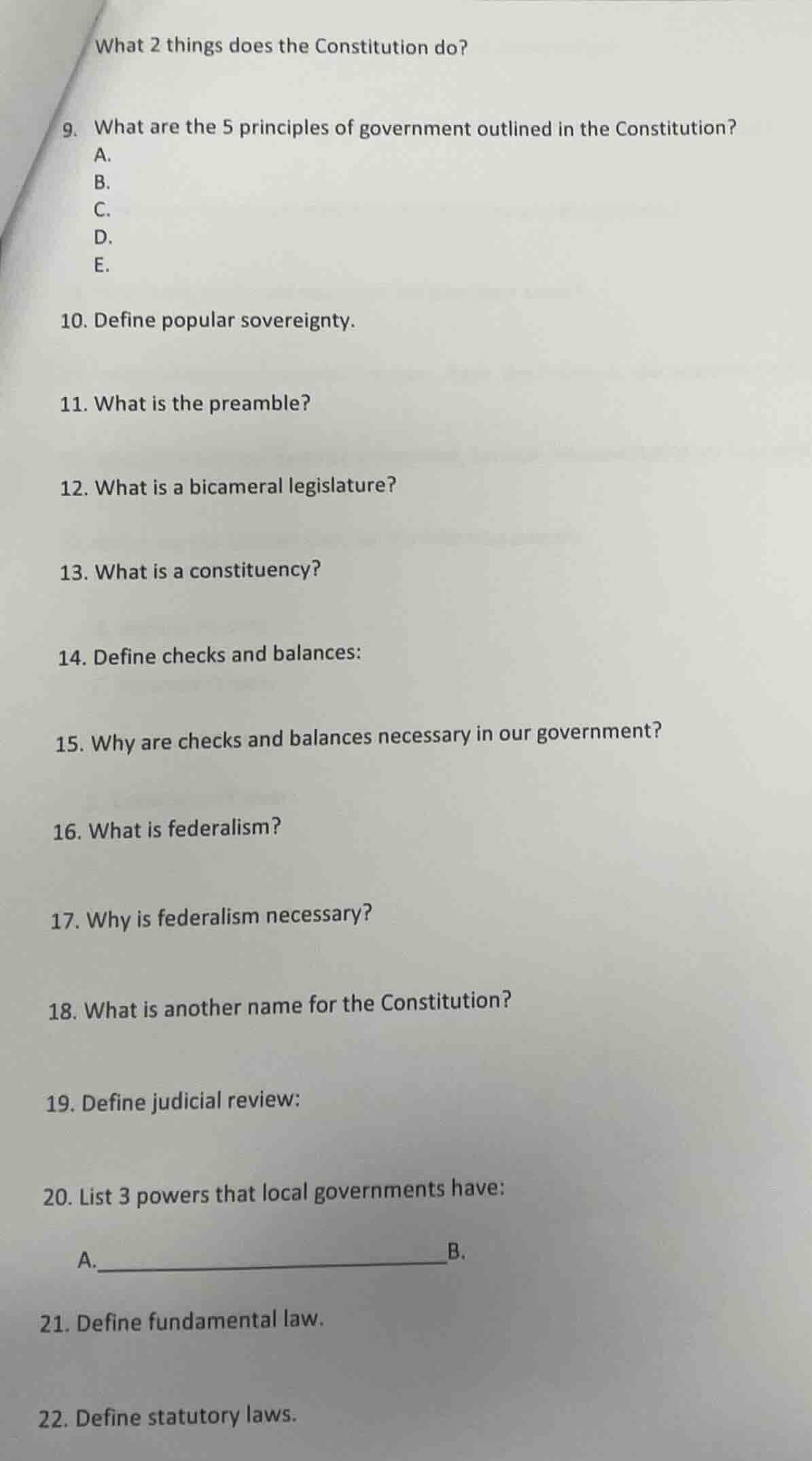
what 2 things does the constitution do?
- what are the 5 principles of government outlined in the constitution?
a.
b.
c.
d.
e.
- define popular sovereignty.
- what is the preamble?
- what is a bicameral legislature?
- what is a constituency?
- define checks and balances:
- why are checks and balances necessary in our government?
- what is federalism?
- why is federalism necessary?
- what is another name for the constitution?
- define judicial review:
- list 3 powers that local governments have:
a._________________________b.
- define fundamental law.
- define statutory laws.
Brief Explanations
- Addresses core functions of the U.S. Constitution.
- Covers key foundational principles of U.S. government from the Constitution.
- Defines a core principle of democratic governance.
- Explains the introductory section of the Constitution.
- Defines the structure of the U.S. legislative branch.
- Explains a key term in representative government.
- Defines a core system of governmental oversight.
- Justifies the need for governmental oversight systems.
- Defines the U.S. system of shared governmental power.
- Justifies the U.S. system of shared governmental power.
- Provides an alternate official name for the U.S. Constitution.
- Defines a key judicial power established by precedent.
- Lists core authorities of local U.S. governments.
- Defines the highest legal framework of a nation.
- Defines laws created by legislative bodies.

Snap & solve any problem in the app
Get step-by-step solutions on Sovi AI
Photo-based solutions with guided steps
Explore more problems and detailed explanations
- What 2 things does the Constitution do?
- Establishes the structure of the U.S. federal government
- Outlines the fundamental rights of U.S. citizens
- What are the 5 principles of government outlined in the Constitution?
A. Popular Sovereignty
B. Limited Government
C. Separation of Powers
D. Checks and Balances
E. Federalism
- Define popular sovereignty.
- The principle that the authority of the government is created and sustained by the consent of its people, who are the source of all political power.
- What is the preamble?
- The introductory statement to the U.S. Constitution that sets out the guiding purposes and principles of the document.
- What is a bicameral legislature?
- A legislative body that is divided into two separate chambers, such as the U.S. Senate and House of Representatives.
- What is a constituency?
- A group of voters in a specific geographic area who elect a representative to a legislative body.
- Define checks and balances:
- A system where each branch of government has the ability to limit the powers of the other branches to prevent any one branch from becoming too powerful.
- Why are checks and balances necessary in our government?
- To prevent the concentration of power in any one branch of government, protect against potential abuse of authority, and ensure a system of accountability.
- What is federalism?
- A system of government where power is divided between a central (federal) government and regional (state) governments, each with their own distinct areas of authority.
- Why is federalism necessary?
- To balance national unity with regional autonomy, allow for tailored policies to local needs, and prevent the concentration of power in a single national government.
- What is another name for the Constitution?
- The U.S. Constitution is sometimes formally referred to as the "Supreme Law of the Land," though its most common alternate official title is the "Constitution of the United States of America."
- Define judicial review:
- The power of the judicial branch to review laws and government actions to determine if they are consistent with the Constitution; if not, the law or action can be declared unconstitutional.
- List 3 powers that local governments have:
A. Managing local public schools
B. Operating local law enforcement (police departments)
C. Regulating local land use and zoning
- Define fundamental law.
- The basic, overriding legal framework of a nation or state that establishes the structure of government and the rights of citizens, which cannot be easily changed by ordinary legislative acts (e.g., a constitution).
- Define statutory laws.
- Laws formally enacted, written, and codified by a legislative body (such as the U.S. Congress, state legislatures, or local city councils).