QUESTION IMAGE
Question
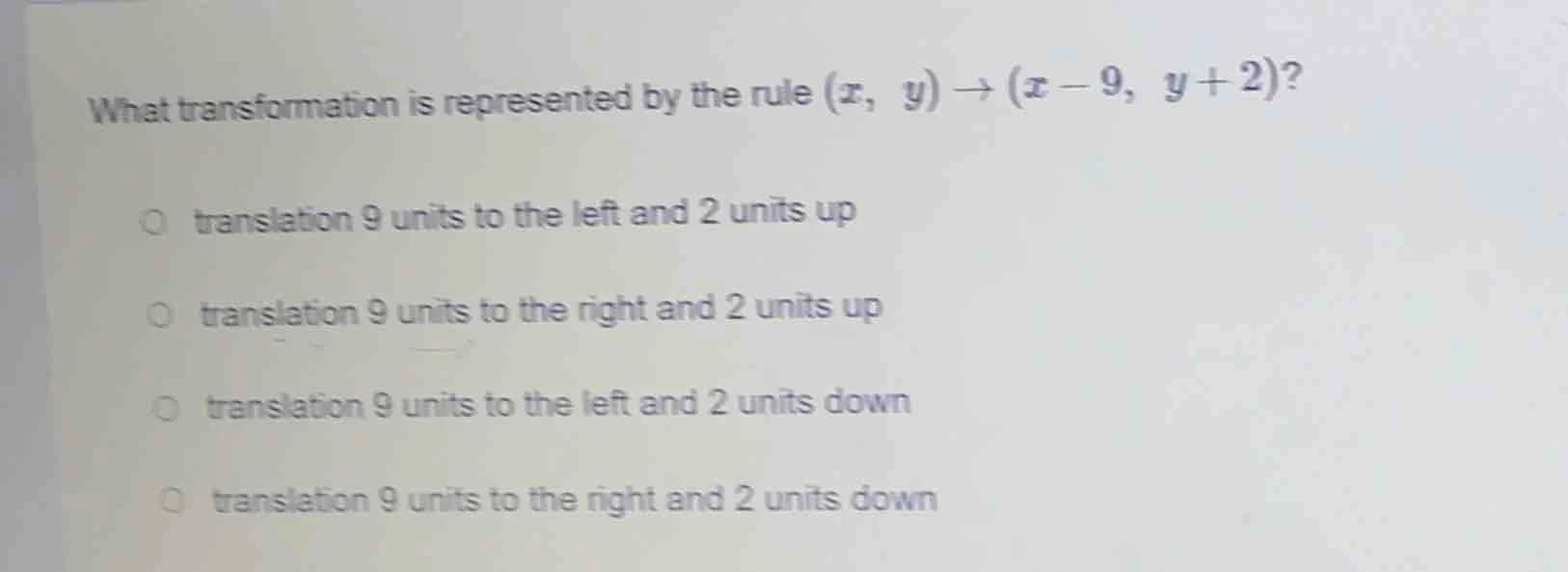
what transformation is represented by the rule ((x, y) \to (x - 9, y + 2))?
- translation 9 units to the left and 2 units up
- translation 9 units to the right and 2 units up
- translation 9 units to the left and 2 units down
- translation 9 units to the right and 2 units down
Step1: Analyze x - coordinate change
In a translation, for the x - coordinate: if we have a transformation \((x,y)\to(x + a,y + b)\), when \(a<0\), the graph moves left, and when \(a > 0\), it moves right. Here, the x - coordinate changes from \(x\) to \(x-9\), which is equivalent to \(x+(- 9)\). So \(a=-9\), which means the graph moves 9 units to the left.
Step2: Analyze y - coordinate change
For the y - coordinate: when \(b>0\), the graph moves up, and when \(b < 0\), it moves down. Here, the y - coordinate changes from \(y\) to \(y + 2\), so \(b = 2>0\), which means the graph moves 2 units up.

Snap & solve any problem in the app
Get step-by-step solutions on Sovi AI
Photo-based solutions with guided steps
Explore more problems and detailed explanations
A. translation 9 units to the left and 2 units up