QUESTION IMAGE
Question
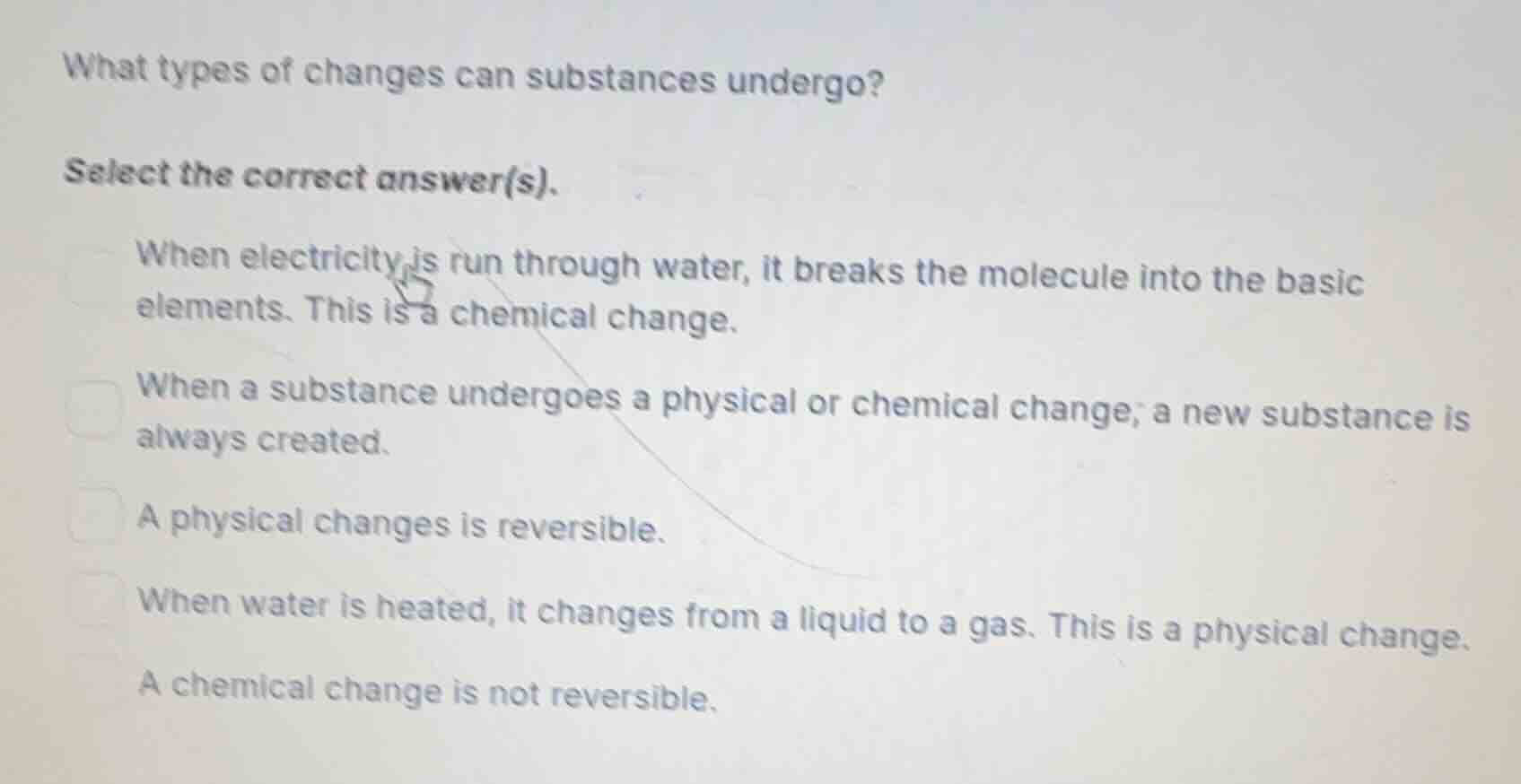
what types of changes can substances undergo?
select the correct answer(s).
when electricity is run through water, it breaks the molecule into the basic elements. this is a chemical change.
when a substance undergoes a physical or chemical change, a new substance is always created.
a physical changes is reversible.
when water is heated, it changes from a liquid to a gas. this is a physical change.
a chemical change is not reversible.
Brief Explanations
- Electrolysis of water: Splitting water into hydrogen and oxygen via electricity forms new substances, so this is a chemical change.
- Physical vs chemical change distinction: Physical changes only alter state/shape without forming new substances; only chemical changes create new substances.
- Physical change reversibility: Most physical changes (like phase changes) can be reversed (e.g., condensing steam back to water).
- Water vaporization: Heating water to steam only changes its phase, not its chemical identity, so this is a physical change.
- Chemical change reversibility: While some chemical changes can be reversed with additional chemical processes, they are not easily reversed like most physical changes, and the statement aligns with standard basic chemistry framing of the difference.

Snap & solve any problem in the app
Get step-by-step solutions on Sovi AI
Photo-based solutions with guided steps
Explore more problems and detailed explanations
- When electricity is run through water, it breaks the molecule into the basic elements. This is a chemical change.
- A physical change is reversible.
- When water is heated, it changes from a liquid to a gas. This is a physical change.
- A chemical change is not reversible.