QUESTION IMAGE
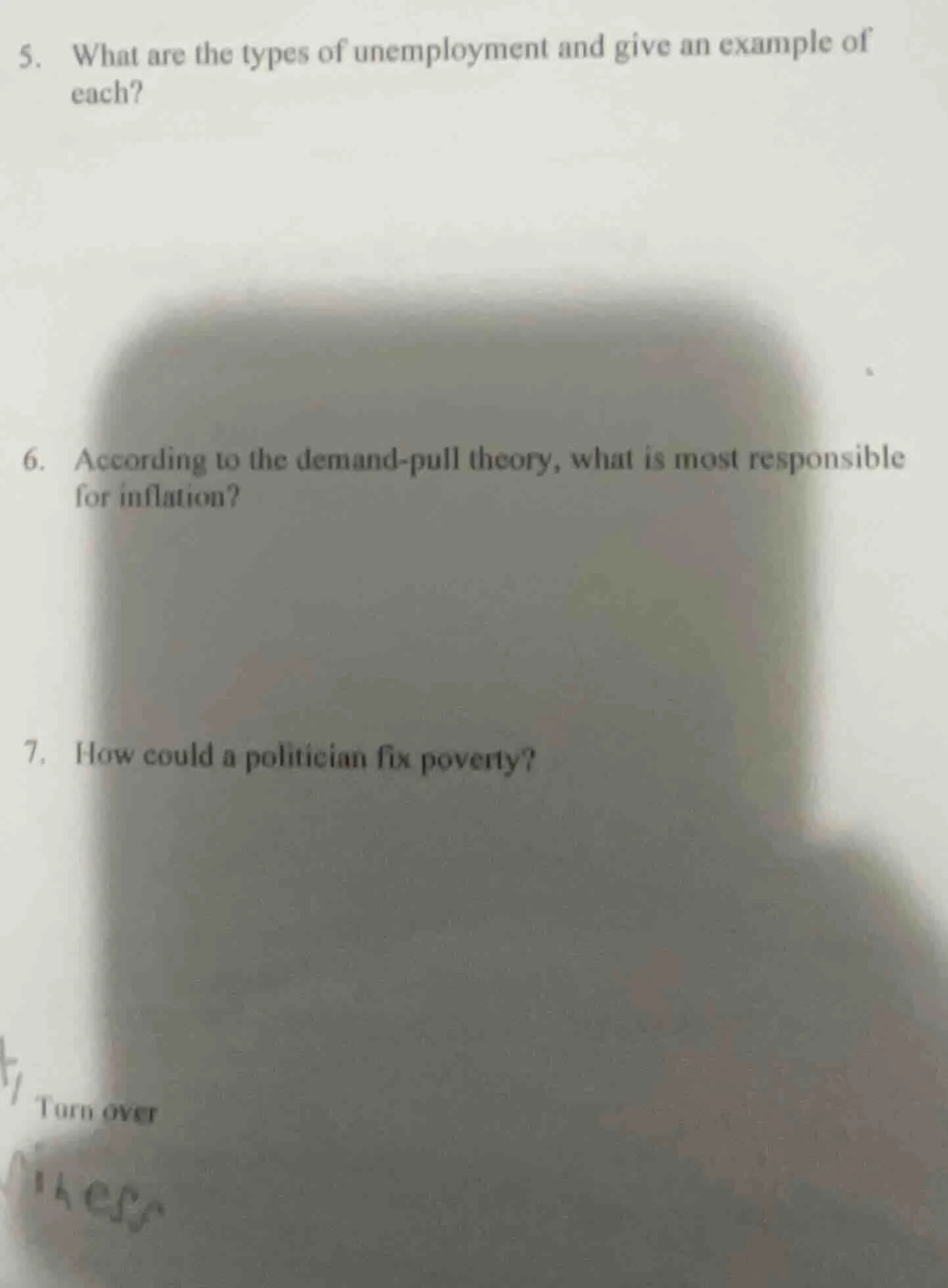
Question
- what are the types of unemployment and give an example of each?
- according to the demand - pull theory, what is most responsible for inflation?
- how could a politician fix poverty?
turn over
Question 5
Unemployment types include frictional (e.g., a recent graduate searching for their first job), structural (e.g., coal miners unemployed due to shift to renewable energy), cyclical (e.g., workers laid off in a recession), and seasonal (e.g., ski resort workers unemployed in summer). Each type arises from different economic or labor - market factors.
The demand - pull theory of inflation states that inflation occurs when aggregate demand in an economy exceeds aggregate supply. When there is more demand for goods and services (from consumers, businesses, government, or foreign buyers) than what the economy can produce at full employment, prices are "pulled up" as producers respond to the excess demand by raising prices.
A politician can address poverty through policies like increasing the minimum wage to ensure workers earn a living wage, investing in education and job training to improve employability, providing affordable housing to reduce housing costs, expanding access to healthcare to prevent medical debt, and implementing progressive tax policies to redistribute wealth. Also, creating job - creation programs and social safety net programs (like unemployment benefits, food stamps) can help.

Snap & solve any problem in the app
Get step-by-step solutions on Sovi AI
Photo-based solutions with guided steps
Explore more problems and detailed explanations
- Frictional Unemployment: Example - A college graduate who has just finished their degree and is actively looking for their first job in their field. This type of unemployment occurs as people transition between jobs or enter the labor market for the first time.
- Structural Unemployment: Example - Workers in the coal industry who lose their jobs because the country is shifting towards using more renewable energy sources, and their skills are no longer in high demand in the energy sector. It is caused by a mismatch between the skills workers have and the skills required by available jobs.
- Cyclical Unemployment: Example - During an economic recession, a car factory worker is laid off because the overall demand for cars has decreased as consumers are spending less. This is related to the business cycle, with unemployment rising during economic downturns.
- Seasonal Unemployment: Example - A lifeguard at a beach who is unemployed during the winter months when the beach is less crowded and there is less demand for lifeguard services. This is due to seasonal fluctuations in demand for certain types of work.