QUESTION IMAGE
Question
what is the value of x?
options: x=2, x=3, x=4, x=6
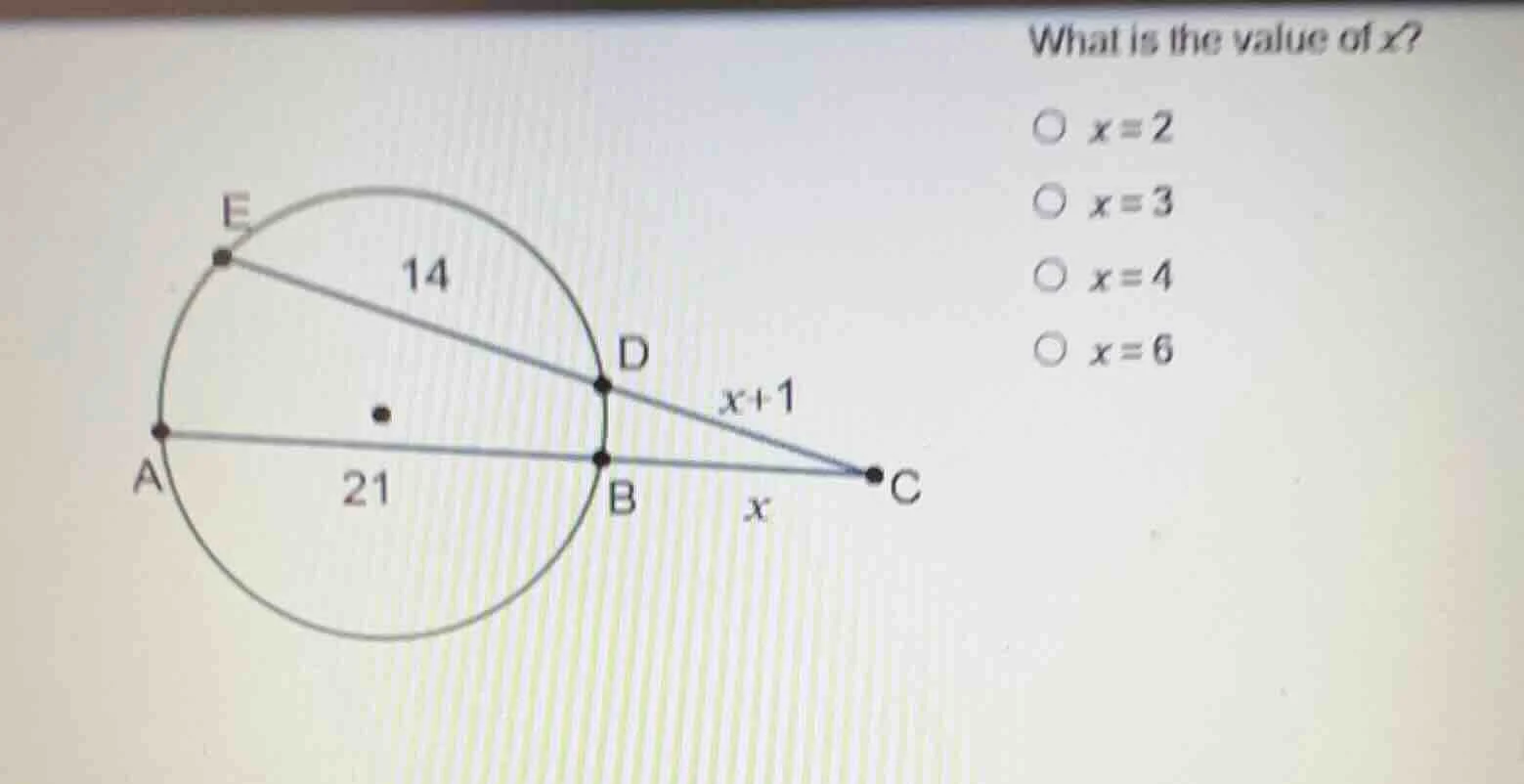
(image of a circle with points a, b, d, e on it and point c outside. segments: ae? no, ed=14, ab=21, cb=x, cd=x+1)
Step1: Apply the secant-secant theorem
The secant-secant theorem states that if two secant segments are drawn from a point outside a circle, then the product of the length of one secant segment and its external part is equal to the product of the length of the other secant segment and its external part. For point \( C \), the first secant is \( CA \) with length \( 21 + x \) (since \( AB = 21 \) and \( BC = x \)) and external part \( x \). The second secant is \( CE \) with length \( 14 + (x + 1)=15 + x \) and external part \( x + 1 \). So we have the equation:
\( x(21 + x)=(x + 1)(14 + x + 1) \)
Step2: Expand both sides
Expand the left side: \( x(21 + x)=21x+x^{2} \)
Expand the right side: \( (x + 1)(x + 15)=x^{2}+15x+x + 15=x^{2}+16x + 15 \)
Step3: Set the equations equal and solve for \( x \)
Set \( 21x+x^{2}=x^{2}+16x + 15 \)
Subtract \( x^{2} \) from both sides: \( 21x=16x + 15 \)
Subtract \( 16x \) from both sides: \( 5x=15 \)
Divide both sides by 5: \( x = 3 \)

Snap & solve any problem in the app
Get step-by-step solutions on Sovi AI
Photo-based solutions with guided steps
Explore more problems and detailed explanations
\( x = 3 \) (corresponding to the option \( x = 3 \))