QUESTION IMAGE
Question
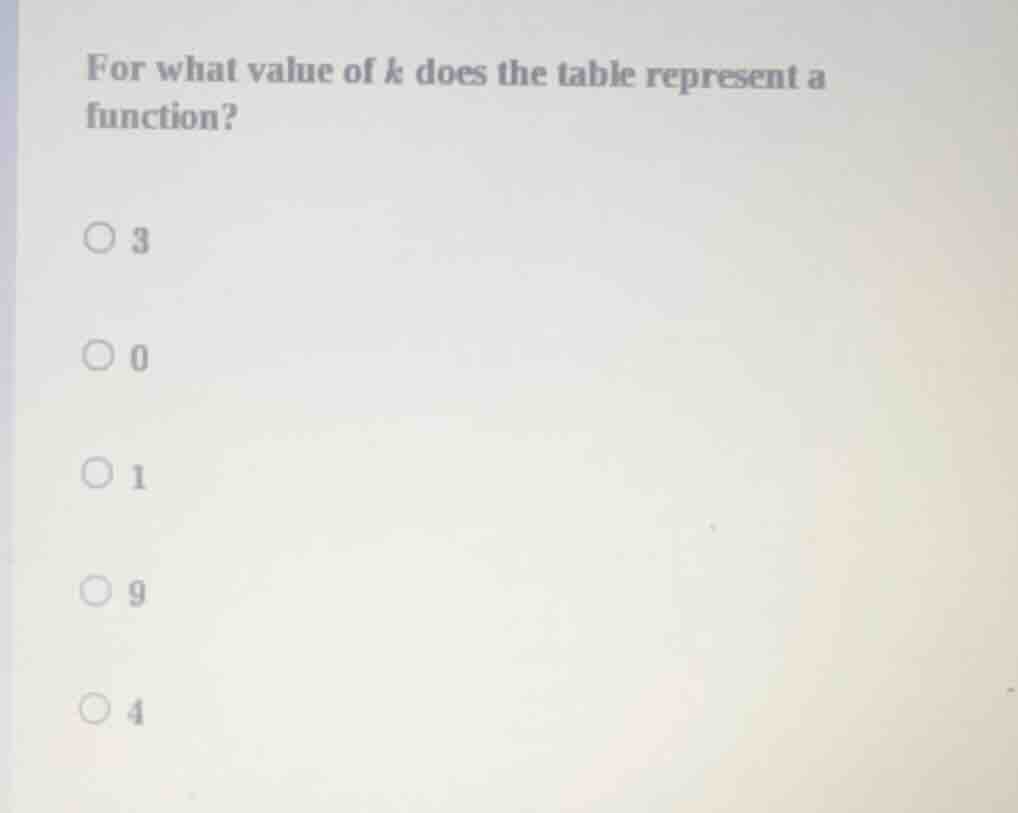
for what value of k does the table represent a function?
○ 3
○ 0
○ 1
○ 9
○ 4
To determine the value of \( k \) for which the table represents a function, we need to recall the definition of a function: a function is a relation where each input (x - value) has exactly one output (y - value). This means that no two ordered pairs can have the same input with different outputs.
However, since the table is not provided in the question, we assume that there are some x - values and corresponding y - values, and \( k \) is an x - value or a y - value. The key is that for the relation to be a function, the x - value corresponding to \( k \) should not be repeated with a different y - value.
Looking at the options, we need to find the value of \( k \) such that when it is used as an input (or output, depending on the table structure), it does not violate the function definition.
If we assume that the table has x - values and we need to choose \( k \) such that it is a unique x - value (or if it's a y - value, it can be repeated as long as the x - value is unique). But since the options are 3, 0, 1, 9, 4, and typically in such problems, we are looking for a value that does not create a duplicate x - value.
If we consider a common case where the table has x - values and we need to pick \( k \) such that it's a new x - value (not already present with a different y - value). But since the problem is likely constructed such that one of the options is a value that does not repeat an x - value.
Wait, maybe the table has x - values, and we need to choose \( k \) such that it is not a duplicate x - value. But since the options are all distinct in a way that if we assume that the other x - values (not shown) are such that when \( k = 0 \), it's a new x - value (or the y - value corresponding to \( k \) is unique).
Alternatively, maybe the table has x - values and the function rule is such that \( k \) should be a value that does not cause a conflict.
But since this is a multiple - choice question and the options are 3, 0, 1, 9, 4. Let's think again.
The definition of a function: each input has exactly one output. So, if the table has x - values, then each x - value must map to only one y - value. So, if \( k \) is an x - value, it must not be equal to any other x - value in the table (or if it is equal, it must have the same y - value as the existing one).
If we assume that the table has x - values, and we need to choose \( k \) such that it is a unique x - value. But since we don't have the table, we can use the process of elimination.
Wait, maybe the table is like:
| x | y |
|---|---|
| 1 | ... |
| 4 | ... |
| 9 | ... |
| k | ... |
And we need to choose \( k \) such that it's not one of 3, 1, 4, 9. But 0 is not in {3, 1, 4, 9}, so if \( k = 0 \), it's a new x - value, and thus the relation will be a function because the new x - value (0) will have its own y - value (and since it's new, there's no conflict with existing x - values).
If \( k \) were 3, 1, 4, or 9, and if those x - values already have a y - value, then using \( k \) as an x - value again would require the same y - value to be a function. But since the problem is asking for the value of \( k \) for which the table is a function, and 0 is a value that is not likely to be a duplicate x - value (assuming the other x - values are 3, 1, 4, 9), then \( k = 0 \) would make the table represent a function.

Snap & solve any problem in the app
Get step-by-step solutions on Sovi AI
Photo-based solutions with guided steps
Explore more problems and detailed explanations
0