QUESTION IMAGE
Question
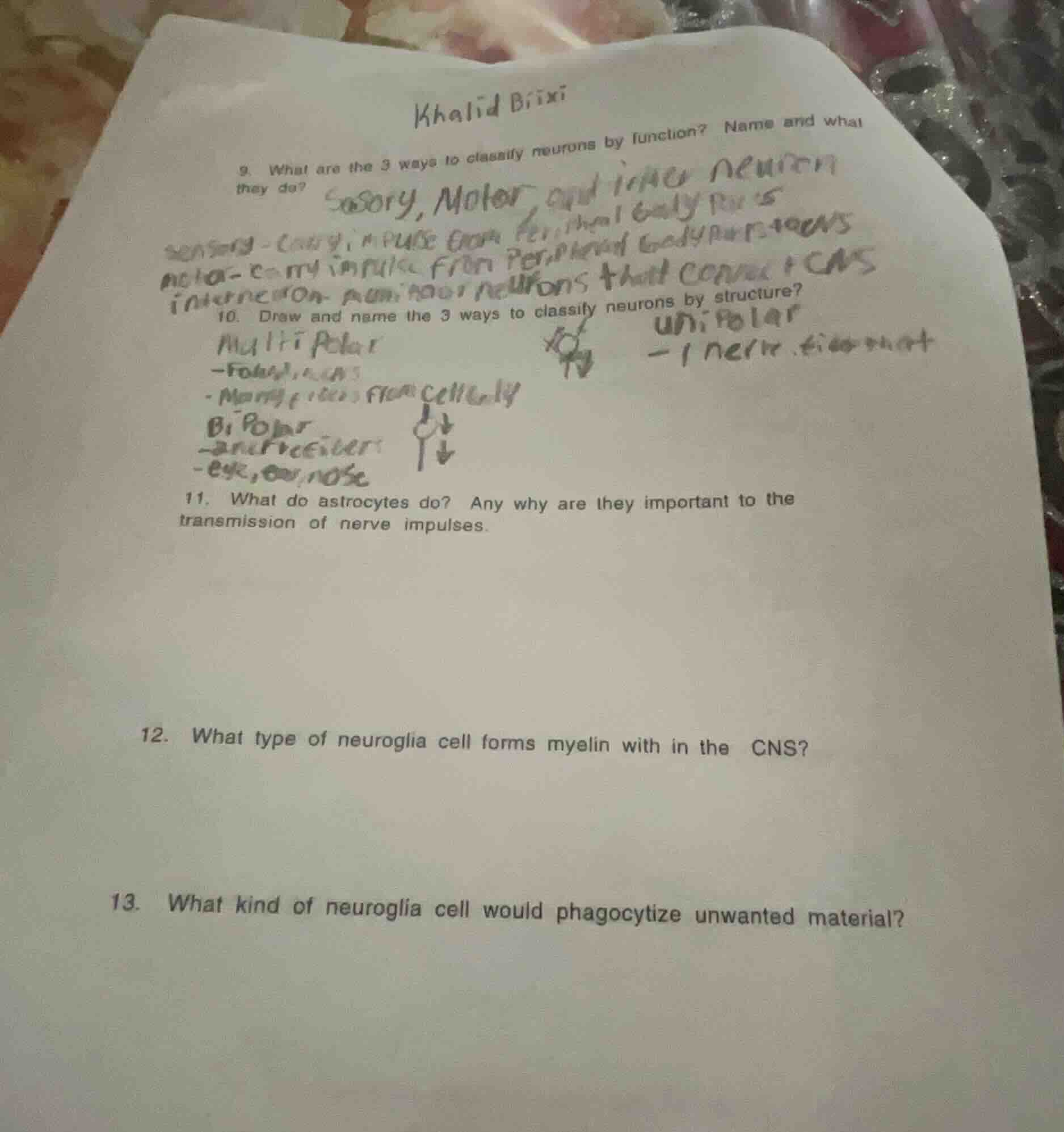
- what are the 3 ways to classify neurons by function? name and what they do?
- draw and name the 3 ways to classify neurons by structure?
- what do astrocytes do? any why are they important to the transmission of nerve impulses.
- what type of neuroglia cell forms myelin with in the cns?
- what kind of neuroglia cell would phagocytize unwanted material?
Question 9
Neurons can be classified by function into three types: Sensory neurons (carry impulses from peripheral body parts to the central nervous system, CNS), Motor neurons (carry impulses from the CNS to peripheral body parts to cause action), and Interneurons (association neurons that connect sensory and motor neurons within the CNS, facilitating communication between them).
By structure, neurons are classified based on the number of processes (extensions) from the cell body:
- Multipolar Neurons: Have many processes (one axon, multiple dendrites). Most common in the CNS (e.g., motor neurons).
- Bipolar Neurons: Have two processes (one axon, one dendrite). Found in special sensory organs (e.g., retina of eye, inner ear, olfactory mucosa).
- Unipolar Neurons: Have a single process that splits into a peripheral (dendrite - like) and central (axon - like) part. Found in sensory ganglia of PNS (e.g., dorsal root ganglia).
(Note: For drawing, sketch each: Multipolar with a cell body, multiple dendrites, one axon; Bipolar with cell body between one dendrite and one axon; Unipolar with a single process splitting into two branches.)
Astrocytes are a type of neuroglia in the CNS. Their functions include:
- Structural Support: Anchor neurons to capillaries (form the blood - brain barrier, BBB, by wrapping around capillaries to regulate what enters the CNS tissue from blood).
- Metabolic Support: Provide nutrients (like glucose) to neurons, and remove waste (e.g., excess neurotransmitters, ions like $K^+$).
- Regulate Extracellular Environment: Maintain ion balance (e.g., reabsorb excess $K^+$ from synapses) and neurotransmitter levels (take up neurotransmitters after release, preventing continuous stimulation).
Importance to nerve impulse transmission:
- Blood - Brain Barrier (BBB): Regulates the chemical environment of neurons (prevents toxins from blood, controls nutrient/waste exchange), ensuring neurons have a stable environment to generate/transmit impulses.
- Ion Homeostasis: By controlling $K^+$ levels, they prevent ion imbalances that could disrupt action potentials (neurons rely on ion gradients for impulses).
- Neurotransmitter Clearance: Remove neurotransmitters from synapses, terminating signals and allowing precise, controlled impulse transmission.

Snap & solve any problem in the app
Get step-by-step solutions on Sovi AI
Photo-based solutions with guided steps
Explore more problems and detailed explanations
The three ways to classify neurons by function are:
- Sensory Neurons: Carry impulses from peripheral body parts to the CNS.
- Motor Neurons: Carry impulses from the CNS to peripheral body parts (to effectors like muscles/glands).
- Interneurons (Association Neurons): Connect sensory and motor neurons within the CNS, enabling communication between them.