QUESTION IMAGE
Question
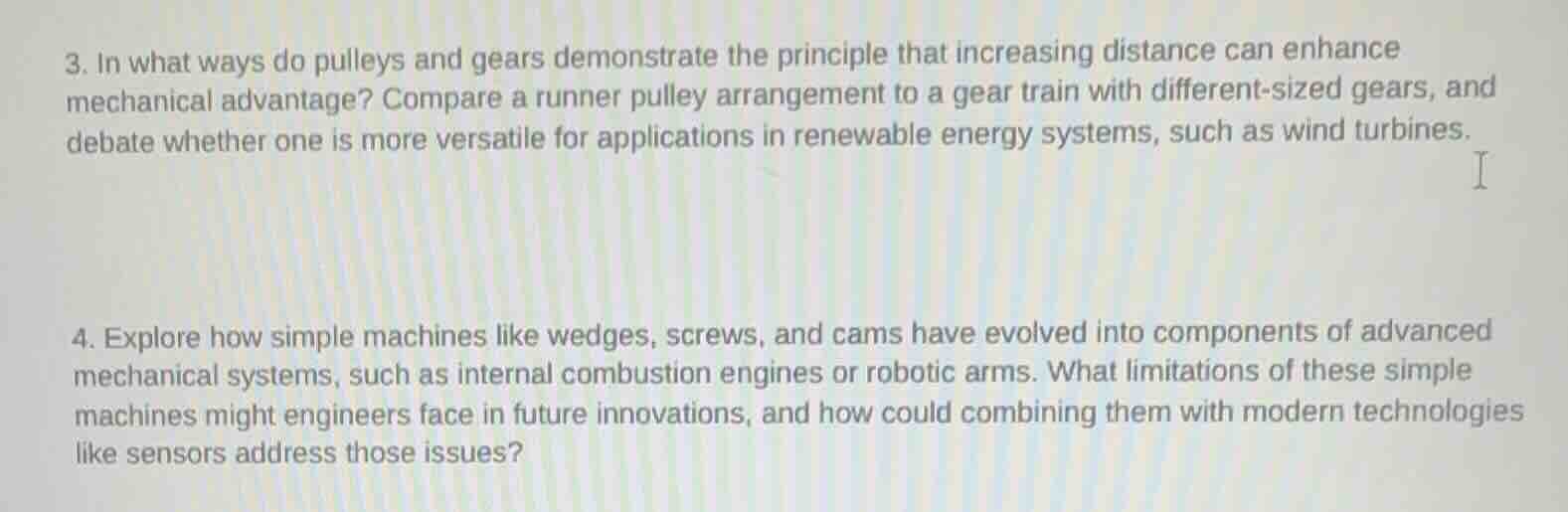
- in what ways do pulleys and gears demonstrate the principle that increasing distance can enhance mechanical advantage? compare a runner pulley arrangement to a gear train with different - sized gears, and debate whether one is more versatile for applications in renewable energy systems, such as wind turbines.
- explore how simple machines like wedges, screws, and cams have evolved into components of advanced mechanical systems, such as internal combustion engines or robotic arms. what limitations of these simple machines might engineers face in future innovations, and how could combining them with modern technologies like sensors address those issues?
Response
For Question 3:
Brief Explanations
- Pulleys & Mechanical Advantage: A runner (movable) pulley increases the distance the rope travels to lift a load. The mechanical advantage (MA) equals the number of supporting rope segments: $MA = 2$ for a single runner pulley, meaning the force needed is $\frac{1}{2}$ the load weight, while the rope is pulled twice the distance the load is lifted. For a pulley system with $n$ supporting segments, $MA = n$, and rope pull distance $d = n \times$ load lift distance.
- Gears & Mechanical Advantage: In a gear train, a small driving gear turning a large driven gear increases torque (mechanical advantage) by increasing the distance the driven gear's edge travels. $MA = \frac{\text{Driven Gear Teeth}}{\text{Driving Gear Teeth}} = \frac{\text{Driven Gear Radius}}{\text{Driving Gear Radius}}$. The driven gear rotates slower, so the distance its edge moves per input rotation is greater, trading speed for torque.
- Renewable Energy Versatility: Gear trains are more versatile for wind turbines. They efficiently convert the low-torque, high-speed rotation of turbine blades to the high-torque, low-speed rotation needed for generators, handle heavy loads consistently, and are compact. Pulley systems are prone to rope stretch, wear, and slippage, making them less reliable for sustained, high-load wind energy applications.
Brief Explanations
- Evolution in Advanced Systems:
- Wedges: Evolved into engine valves (split high-pressure combustion gases) and robotic gripper jaws (apply focused force to grip objects).
- Screws: Evolved into engine cylinder bolts (create tight, pressure-sealed joints) and robotic linear actuators (convert rotational motion to precise linear motion for arm positioning).
- Cams: Evolved into engine camshafts (open/close valves at precise timing) and robotic joint cams (control repetitive, fixed-path motion).
- Limitations of Simple Machines:
- Wedges: Wear quickly under high friction; limited to fixed-angle force application.
- Screws: Prone to thread stripping under heavy loads; slow motion conversion.
- Cams: Only produce fixed, pre-designed motion; cannot adapt to variable conditions.
- Modern Technology Solutions:
- Sensors (force, position, wear sensors) can monitor stress on wedges/screws to trigger maintenance, detect cam motion deviations, and feed data to computer controls. Combined with AI, sensors can adjust robotic systems in real time (e.g., modify gripper wedge angle or screw actuator speed) to adapt to variable tasks, reducing wear and adding flexibility.

Snap & solve any problem in the app
Get step-by-step solutions on Sovi AI
Photo-based solutions with guided steps
Explore more problems and detailed explanations
- Pulleys use supporting rope segments to increase distance pulled, reducing force needed (MA equals number of supporting segments). Gears use size differences: larger driven gears travel more distance per input rotation, boosting torque (MA = ratio of driven to driving gear size).
- Gear trains are more versatile for wind turbines, as they handle heavy loads reliably and efficiently convert blade rotation to generator-compatible motion, while pulleys suffer from stretch, wear, and slippage issues.
---