QUESTION IMAGE
Question
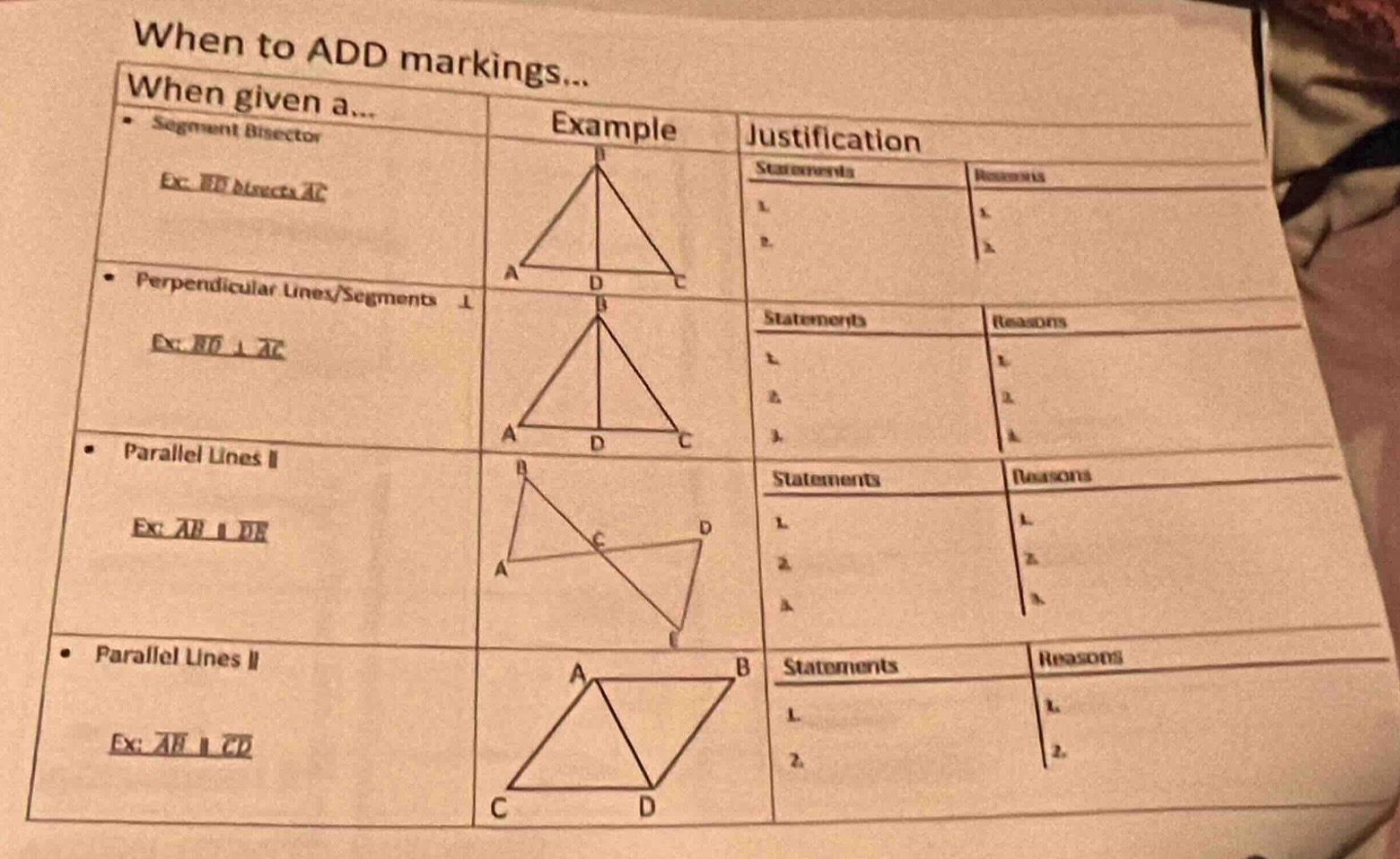
when to add markings...
when given a...
- segment bisector
ex. \\( \overline{bd} \\) bisects \\( \overline{ac} \\)
- perpendicular lines/segments \\( \perp \\)
ex. \\( \overline{bd} \perp \overline{ac} \\)
- parallel lines \\( \parallel \\)
ex. \\( \overline{ab} \parallel \overline{de} \\)
- parallel lines \\( \parallel \\)
ex. \\( \overline{ae} \parallel \overline{cd} \\)
(examples have corresponding triangle or quadrilateral diagrams, and a table with example, statements, reasons columns)
To solve the problem of determining when to add markings (segment bisector, perpendicular lines, parallel lines) in geometric figures, we analyze each case:
1. Segment Bisector
Example: \( \overline{BD} \) bisects \( \overline{AC} \)
- Step 1: Identify the bisector property
A segment bisector divides another segment into two equal parts. So, \( \overline{BD} \) bisecting \( \overline{AC} \) means \( AD = DC \).
- Step 2: Add markings
In the triangle \( \triangle ABC \) with \( D \) on \( \overline{AC} \), mark \( AD \) and \( DC \) with the same tick mark (e.g., a single hash) to show they are congruent.
2. Perpendicular Lines/Segments
Example: \( \overline{BD} \perp \overline{AC} \)
- Step 1: Identify the perpendicular property
Perpendicular lines form a right angle (\( 90^\circ \)). So, \( \angle ADB \) and \( \angle CDB \) are right angles.
- Step 2: Add markings
Draw a small square at the intersection of \( \overline{BD} \) and \( \overline{AC} \) (at point \( D \)) to indicate a right angle.
3. Parallel Lines (e.g., \( \overline{AB} \parallel \overline{DE} \))
Example: \( \overline{AB} \parallel \overline{DE} \)
- Step 1: Identify the parallel property
Parallel lines never intersect and have the same slope (or direction).
- Step 2: Add markings
Use arrowheads on \( \overline{AB} \) and \( \overline{DE} \) to show they are parallel. If there are two pairs of parallel lines, use two arrowheads, etc.
4. Parallel Lines (e.g., \( \overline{AE} \parallel \overline{CD} \))
Example: \( \overline{AE} \parallel \overline{CD} \)
- Step 1: Identify the parallel property
Same as above: parallel lines have the same direction.
- Step 2: Add markings
Use arrowheads on \( \overline{AE} \) and \( \overline{CD} \) to indicate parallelism (e.g., single arrowhead for one pair, two for another).
Key Justification Logic:
- Segment Bisector: Mark congruent segments with tick marks.
- Perpendicular Lines: Mark right angles with a square.
- Parallel Lines: Mark with arrowheads (number of arrowheads matches the number of parallel pairs).
Final Answer (Summary of Marking Rules):
- Segment Bisector: Mark congruent sub - segments (e.g., \( AD = DC \)) with tick marks.
- Perpendicular Lines: Mark the right angle at intersection with a square.
- Parallel Lines: Mark with arrowheads (consistent for each pair of parallel lines).

Snap & solve any problem in the app
Get step-by-step solutions on Sovi AI
Photo-based solutions with guided steps
Explore more problems and detailed explanations
To solve the problem of determining when to add markings (segment bisector, perpendicular lines, parallel lines) in geometric figures, we analyze each case:
1. Segment Bisector
Example: \( \overline{BD} \) bisects \( \overline{AC} \)
- Step 1: Identify the bisector property
A segment bisector divides another segment into two equal parts. So, \( \overline{BD} \) bisecting \( \overline{AC} \) means \( AD = DC \).
- Step 2: Add markings
In the triangle \( \triangle ABC \) with \( D \) on \( \overline{AC} \), mark \( AD \) and \( DC \) with the same tick mark (e.g., a single hash) to show they are congruent.
2. Perpendicular Lines/Segments
Example: \( \overline{BD} \perp \overline{AC} \)
- Step 1: Identify the perpendicular property
Perpendicular lines form a right angle (\( 90^\circ \)). So, \( \angle ADB \) and \( \angle CDB \) are right angles.
- Step 2: Add markings
Draw a small square at the intersection of \( \overline{BD} \) and \( \overline{AC} \) (at point \( D \)) to indicate a right angle.
3. Parallel Lines (e.g., \( \overline{AB} \parallel \overline{DE} \))
Example: \( \overline{AB} \parallel \overline{DE} \)
- Step 1: Identify the parallel property
Parallel lines never intersect and have the same slope (or direction).
- Step 2: Add markings
Use arrowheads on \( \overline{AB} \) and \( \overline{DE} \) to show they are parallel. If there are two pairs of parallel lines, use two arrowheads, etc.
4. Parallel Lines (e.g., \( \overline{AE} \parallel \overline{CD} \))
Example: \( \overline{AE} \parallel \overline{CD} \)
- Step 1: Identify the parallel property
Same as above: parallel lines have the same direction.
- Step 2: Add markings
Use arrowheads on \( \overline{AE} \) and \( \overline{CD} \) to indicate parallelism (e.g., single arrowhead for one pair, two for another).
Key Justification Logic:
- Segment Bisector: Mark congruent segments with tick marks.
- Perpendicular Lines: Mark right angles with a square.
- Parallel Lines: Mark with arrowheads (number of arrowheads matches the number of parallel pairs).
Final Answer (Summary of Marking Rules):
- Segment Bisector: Mark congruent sub - segments (e.g., \( AD = DC \)) with tick marks.
- Perpendicular Lines: Mark the right angle at intersection with a square.
- Parallel Lines: Mark with arrowheads (consistent for each pair of parallel lines).